A-01Appliqué (Applique)
- Definition
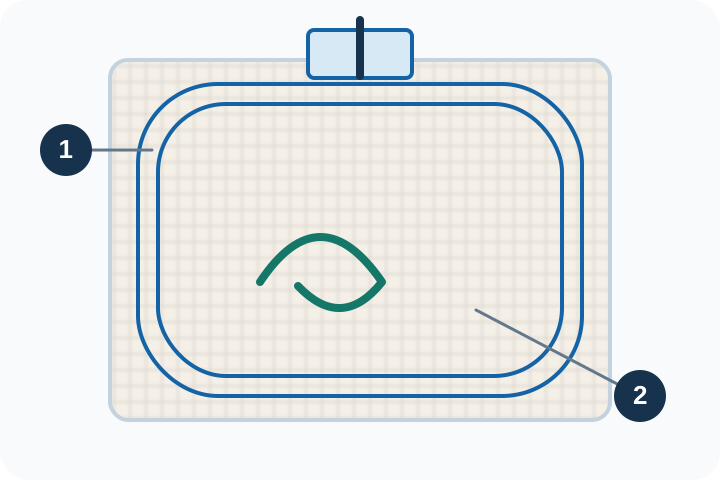
- A technique where a fabric piece is placed on the base fabric and stitched down, reducing stitch count and adding texture/contrast.
- Why it matters
- Cuts run time and thread usage, enables bold colors and large areas without dense fills.
- File/Tech notes
- Provide placement, tackdown, and cover stitches; include cut path for laser/cutter. Common cover: satin or zig‑zag.
- Pro tips
- Pre‑shrink appliqué fabric; match cover‑stitch width to fabric fray level.
Related:A-02,A-03,A-04,A-05,A-14,C-07 (Cover Stitch),Z-01 (Zig-zag)
A-02Appliqué Placement Line (APL)
- Definition
- A light run stitch that shows where to place the appliqué fabric on the garment.
- Why it matters
- Ensures accurate alignment; reduces mis‑placement waste.
- File/Tech notes
- Usually 1.0–1.5 mm stitch length; run before any tackdown. Color‑stop for manual placement.
- Pro tips
- Use contrasting thread for visibility on dark fabrics.
Related:A-03,A-04,A-05
A-03Appliqué Tack down Stitch
- Definition
- Stitching that secures the appliqué fabric to the base before the final cover stitch.
- Why it matters
- Prevents lift and puckering during cover stitching.
- File/Tech notes
- Narrow zig‑zag or running stitch; keep inside the final cover width.
- Pro tips
- Test tackdown tension to avoid tunneling on stretchy knits.
Related:A-02,A-04,Z-01
A-04Appliqué Cover Stitch
- Definition
- The final visible edge stitch (often satin/zig‑zag) that seals and decorates the appliqué edge.
- Why it matters
- Delivers the finished look and keeps edges from fraying.
- File/Tech notes
- Typical satin width 2.2–4.0 mm; increase density at sharp corners.
- Pro tips
- Add corner pull‑compensation; round acute angles when possible.
Related:S-07 (Satin Stitch),Z-01
A-05Appliqué Cut Path (Cut File)
- Definition
- Vector/plotter line used by laser/cutters to pre‑cut appliqué fabric (or to machine‑trim in‑hoop).
- Why it matters
- Clean edges and faster production vs hand‑cut.
- File/Tech notes
- Supply as separate vector layer (e.g., AI/SVG) with exact scale; offset to account for cover width.
- Pro tips
- Test ±0.2–0.5 mm offsets for perfect coverage.
Related:V-05 (Vector Paths),L-01 (Laser Cut),A-04
A-06Adhesive Backing (Peel‑and‑Stick)
- Definition
- Stabilizer with a pressure‑sensitive adhesive for hooping hard‑to‑hoop items (caps, sleeves).
- Why it matters
- Prevents hoop burns and slippage.
- File/Tech notes
- Combine with light tearaway for crisp edges; mind residue on needles.
- Pro tips
- Score the paper liner to expose only what you need.
Related:B-01 (Backing/Stabilizer),H-02 (Hooping)
A-07Adhesive Spray (Temporary)
- Definition
- Light spray adhesive to hold fabric/appliqué in place.
- Why it matters
- Reduces shifting and registration errors.
- File/Tech notes
- Use minimally to avoid gumming; allow flash‑off.
- Pro tips
- Mask surrounding areas with scrap paper.
Related:A-06,A-02
A-08Alignment (Hoop/Design Alignment)
- Definition
- The process of centering and aligning the design on the garment.
- Why it matters
- Symmetry and brand standards rely on precise placement.
- File/Tech notes
- Use center‑cross, axis marks; include alignment stitches if needed.
- Pro tips
- Use rulers/laser guides; mark with erasable pens.
Related:A-09,R-03 (Registration)
A-09Alignment Marks (Registration Marks)
- Definition
- Small marks/stitches used to line up multi‑part designs, colors, or appliqué layers.
- Why it matters
- Prevents color shift and mis‑registration.
- File/Tech notes
- Make them unobtrusive and removable if visible.
- Pro tips
- For caps, place marks along natural seams.
Related:R-03,C-02 (Colorway)
A-10Alpha Channel (Transparency)
- Definition
- The transparency layer in images (e.g., PNG) used for mockups and web graphics.
- Why it matters
- Enables clean, background‑free previews on product pages.
- File/Tech notes
- Export PNG with true alpha; avoid white matte edges.
- Pro tips
- Feather 0.2–0.5 px only if needed to blend.
Related:M-01 (Mockup),W-01 (Web Export)
A-11Anti‑Aliasing
- Definition
- Smoothing of jagged edges in raster images by blending pixels.
- Why it matters
- Cleaner previews and client proofs.
- File/Tech notes
- Mind that anti‑aliased art is not true vector; trace carefully.
- Pro tips
- Prefer vector for crisp stitch paths.
Related:V-01 (Vector),R-01 (Raster)
A-12Anchor Point (Vector)
- Definition
- A vector node that defines the path shape for strokes/fills (and later stitch paths).
- Why it matters
- Fewer, cleaner points = smoother stitches and fewer machine jolts.
- File/Tech notes
- Convert unnecessary cusp points to smooth; align handles to stitch angle.
- Pro tips
- Keep point count efficient for small logos.
Related:V-05 (Paths),S-02 (Stitch Angle)
A-13Angle of Stitch (Stitch Angle)
- Definition
- The orientation of stitches within a fill or satin object.
- Why it matters
- Controls sheen, coverage, and push‑pull behavior.
- File/Tech notes
- Vary angles between adjacent segments to avoid tracking.
- Pro tips
- Use 105°/75° alternation on large fills.
Related:D-01 (Density),P-01 (Pull Compensation)
A-14All‑Over Embroidery
- Definition
- A design covering most of the garment area with stitches or multiple appliqués.
- Why it matters
- High impact but heavy; requires careful stabilization.
- File/Tech notes
- Use lighter densities, strategic underlays.
- Pro tips
- Consider appliqué blocks to reduce stitch count.
Related:A-01,D-01,U-01 (Underlay)
A-15Aperture (Counter)
- Definition
- The open “hole” inside letters/objects (e.g., A, O, P) affecting readability at small sizes.
- Why it matters
- Small apertures can close up in stitches.
- File/Tech notes
- Increase counter size, add pull‑comp.
- Pro tips
- Choose fonts with generous counters for <7 mm text.
Related:T-03 (Typography),M-02 (Minimum Size)
A-16Arc Text
- Definition
- Text curved along a path/arc for badges and patches.
- Why it matters
- Matches circular patches and cap fronts elegantly.
- File/Tech notes
- Track/kerning changes on inner vs outer arcs.
- Pro tips
- Reduce letter width slightly on tight arcs to prevent crowding.
Related:B-02 (Badge),T-03 (Typography)
A-17Aspect Ratio
- Definition
- Proportional relationship of width to height of a design.
- Why it matters
- Prevents distortion when resizing for caps, chest, or jacket back.
- File/Tech notes
- Lock ratio in vector; scale within stitch limits.
- Pro tips
- Re‑digitize instead of extreme scaling (>130%).
Related:R-02 (Resizing),S-06 (Scale Limits)
A-18Artwork (Source Artwork)
- Definition
- The client‑provided or designer‑created visual that will be digitized or vectorized.
- Why it matters
- Quality in = quality out.
- File/Tech notes
- Preferred: vector (AI, PDF, SVG) or high‑res raster (≥300 PPI at size).
- Pro tips
- Request color codes (Pantone/HEX) and size specs upfront.
Related:A-19,A-20,V-01
A-19Artwork Cleanup
- Definition
- Refining source art by removing noise, fixing edges, simplifying shapes.
- Why it matters
- Cleaner stitches, fewer jumps, faster runs.
- File/Tech notes
- Snap to pixel grid for small icons; flatten minor details.
- Pro tips
- Merge tiny gaps; avoid lines <0.8 mm in stitch width.
Related:A-18,V-05
A-20Artwork Guidelines (Submission)
- Definition
- The checklist for clients: file types, size at 1:1, color references, placement, due date.
- Why it matters
- Reduces revisions and rush errors.
- File/Tech notes
- Include trim/bleed for patches, appliqué cut paths, and fabric notes.
- Pro tips
- Provide a simple PDF form/template.
Related:O-01 (Order Form),M-01 (Mockup)
A-21Artwork Resolution (PPI/DPI)
- Definition
- Pixel density of raster images used for digitizing/vector tracing.
- Why it matters
- Low‑res input = guesswork and jaggies.
- File/Tech notes
- Aim for 300 PPI at final size; avoid upscaling from tiny JPGs.
- Pro tips
- Request vector whenever possible.
Related:R-01 (Raster),V-01 (Vector)
A-22Auto‑Digitizing
- Definition
- Software‑driven conversion from image/vector to stitch objects with minimal manual input.
- Why it matters
- Fast for simple art, but manual refinement is usually required.
- File/Tech notes
- Review underlay, density, angles, tie‑ins/tie‑offs.
- Pro tips
- Use as a starting point; hand‑tune critical areas.
Related:D-03 (Digitizing),U-01,S-02
A-23Auto‑Trace (Image Trace)
- Definition
- Automated vector tracing of raster art.
- Why it matters
- Speeds vector art prep for patches and cut paths.
- File/Tech notes
- Expand and simplify nodes; correct corners.
- Pro tips
- Rebuild key curves manually for logos.
Related:V-01,A-12
A-24Auto Underlay
- Definition
- Software‑generated underlay settings applied by default to fills/satins.
- Why it matters
- Saves time but may be sub‑optimal for certain fabrics.
- File/Tech notes
- Inspect type (edge/wave/zig‑zag) and density; customize as needed.
- Pro tips
- On performance knits, add lattice underlay for stability.
Related:U-01 (Underlay),F-01 (Fabrics)
A-25AI File (.ai)
- Definition
- Adobe Illustrator vector file commonly used for logo artwork and cut paths.
- Why it matters
- Industry‑standard for vector exchange.
- File/Tech notes
- Outline fonts; embed/expand strokes; include artboards at 1:1.
- Pro tips
- Save a PDF‑compatible copy for wider compatibility.
Related:V-01,P-02 (PDF),S-03 (SVG)
A-26Athletic Twill (Tackle Twill)
- Definition
- Durable woven fabric used for sports letters/numbers, often applied as appliqué.
- Why it matters
- Classic varsity look with lower stitch counts.
- File/Tech notes
- Use bold satin cover; heat‑seal backers for speed.
- Pro tips
- Slightly round sharp inside corners to prevent fray.
Related:A-01,T-04 (Twill),S-07
A-27Anti‑Pill Fleece
- Definition
- Fleece treated to resist pilling, common for hoodies/jackets.
- Why it matters
- Soft pile needs specific underlay and lower density.
- File/Tech notes
- Use topping (water‑soluble) and zig‑zag underlay; widen satins.
- Pro tips
- Test on scraps; avoid super‑small text.
Related:F-01 (Fabrics),T-01 (Toppings)
A-28Ascender Height (Typography)
- Definition
- The part of lowercase letters that rises above x‑height (b, d, h, k, l, t).
- Why it matters
- Affects legibility at small sizes.
- File/Tech notes
- Enlarge x‑height for micro‑text.
- Pro tips
- Choose fonts with open counters and straight stems.
Related:T-03,M-02
A-29Aperture Bridge (Digitizing Bridge)
- Definition
- Small intentional gap or thinning to keep tiny apertures from closing in stitch.
- Why it matters
- Preserves readability on small logos.
- File/Tech notes
- 2–0.4 mm bridge inside counters.
- Pro tips
- Use matching thread to hide the bridge.
Related:A-15,P-01
A-30Artwork Approval (Proof Approval)
- Definition
- Client sign‑off on mockup showing size, placement, colors, and stitch effects.
- Why it matters
- Locks scope and prevents disputes.
- File/Tech notes
- Include measurements, Pantone refs, and fabric notes.
- Pro tips
- Keep a timestamped PDF of approvals.
Related:M-01 (Mockup),O-02 (Order Workflow)