
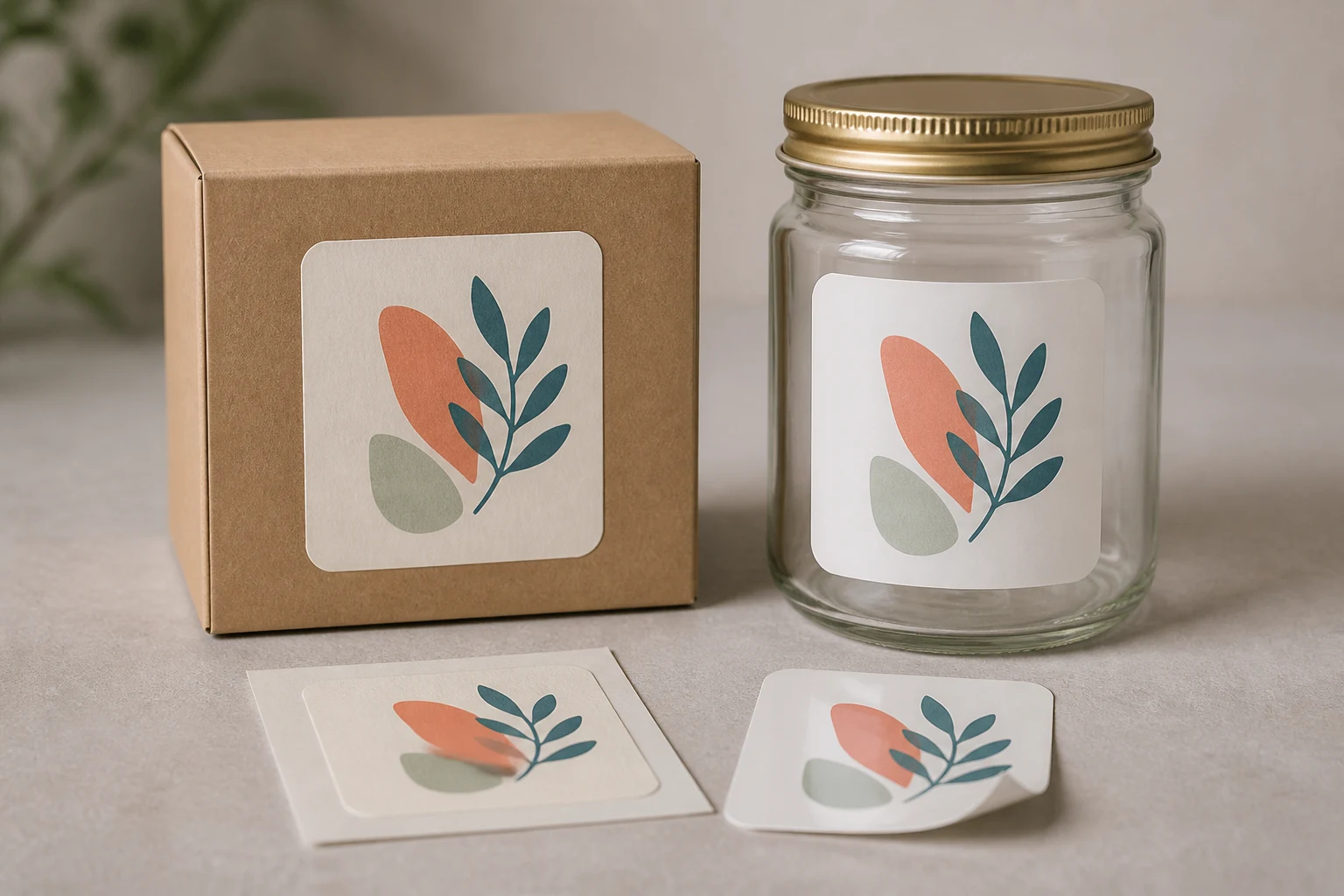
Cover image: AI-generated editorial concept; not a customer project or production proof.
Choose paper for dry indoor packaging; consider a suitable vinyl or other film sticker for moisture, frequent handling or outdoor exposure. Specify the complete sticker—face material, printed finish and adhesive—for its actual use. A material name alone does not establish a waterproof, outdoor or dishwasher rating.
Paper vs. vinyl and film: compare the application
Your application | Starting point and checks |
|---|---|
Dry gift boxes, envelopes or indoor packaging | Consider paper. Check the appearance, surface adhesion and suitability for handwriting. |
Bottles exposed to condensation | Consider a film construction rated for that exposure. Confirm print protection and adhesion on the actual bottle. |
Outdoor promotional use | Request a weather-resistant construction. Confirm sunlight exposure, temperature limits and intended service life. |
Temporary promotions or removable labels | Specify removal requirements with either material. Test adhesion, removal and residue after the intended period. |
These are starting points for discussing an order. Request the specification for the exact product before making a final choice.
What is the difference between paper and film stickers?
Paper is a fiber-based face material. Film is plastic-based, and vinyl is one type of film. Other films can also be suitable for product labels; the useful comparison is between specific constructions rather than names alone. Avery explains these material families in its paper, film and vinyl label guide.
Ask the printer to identify the face material, adhesive and protective finish. Two stickers described as “vinyl” may have different specifications, so do not transfer a performance claim from one product to another.
When paper is worth considering
For a sticker that will stay dry on a box, envelope or printed insert, paper is a useful starting point. Decide whether you want a smooth printed surface, an uncoated feel or a textured appearance, then review a physical sample.
If you need to handwrite a name, date or batch note, test your intended pen on the chosen finish. Check drying time and smudging rather than assuming every paper coating accepts writing.
Describe any likely oil, damp storage or condensation before choosing. For a concrete example, StickerApp states that its unlaminated kraft paper stickers are unsuitable for outdoor use or water exposure. That guidance concerns its particular construction, rather than every paper label. See its kraft paper outdoor-use guidance.
When to discuss vinyl or another film
Consider a suitable film construction when the sticker will encounter moisture or repeated handling. Give the printer the actual surface: a smooth glass jar, a coated metal bottle and a textured plastic container are different applications.
For curved containers, check whether the sample follows the surface without wrinkles or edge lifting. For outdoor use, request the conditions covered by the supplier’s weathering claim, including sunlight and temperature exposure.
For refrigerated or frozen products, distinguish application temperature from service temperature. The first concerns conditions while attaching the label; the second concerns conditions after it has been applied. Avery Dennison’s cold-temperature label guidance explains why both matter. Request limits for your own construction, with units clearly identified as °F or °C.
Water-resistant, waterproof and dishwasher-safe are different claims
An occasional splash, repeated condensation, immersion and a dishwasher cycle are different exposures. Avery’s waterproof versus water-resistant label guide distinguishes light moisture from more sustained water exposure.
Ask what the proposed product’s claim covers: exposure duration, temperature, cleaning agents and surface preparation. Confirm that it applies to the finished printed sticker, including adhesion and print performance. For a reusable bottle, request explicit washing instructions; do not infer dishwasher suitability from “waterproof.”
A glossy appearance is not evidence of water resistance. Select the finish you prefer, then verify the performance separately.
Do not overlook the adhesive
Decide whether the sticker should remain in place or be removed later. Describe the surface material, texture and coating, and follow the supplier’s preparation instructions. Avery’s label application guidance emphasizes clean, dry surfaces and allowing time for the adhesive to set.
Use the preparation method and waiting time specified for your product. If removal matters, agree on the intended removal period and test for residue or surface damage on a suitable sample area.
A water-resistant face does not establish that the adhesive suits your container, and strong adhesion does not establish that the print tolerates cleaning. Review both requirements together.
A practical sample-check routine
Record the material specification, adhesive, finish, artwork version and sample date.
Apply the sample to the actual item using the supplier’s preparation instructions.
Allow the specified adhesive settling time before testing.
Check print appearance, edges and attachment under the intended handling and exposure conditions.
If removability is required, test removal after the relevant period.
Photograph the results and resolve problems before approving the full order.
Include handwriting checks where needed. When comparing paper and film, use the same artwork and evaluate both samples under similar lighting.
This routine helps assess suitability for your application. It does not establish a certification or replace supporting evidence for a supplier’s performance claim.
Compare cost using the same order details
Request quotes for the same finished size, design count, quantity and supply format. Include adhesive, finish, print protection and sample requirements. Do not assume paper always costs less for every quantity or order format.
For orders destined for the US, Canada or UK, state the delivery country and postal or ZIP code. Compare quotes in the same currency and check which shipping charges, taxes or import charges are included.
Material and cut format are separate decisions. Our die-cut versus kiss-cut guide explains the formats. Decide whether you need individual pieces, larger backing cards or sheets as part of the order brief; that choice does not establish the sticker’s durability.
Common material questions
Is every paper sticker unsuitable for moisture?
No. Coated and specialized constructions vary. Ordinary uncoated paper is a poor starting point for wet use; request the specific product rating when moisture is expected.
Does a glossy finish mean the sticker is waterproof?
No. Gloss describes appearance. Ask for the finished sticker’s performance specification and the conditions it covers.
Can I use the same artwork for paper and film?
You can start with the same design, but review a proof for each material. Ask for physical samples when substrate color, printed color or finish is important to the result.
Is paper automatically recyclable or compostable?
No. Do not infer either claim from the face material alone. Avery’s label recycling guidance explains that adhesive, liner and packaging material also affect recycling compatibility. Request evidence for the complete product and check the intended local collection route in the US, Canada or UK. Ask separately about compostability.
Prepare your sticker brief
Send the artwork, finished width and height, quantity, supply format, intended surface, exposure, finish preference, removal requirements and delivery destination. Clearly label dimensions in inches or millimeters. Include any handwriting, washing or cold-storage requirements.
For the artwork, confirm the printer’s file, cut-line, bleed and proof requirements before approval; see our sticker artwork preparation guide. If the material is undecided, describe the application so suitable options can be reviewed.
Explore DigitEMB custom stickers and confirm the available construction for your order.
Practical details for Vinyl vs. Paper Stickers: Choose for the Application
A sticker is more than a picture on adhesive material. Surface, shape, size, finish and handling conditions affect the right production choice, so define those details before artwork approval.
Work through these points in order and keep the answers with the artwork or production request. A short written brief makes it easier to compare a proof with the intended result, ask a useful follow-up question and avoid relying on assumptions made from a screen image alone.
The aim is not to add unnecessary steps. It is to identify the choices that change the final result before work begins. If a requirement is unknown, flag it for confirmation rather than guessing; that keeps the approval process focused on the design, material and use that apply to this particular project. Save the approved brief with the project files for future reorders or revisions.
Identify the surface and environment
Explain whether the sticker will be used on packaging, a jar, a bottle, a window, a laptop or another surface. Note curves, moisture, handling and expected wear so the material and adhesive can be matched to the job.
Set the cut shape and safe area
Provide the final size and decide whether the sticker is die-cut, kiss-cut, rectangular, circular or another custom shape. Keep important text and marks away from the cut edge so they are not crowded or trimmed.
Check the artwork at print size
Review small type, fine lines, colour contrast and transparent areas at the real finished size. A proof should confirm the wording, shape, finish and placement of the design elements.
Quick questions to check before you proceed
What information helps quote a sticker project?
Share the artwork, final size, quantity, intended surface, cut style and the finish or material you are considering.
Why does the surface matter?
Flat paper packaging, curved containers and outdoor equipment place different demands on adhesion, flexibility and finish.
What should I check on a proof?
Check spelling, dimensions, cut line, safe margins, colour, finish and whether the design still reads clearly at the final size.