
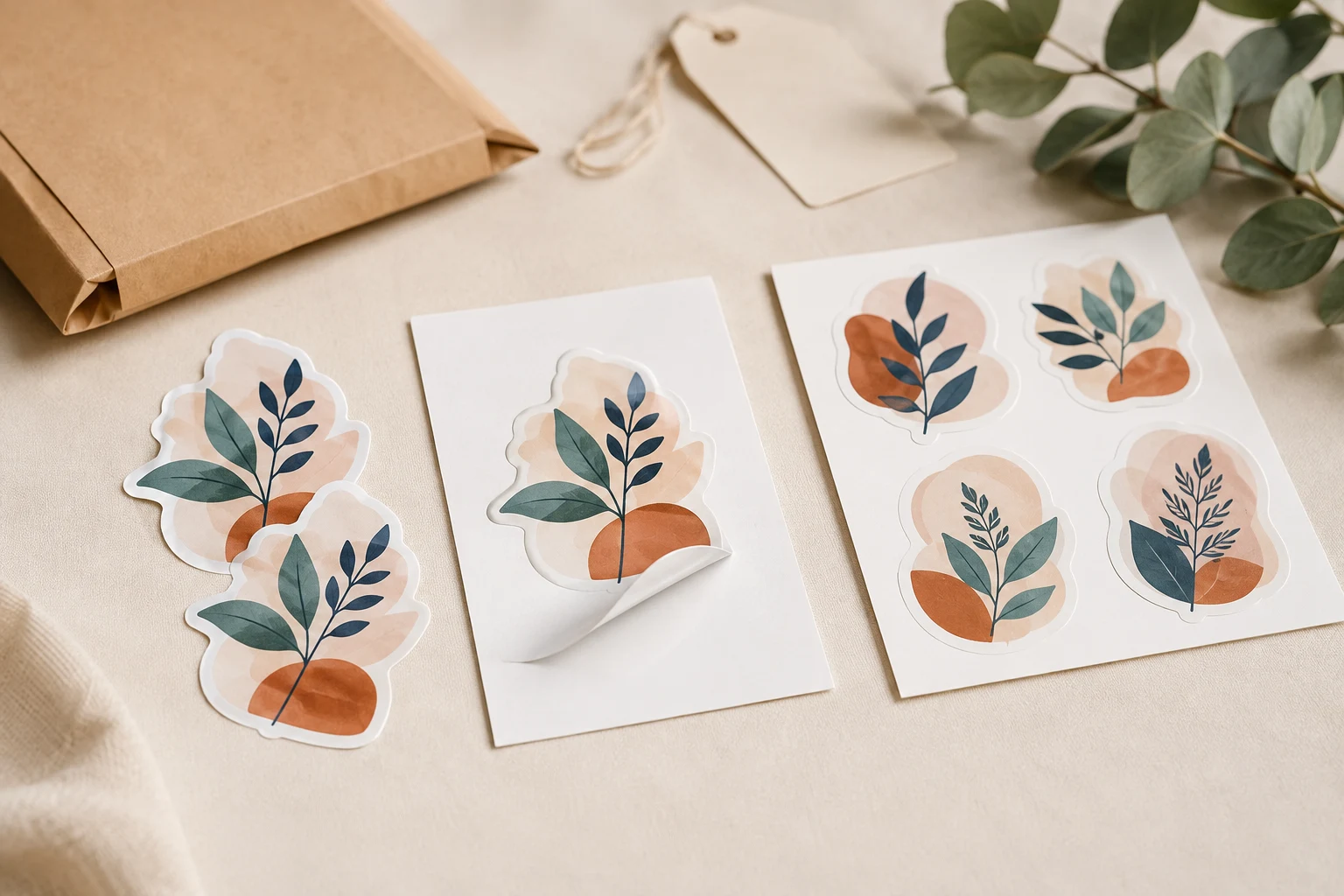
Cover image: AI-generated editorial concept; not a customer project or production proof.
Choose die-cut for an individual sticker whose backing follows the design’s outline. Choose kiss-cut when you want extra backing around the sticker for handling or presentation. Die-cut passes through both the sticker material and release backing; kiss-cut leaves the backing intact. StickerApp’s cut-format reference confirms this distinction.
Both formats can produce the same peeled sticker shape. Your choice mainly affects how the sticker looks and handles before application, while material and adhesive specifications determine its suitability for the intended use.
Die-cut vs. kiss-cut at a glance
Format | What it means for your order |
|---|---|
Die-cut | The sticker and backing are cut to an outline, creating an individual shaped piece. Useful for loose giveaways and merchandise. Specify finished sticker width, height and quantity per design. |
Kiss-cut | The sticker is cut while a larger backing remains intact. Useful for inserts, supported individual designs and collections. Specify both sticker dimensions and overall card or sheet dimensions. |
When die-cut is a useful choice
Consider die-cut when the silhouette is part of the appeal: a mascot, badge, illustrated product or logo distributed as a single piece. The shaped presentation can suit event handouts, merchandise packs and individual stickers offered at a counter.
Before ordering, review narrow projections, tiny gaps and disconnected elements with the printer. Ask whether the outline needs simplifying at the finished size, and specify whether you want a visible border. DigitEMB’s custom die-cut sticker page describes this format and the outline details that need attention.
When kiss-cut is a useful choice
Consider kiss-cut when surrounding backing helps recipients hold and peel the sticker, or when you want a larger presentation area around a delicate design. A single sticker can sit on its own card; several peelable designs can share a sheet. See DigitEMB’s custom kiss-cut stickers and sticker sheets for these layouts.
For an order insert, check that the complete card fits the package. If you want printed instructions or other information around the design, ask whether that printing will be on surrounding sticker material, the release liner or a separate card. These are different arrangements, so the proof should identify what peels away and what stays behind.
Extra backing does not replace suitable packing. Choose the card or sheet size with storage, mailing and handling in mind.
The cut does not decide durability
Water resistance depends on the specified construction, including the material and printing system. For example, Avery explains that one of its film label materials can be water-resistant or waterproof depending on the printer and ink used. That illustrates why a cut-format name alone cannot establish performance. Avery’s water-resistance guidance describes those product-specific differences.
For bottles, outdoor equipment or frequently washed items, tell the supplier the surface and exposure conditions. Ask about the adhesive, print protection and tested uses of the exact product being quoted. Do not treat “vinyl” or “waterproof” as confirmation of dishwasher suitability; request explicit care instructions.
Size the sticker and backing separately
For die-cut, state the maximum finished width and height. For kiss-cut, state both the peeled sticker dimensions and the total backing card or sheet dimensions. Otherwise, two quotes described as the same size may refer to different parts of the product.
For example, a 2-inch-wide sticker on a 3-inch-wide card has a sticker width of 50.8 mm and a card width of 76.2 mm. These are illustrative dimensions, not required sizes or production tolerances.
For orders in the US, Canada or UK, label dimensions clearly in inches or millimetres and keep units consistent throughout the artwork and quote request. Review the proof at actual size to assess small lettering and fine details.
Prepare artwork and review the proof
The core illustration may work in either format, but the surrounding layout and cutting setup need to match the product. Before approving production:
Supply the best available artwork and identify the final design version. Ask which file formats and cut-line setup the printer requires.
Confirm the finished sticker dimensions, cut outline and visible border. For kiss-cut, also check the complete card or sheet size.
Identify every peelable piece and review narrow projections, small gaps and spacing between designs.
Keep essential lettering within the printer’s safe area. Obtain its bleed requirements for artwork that extends to the cut edge.
Review spelling, colors and small details at actual size. Approve separate proofs if ordering both formats.
Requirements are supplier-specific. Sticker Mule’s artwork specifications, for example, distinguish resolution, border, bleed and cut-line requirements. Use your chosen printer’s specifications for your order rather than transferring another supplier’s measurements.
If a logo needs redrawing, resolve that before final proof approval so the cutting layout uses the correct artwork.
Common questions
Which is cheaper: die-cut or kiss-cut?
Request comparable quotes using the same sticker size, material, finish and quantity per design. Include overall backing dimensions and clarify whether quantities mean individual stickers, cards or complete sheets. Do not assume one format will always cost less.
Is a kiss-cut sticker rectangular after peeling?
No. A rectangular backing can hold a sticker with a custom outline. The inner cut path determines the peeled shape; check it in the proof.
Are kiss-cut stickers the same as sticker sheets?
Kiss-cut describes the cut. A sheet is a layout that can contain several kiss-cut stickers, while a single kiss-cut sticker can have its own backing card.
Can either format be used on packaging?
Either may be suitable if the selected material and adhesive work with the packaging surface. Explain whether you are applying the sticker as a label or including it as a loose insert. Request a sample if surface compatibility is uncertain.
Can I use the same artwork for both?
Often the main design can remain the same. The printer still needs to prepare the appropriate outer dimensions, cut paths and any surrounding print for each format.
Choose the format for your next order
Send your design, finished sticker dimensions, quantity per design and intended use. For kiss-cut, add the overall card or sheet size and the number of stickers on each. Include the delivery country, postal or ZIP code and required date so timing and shipping can be confirmed in the quote.
Request a custom sticker quote or explore DigitEMB’s custom sticker formats. Before ordering, confirm the quantity units, total price and currency, proof approval process, production time and delivery arrangements.
Practical details for Die-Cut vs. Kiss-Cut Stickers: Which Should You Choose?
A sticker is more than a picture on adhesive material. Surface, shape, size, finish and handling conditions affect the right production choice, so define those details before artwork approval.
Work through these points in order and keep the answers with the artwork or production request. A short written brief makes it easier to compare a proof with the intended result, ask a useful follow-up question and avoid relying on assumptions made from a screen image alone.
The aim is not to add unnecessary steps. It is to identify the choices that change the final result before work begins. If a requirement is unknown, flag it for confirmation rather than guessing; that keeps the approval process focused on the design, material and use that apply to this particular project. Save the approved brief with the project files for future reorders or revisions.
Identify the surface and environment
Explain whether the sticker will be used on packaging, a jar, a bottle, a window, a laptop or another surface. Note curves, moisture, handling and expected wear so the material and adhesive can be matched to the job.
Set the cut shape and safe area
Provide the final size and decide whether the sticker is die-cut, kiss-cut, rectangular, circular or another custom shape. Keep important text and marks away from the cut edge so they are not crowded or trimmed.
Check the artwork at print size
Review small type, fine lines, colour contrast and transparent areas at the real finished size. A proof should confirm the wording, shape, finish and placement of the design elements.
Quick questions to check before you proceed
What information helps quote a sticker project?
Share the artwork, final size, quantity, intended surface, cut style and the finish or material you are considering.
Why does the surface matter?
Flat paper packaging, curved containers and outdoor equipment place different demands on adhesion, flexibility and finish.
What should I check on a proof?
Check spelling, dimensions, cut line, safe margins, colour, finish and whether the design still reads clearly at the final size.