
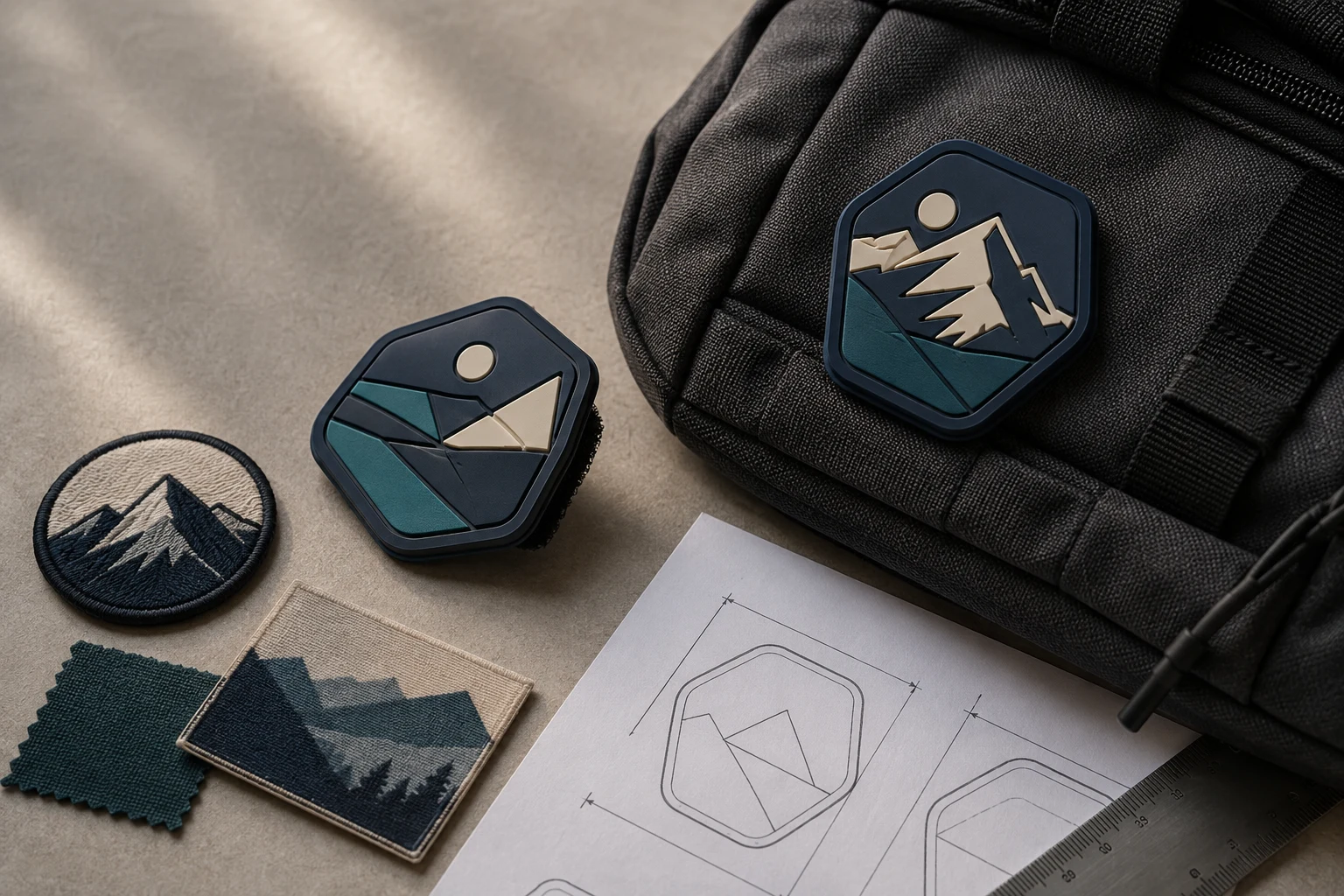
Cover image: AI-generated editorial concept; not a customer project or production proof.
Choose PVC patches for bold, separated colors and molded depth on bags, uniforms and outdoor accessories. Consider embroidery for visible thread texture, woven patches for fine textile detail, and printed patches for photographs or smooth gradients. The right choice depends on the finished artwork, attachment and intended use.
PVC stands for polyvinyl chloride. Flexible PVC patches have a rubber-like feel, but the material is a plastic. Manufacturers form the design in a mold, adding distinct color sections and a base layer. Patches4Less explains its PVC molding process.
When PVC is a good fit
PVC is worth considering when the design depends on a clear silhouette, solid color areas and raised or recessed features. A simple emblem on a gear bag, for example, can use molded depth to separate its main symbol from the background.
Outdoor accessories are another common application. The PVC face resists water, while sewn and hook-and-loop attachments offer different ways to mount the badge. Stadri describes these applications and attachment options.
Assess the complete item before choosing it for wet conditions. A water-resistant patch face does not make the garment, stitching or attachment waterproof. Ask the supplier about the intended washing, abrasion and outdoor exposure instead of treating “durable” as a performance specification.
When another patch type may work better
Keep the comparison tied to the feature your artwork needs most:
Design priority | Patch type to consider |
|---|---|
Bold solid colors and molded depth | PVC |
Visible stitched texture | Embroidered |
Fine detail with a flatter textile finish | Woven |
Photographs and continuous color gradients | Printed |
Woven patches use finer threads that can reproduce details difficult to achieve in conventional embroidery. Small lettering still needs review at its actual finished size. GS-JJ describes woven patch construction and detail.
Standard molded PVC separates colors into distinct areas; do not assume it will reproduce a photographic blend. For a shaded illustration or photograph, consider a printed patch or approve a simplified version with solid colors. GS-JJ’s printed patch information illustrates photographic detail and smooth color transitions.
Check the artwork before production
A large screen preview can conceal problems that become obvious on a small badge. Give the supplier the intended width and height, with units clearly stated. For US, Canadian and UK orders, including both inches and millimeters can help avoid ambiguity.
Before approving the design:
Review it at finished size. Check the smallest letters, narrow lines and gaps between colors. Ask the manufacturer to identify details that need enlarging or simplifying for its process.
Specify the relief. Mark which elements should be raised or recessed. Ask for a profile view or reference sample if the depth is hard to understand from the artwork.
Confirm color references. Identify each solid color and ask how the supplier will match it. Judge important colors on a physical sample as well as a screen.
Check the outline and attachment area. Confirm that the shape fits the intended placement and leaves room for the chosen attachment.
Approve changes explicitly. Keep the final proof with the agreed dimensions, colors and backing so the order has a clear reference.
There is no useful universal minimum letter size for every PVC design. Ask for a review of your actual artwork and the supplier’s production limits.
Choose the backing for the application
For permanent attachment, discuss a sew-on construction. For removal or swapping between items, discuss hook-and-loop backing and confirm that the receiving item has a compatible loop panel. Ask whether both mating parts are included. These are established PVC attachment approaches described by Stadri.
Tell the supplier the fabric, placement and intended care routine. If you want a heat-applied option, obtain instructions for the exact patch and garment combination before using an iron or heat press. Do not borrow application settings from an unrelated patch product.
Inspect a physical sample
A digital proof shows the intended layout; it cannot demonstrate the finished feel, flexibility or attachment. Request a physical sample when color, thickness or fine detail will determine whether the patch works.
Inspect lettering at normal viewing distance, the separation between color areas, the edge finish and the appearance of raised details. Place the sample on the actual bag or garment to check its proportions and whether it sits comfortably on that surface.
If repeated washing or demanding outdoor use matters, agree on a suitable sample evaluation with the supplier. Record the approved sample and any changes before authorizing the full run.
Compare the complete quote
PVC production uses a design-specific mold, so clarify how tooling is handled in the quote and on later reorders. The mold stage is described in Patches4Less’s production explanation.
Quote item | What to confirm |
|---|---|
Patch specification | Quantity, dimensions, colors, relief and backing |
Tooling and revisions | Included setup, charges for changes and reorder terms |
Sampling | Sample cost, shipping and approval stage |
Attachment | Loose patches or attachment to supplied garments |
Shipping | Destination, shipping cost and quoted currency |
Schedule | Proof, sample, production and transit stages separately |
For delivery to the United States, Canada or the United Kingdom, provide the destination postal code and required arrival date. If the shipment crosses a border, ask whether the quote includes applicable import charges and handling fees. Compare total order costs in the same currency.
For an event, distinguish the date production finishes from the date the package is expected to arrive. Ask how proof changes or sample revisions affect the schedule.
PVC patch FAQs
Are PVC patches indestructible?
No. Assess the patch face, backing and attachment together. Ask for suitability information for your actual washing and exposure conditions rather than assuming unlimited resistance to wear.
Is PVC always best for tiny text?
No. Letter size, spacing and mold detail all matter. Compare a simplified PVC design with a woven option, then inspect the chosen construction at finished size.
Can PVC patches reproduce gradients?
Standard molded color sections do not create a continuous photographic gradient. Discuss a printed alternative or a solid-color redesign; if a supplier proposes printing onto PVC, confirm that specific process and inspect a sample.
Can I iron on a PVC patch?
Only use heat application when the supplier confirms that the specific patch, backing and fabric are compatible and provides application instructions. Otherwise, discuss sew-on or hook-and-loop attachment.
Plan your custom patch
Explore DigitEMB custom PVC patches and send your artwork, finished dimensions, quantity, backing preference, delivery destination and required arrival date for a project-specific review.
Practical details for PVC Patches: Uses, Design Limits and Ordering Checklist
A patch works best when its artwork, size, border and attachment method are chosen together. Use the guidance in this article to create a production brief that is clear enough for a proof review.
Work through these points in order and keep the answers with the artwork or production request. A short written brief makes it easier to compare a proof with the intended result, ask a useful follow-up question and avoid relying on assumptions made from a screen image alone.
The aim is not to add unnecessary steps. It is to identify the choices that change the final result before work begins. If a requirement is unknown, flag it for confirmation rather than guessing; that keeps the approval process focused on the design, material and use that apply to this particular project. Save the approved brief with the project files for future reorders or revisions.
Choose the patch type for the artwork
Consider whether embroidered, woven, chenille or PVC construction best suits the amount of detail, texture and finish you want. Fine lettering and small shapes should be assessed at the real patch size.
Set the size and edge treatment
Give the finished width and height, including any outline or border. A merrowed edge, hot-cut edge or shaped outline changes the usable design area and how the patch reads from a distance.
Select the backing for the use case
Iron-on, sew-on, hook-and-loop and other backings serve different garments and applications. Confirm the item surface and whether the patch must be removable before approving the proof.
Quick questions to check before you proceed
What should be on a patch order brief?
Include the artwork, finished size, quantity, patch type, border preference, backing choice and the product or garment where it will be used.
Why can small text change on a patch?
Patch construction has physical limits. At a small size, very thin lettering or tight spaces may need adjustment so the finished patch stays legible.
When should I approve the proof?
Approve only after checking spelling, dimensions, border, colours, backing and every detail that must be visible in the finished patch.