
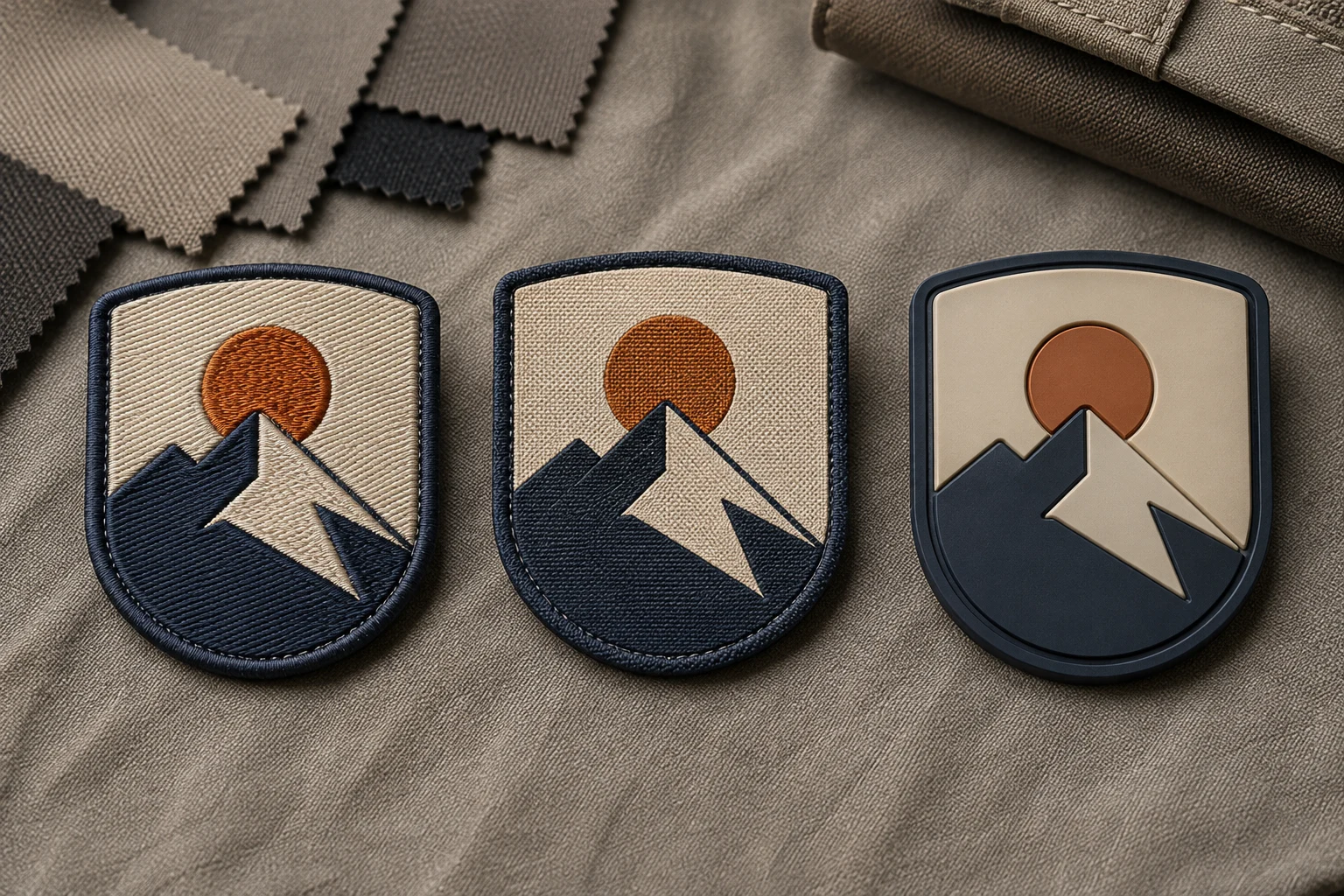
Cover image: AI-generated editorial concept; not a customer project or production proof.
Choose embroidered patches for raised thread texture, woven patches for a flatter textile finish with finer detail, and PVC patches for a molded, rubber-like appearance. Start with the finished design size and intended application, then compare samples and attachment options before ordering.
For buyers in the US, Canada and UK, the useful comparison goes beyond appearance: check whether the wording stays readable, the patch fits its placement and the quoted construction includes the backing you need.
Embroidered vs. woven vs. PVC: quick comparison
Patch type | Appearance and what to review |
|---|---|
Embroidered | Visible, raised stitches suit bold lettering and traditional badges. Review small details, stitch coverage and the border. |
Woven | A flatter textile surface suits finer shapes and lettering. Review readability at actual size and the edge finish. |
PVC | A smooth, molded face suits defined color areas and dimensional shapes. Review depth, thickness, flexibility and attachment. |
These are starting points, not guarantees that every logo will reproduce equally well. STAHLS’ woven and embroidered patch comparison explains the textile distinction; its PVC patch page illustrates the rubber-like finish and dimensional options. Individual product specifications vary.
Choose embroidery when texture matters
An embroidered patch forms its design with stitches on a fabric base. It suits designs where the thread surface is part of the appeal, such as a bold team emblem or a simple workwear badge. Full coverage fills the face with stitching; partial coverage leaves some base fabric visible. You can review these construction choices on DigitEMB’s custom embroidered patches page.
If your logo includes a tiny slogan, prepare a version with larger lettering or without the slogan. Compare both at the intended patch size. Enlarging the whole patch is another option, but measure the garment placement first.
Ask the proof to identify exposed fabric, stitched areas and the border. This makes it easier to judge whether the finished badge will have the texture you want.
Consider woven patches for finer textile detail
Woven patches form the image within the weave using fine threads. Their flatter construction can accommodate detail and lettering that are difficult to reproduce in conventional embroidery. Elita Woven Labels describes these differences in its patch construction guide, page 6.
A useful comparison for a club badge with a long motto is a woven version alongside a simplified embroidered version. Keep the outer dimensions the same and decide which required words remain readable.
Woven construction still has limits. Review letter spacing, narrow gaps and the outline at actual size instead of assuming that everything visible in an enlarged digital logo will survive production.
Consider PVC for a sculpted appearance
PVC patches have a molded face rather than a stitched textile surface. Flat and domed details can give a bold emblem a sculpted appearance. Review a physical example to judge whether its thickness and flexibility suit the intended item; STAHLS’ PVC product information shows examples of these finish options.
Specify solid color sections and mark the intended raised or recessed areas. Conventional molded artwork may need adaptation if it contains photographs or continuous gradients. For example, STAHLS’ PVC specification sheet specifies solid colors without gradients for its product. Ask the chosen supplier about the limits of the actual process being quoted.
If shading is essential to the identity, request a printed patch comparison or a version redrawn into solid color areas. Approve the artwork intended for each construction separately.
Separate material choice from backing choice
Embroidered, woven and PVC describe the patch face. Sew-on, heat-applied and hook-and-loop describe attachment methods. Confirm both choices in the order: a material name alone does not specify its backing.
Attachment | What to confirm |
|---|---|
Sew-on | A suitable sewing area on the patch and access to the intended garment placement. |
Heat-applied | Compatibility with the fabric, required equipment and the supplier’s temperature, pressure and time instructions. |
Hook-and-loop | Whether the order includes the receiving side and how that panel will attach to the item. |
Application settings are specific to the product and equipment. For example, STAHLS’ publishes separate application and care instructions on its PVC patch page. Obtain instructions for the patch you purchase instead of transferring settings from another product.
Describe expected washing, rain exposure and friction when requesting a recommendation. Evaluate the patch, backing and garment together.
Use the same brief when comparing quotes
Give each supplier the same information so differences in price reflect a comparable order:
Artwork: Send the same logo version and identify details that must remain.
Dimensions: Provide width and height with explicit units, plus measurements or a photograph of the placement. If supplying inches and millimeters, identify the controlling dimensions.
Quantity: Separate designs, sizes and color variants instead of providing only a combined total.
Construction: Specify the face material, edge, backing and any flexibility or thickness requirements.
Approval: Ask what the digital proof represents and whether a physical sample is available, included or separately charged.
Delivery: Give the destination and required arrival date. Ask for artwork approval, sampling, production and transport to be shown separately in the schedule.
Compare the complete quoted cost, including any setup or tooling, samples, revisions and shipping. Do not assume one material is always the cheapest or fastest.
For US, Canadian and UK orders, ask the quote to state its currency and which destination-related charges are included or excluded. Treat the required arrival date as a planning requirement to confirm, rather than an automatic delivery commitment.
What to approve on a sample
A digital proof helps you review layout; use a physical sample to judge the actual surface and fit. Elita’s production guide also recommends physical sampling when color matching is critical.
Read every word at the finished patch size.
Check the outer shape, border width and position of key details.
Compare physical colors with the agreed references.
Feel the surface and check whether the patch sits correctly on the intended item.
Confirm the backing and obtain the applicable attachment and care instructions.
Keep the approved artwork version and sample decision together. If the size, backing or artwork changes later, ask which approvals need to be repeated.
Common comparison questions
Which patch is best for small text?
Woven is often a useful starting point for finer textile lettering, as described in STAHLS’ comparison. Readability still depends on letterforms, spacing and finished size. Request an artwork review rather than relying on a universal minimum text height.
Are PVC patches automatically waterproof?
Some suppliers describe their PVC patch faces as waterproof, including STAHLS’. That claim does not establish the performance of the attachment or garment. Confirm the intended exposure and care conditions for the complete item.
Can one logo work across all three materials?
Use the same identity as the starting point, then request process-specific versions where necessary. Compare any changes to spacing, line thickness and color areas before approving each version.
Should I choose by price alone?
Compare design fit, sample quality, attachment and total order scope alongside price. If an option requires removing essential wording or does not sit properly on the garment, revisit the construction or size before ordering.
Get a patch recommendation for your artwork
Explore DigitEMB custom patches and provide your design, dimensions, quantity, intended item, destination and required date. Identify which details must stay and which can be simplified so the proposed construction can be assessed against your actual brief.
Practical details for Embroidered vs. Woven vs. PVC Patches: How to Choose
A patch works best when its artwork, size, border and attachment method are chosen together. Use the guidance in this article to create a production brief that is clear enough for a proof review.
Work through these points in order and keep the answers with the artwork or production request. A short written brief makes it easier to compare a proof with the intended result, ask a useful follow-up question and avoid relying on assumptions made from a screen image alone.
The aim is not to add unnecessary steps. It is to identify the choices that change the final result before work begins. If a requirement is unknown, flag it for confirmation rather than guessing; that keeps the approval process focused on the design, material and use that apply to this particular project. Save the approved brief with the project files for future reorders or revisions.
Choose the patch type for the artwork
Consider whether embroidered, woven, chenille or PVC construction best suits the amount of detail, texture and finish you want. Fine lettering and small shapes should be assessed at the real patch size.
Set the size and edge treatment
Give the finished width and height, including any outline or border. A merrowed edge, hot-cut edge or shaped outline changes the usable design area and how the patch reads from a distance.
Select the backing for the use case
Iron-on, sew-on, hook-and-loop and other backings serve different garments and applications. Confirm the item surface and whether the patch must be removable before approving the proof.
Quick questions to check before you proceed
What should be on a patch order brief?
Include the artwork, finished size, quantity, patch type, border preference, backing choice and the product or garment where it will be used.
Why can small text change on a patch?
Patch construction has physical limits. At a small size, very thin lettering or tight spaces may need adjustment so the finished patch stays legible.
When should I approve the proof?
Approve only after checking spelling, dimensions, border, colours, backing and every detail that must be visible in the finished patch.