
Cover image: AI-generated editorial concept; not a customer project or production proof.
Start planning holiday merchandise by confirming your required delivery date, quantities, product details and sample approval process. Work backward using your suppliers’ confirmed production and shipping times, with room for revisions. September can be a useful checkpoint for a year-end launch, but the right ordering deadline depends on your complete order.
When should you start planning holiday merchandise?
Begin while there is still time to prepare artwork, review a sample and make changes before production. A digital stitch file, finished embroidered garments and a shipment of custom patches involve different steps. Confirm who handles each stage and whether the quote covers files, physical goods or both.
For buyers in the US, Canada and UK, specify the destination and the date goods must be available for use. Write dates with the month spelled out to avoid ambiguity, and identify dimensions in inches or millimeters. If several locations need deliveries, give each location its own required arrival date.
September is a planning suggestion, not an industry-wide cutoff or evidence of a guaranteed seasonal turnaround.
Build your schedule backward from delivery
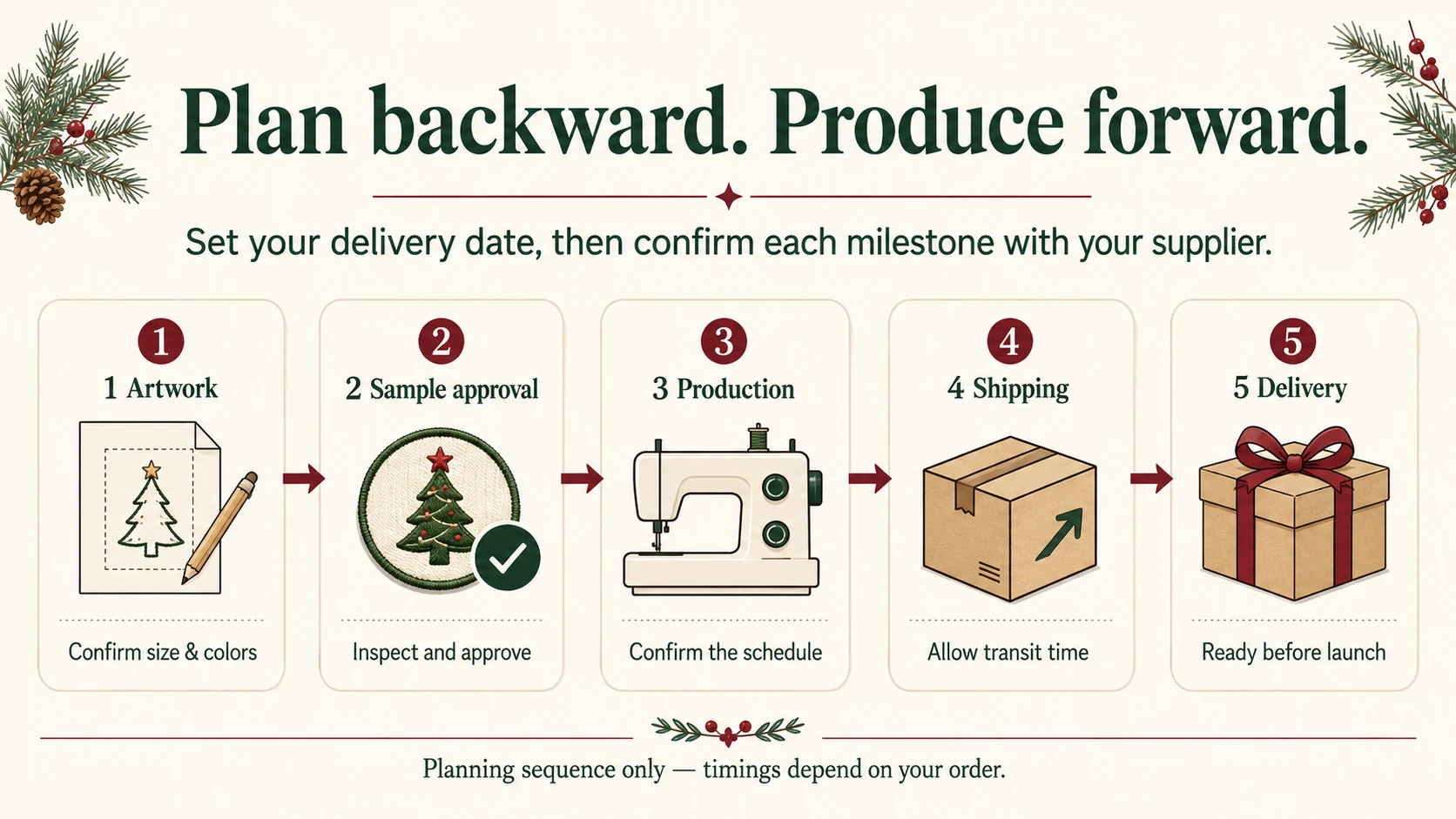
Use this sequence to agree on dates with each supplier. These are planning milestones, not promised lead times.
Required delivery: Set the arrival date, allowing time for inspection, packing, photography or distribution before your launch or event.
Shipping: Confirm the dispatch date, delivery method and estimated transit time for the actual destination. Ask what contingency is appropriate, particularly for an international shipment.
Production: Confirm when work can start after approval. Include product availability, quantities, decoration, patch attachment and finishing where applicable.
Sample approval: Allow time to receive and inspect the sample, request changes and review a replacement if needed.
Artwork preparation: Finalize wording, dimensions, placement and colors before digitizing or preparing print files.
Record an owner and a confirmed date for each milestone. Ask whether quoted durations mean business days or calendar days and which closures affect the schedule. Keep dispatch and arrival dates separate.
If the schedule is too tight, discuss a smaller initial run, an available alternative product or a revised launch date. Confirm the consequences before committing to the order.
Prepare one complete artwork brief
Send these details together when requesting a quote:
The best available original artwork and exact wording to reproduce.
Finished design width and height, with units.
Product type, material, color and decoration placement.
Quantities by design, garment size and color variation.
Color references and any small lettering or details that must remain legible.
Whether you need a digital file, finished patches, decorated products or a combination.
The production shop’s requested machine file format, if ordering digitizing.
Required delivery date and destination for physical goods.
The person approving the sample and their availability for revisions.
For a mixed order, identify each product separately. A cap and a hoodie may share artwork while requiring different production preparation. Fabric affects embroidery behavior: Hatch explains that pull compensation accounts for fabric drawing inward during stitching and that suitable settings vary with fabric. Hatch’s pull compensation guidance.
For background on the file preparation stage, read how embroidery digitizing works.
Choose embroidery, patches or print for the product
Choose the finish alongside the product and artwork so the sample represents what you intend to order.
Decoration option | What to confirm |
|---|---|
Direct embroidery: a design stitched onto the garment | Fabric, placement, finished size, lettering and a sew-out. Identify who supplies the stitch file and who embroiders the goods. |
Custom patches: separate badges attached to a product | Patch dimensions, construction, border, backing and who performs attachment. Ask whether patches arrive loose or already attached. |
Printed merchandise: artwork reproduced using the selected printing method | Product material, print area, file requirements, color references and the printer’s proof or sample process. |
Use DigitEMB’s embroidery digitizing service to discuss stitch-file preparation, or explore custom patches for separate badges. Confirm the exact scope of the physical order with the supplier.
For printed products, raster-to-vector services can help with artwork that needs rebuilding. Artwork preparation and printing are separate services; confirm who performs each.
Ask the printer what image quality is required at the finished size. A raster image’s pixel dimensions and printed dimensions determine its effective resolution, so judging a small screen preview is insufficient. Adobe’s printed image resolution guide.
Approve the result before the full run
Agree on what the approval stage includes: an artwork proof, a software rendering, photographs of a physical sample or a sample delivered to you. Ask which one you are reviewing.
For embroidery, request a sew-out at the intended size on the planned material where practical. Check spelling, legibility, placement, edges, thread colors and visible distortion. For patches, inspect dimensions, border and backing, and test the intended attachment. For print, review layout and wording in the proof; request a physical sample when color, feel or finish matters to the decision.
Keep the approved artwork version, product specification and sample record together. If size, material or decoration method changes, ask whether a revised file or sample is needed. One approved product should not automatically stand in for every variation.
Before dispatch, agree on production checks and packing requirements. On arrival, check quantities, sizes, decoration and any damage while there is still time to resolve discrepancies before distribution.
Common holiday merchandise questions
Is September a fixed ordering deadline?
No. Treat it as a useful planning checkpoint for a year-end launch. Your deadline should follow from the required arrival date and confirmed artwork, sampling, production and shipping schedule.
Can I use the same embroidery file on caps and hoodies?
Have the digitizer and embroiderer assess both applications. Size, placement, fabric and the production setup may require changes. Approve a suitable sample for each application rather than assuming the first approval covers both.
Does digitizing turnaround include finished merchandise delivery?
Do not assume it does. Ask whether the quote covers a digital stitch file, physical products or both. Request separate timing for sampling, manufacturing and shipping where those stages apply.
What if my delivery date is already close?
Send the complete brief immediately and ask which scope is feasible. Discuss available products, fewer variations or a smaller first shipment, then confirm the revised schedule before ordering.
Prepare your holiday order
Request a DigitEMB quote with your artwork, dimensions, product details, quantity, destination and required date. Confirm which preparation and production steps are included, who approves the sample and when each stage must be completed.
Practical details for Holiday Merch: Plan Ahead of the Rush
The best next step is to translate the topic in this article into a short, specific brief. That gives everyone involved the same reference before a file, proof or finished product is prepared.
Work through these points in order and keep the answers with the artwork or production request. A short written brief makes it easier to compare a proof with the intended result, ask a useful follow-up question and avoid relying on assumptions made from a screen image alone.
The aim is not to add unnecessary steps. It is to identify the choices that change the final result before work begins. If a requirement is unknown, flag it for confirmation rather than guessing; that keeps the approval process focused on the design, material and use that apply to this particular project. Save the approved brief with the project files for future reorders or revisions.
State the intended outcome
Describe where and how the finished item will be used, who it is for and the result that matters most. This helps separate a useful requirement from a visual preference.
Collect the source material
Provide the clearest artwork, references and text available. Mark anything that cannot change, such as a logo, spelling, colour or placement requirement.
Review the final details
Before approving work, check the real size, material, format and any production constraints. Confirm the details that affect how the design will look in use, not only on a screen.
Quick questions to check before you proceed
What should I prepare first?
Start with the artwork, its intended use, finished size and any requirements that cannot change.
Why is a proof important?
A proof is the shared reference for checking details before production. It is the best time to correct a size, spelling, colour or placement issue.
What makes a useful request?
A clear request explains the goal, provides the best available source material and identifies the details that need approval.