
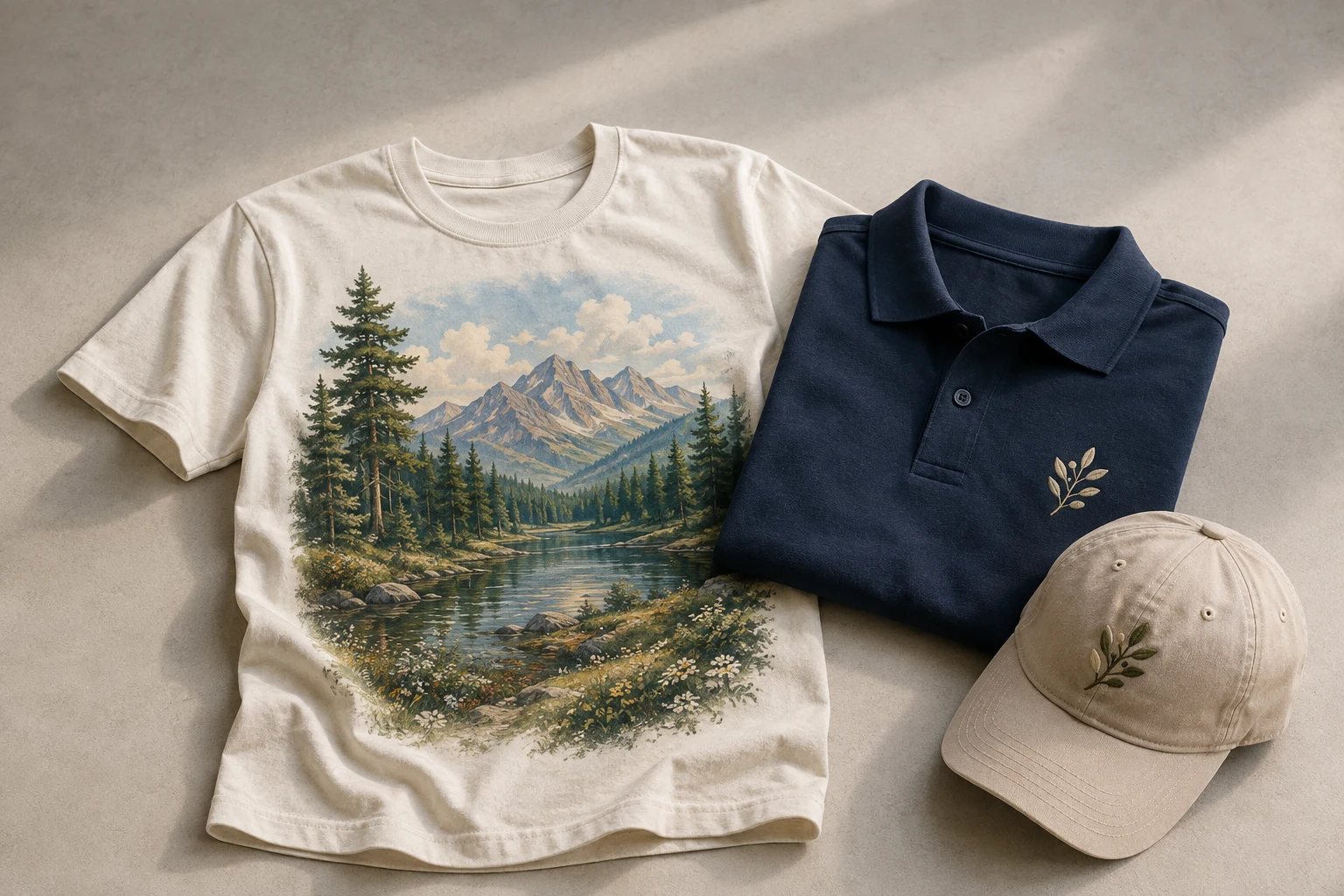
Cover image: AI-generated editorial concept; not a customer project or production proof.
Choose DTG for large, colorful graphics and photographic artwork; choose embroidery for textured logos, monograms and compact designs on suitable garments. A print-on-demand catalog can use both. Match the decoration to the product, then confirm the result with a physical sample before offering it to customers.
DTG: a practical choice for detailed graphics
Direct-to-garment printing applies ink directly to fabric. It suits artwork whose appeal depends on color variation and printed detail, particularly front or back graphics on T-shirts.
Fabric matters. Printful says its standard DTG process works best on 100% cotton, while blends can produce a more faded appearance. Check the composition of each garment color rather than assuming every version of a style uses the same fabric.
DTG needs a prepared print file, even though it does not need an embroidery stitch file. Follow the chosen product’s requirements for resolution, dimensions, background transparency and color profile. A printable area that avoids seams, pockets and zippers is easier to work with. See Printful’s DTG file guidance.
Embroidery: texture for logos and smaller placements
Embroidery builds a design with stitches and thread. Its visible texture makes it a useful option for logos on polos, caps and sweatshirts, or a restrained left-chest mark.
Artwork must be digitized into machine-readable stitch instructions. That process determines elements such as stitch density, thread paths and thread-color mapping. A different product or placement may require a separate digitized version; an existing file is not automatically suitable for every item. Printful explains embroidery digitization.
Simplified artwork is usually the more practical starting point for standard POD embroidery. Very small lettering can become unreadable, while large, heavy stitched areas can distort thin fabric. The garment’s texture also affects how stitches appear. These are reasons to inspect a sew-out rather than approve solely from a mockup. See Printful’s production limitations.
Which method fits your product?
Use these starting points alongside the supplier’s product-specific decoration options.
Product or design need | Practical starting choice |
|---|---|
T-shirt with a photograph or colorful illustration | DTG; check detail and color on the chosen blank. |
Polo with a compact logo | Embroidery; confirm lettering remains readable at the finished size. |
Cap with a simple emblem | Embroidery; use the cap’s specific placement requirements. |
Sweatshirt with a large front graphic | DTG when printed detail is central to the design. |
Sweatshirt with a small monogram | Embroidery when visible thread texture is part of the appeal. |
Thin shirt with a large, dense logo | Consider DTG or simplify and reduce the embroidered area after sampling. |
Compare setup and total order cost
Neither method is always cheaper. Request a quote for the actual garment, decoration size, placements and quantity. For embroidery, ask whether digitization or design adjustments are separate charges and when that work can be reused.
For a POD catalog, compare the complete cost of a sale: the decorated garment, allocated setup and sample costs, shipping, selling fees and an allowance for replacements. Keep this comparison specific to the products you intend to sell; a low base garment price alone does not establish a better margin.
For buyers serving the US, Canada and UK, compare quotes in a consistent currency and confirm the destination-specific total at checkout. Ask where each product will be fulfilled and whether the same blank and decoration option are available for your target destinations. Supply design dimensions in both inches and millimeters to reduce ambiguity.
If you need outside file preparation, DigitEMB’s embroidery digitizing service is a relevant starting point. First ask your POD provider whether it accepts externally digitized files and what specifications it requires.
Judge feel and durability with a sample
Printed artwork and stitched artwork create different surfaces. Handle a sample to assess the print’s feel, the embroidery’s texture and how the decorated area moves with the garment. Neither method warrants a blanket promise about how many washes it will survive.
Follow the supplier’s care instructions for the finished product. For example, Printful recommends cold, gentle washing inside out for both DTG apparel and embroidered clothing, but gives different drying guidance and recommends hand-washing caps. Avoid applying one care routine across an entire mixed catalog. See Printful’s product care instructions.
Before listing an item, inspect its placement, color, legibility and comfort, then wash it according to those instructions. Photograph the actual sample so buyers can see the finish they are choosing.
Frequently asked questions
Is embroidery always better quality than DTG?
No. Quality depends on whether the process suits the artwork and garment. A detailed illustration may work better as a print, while a simple logo may benefit from thread texture.
Can I use the same artwork for both methods?
You can start from the same original, but prepare separate production versions. DTG needs a suitable print file; embroidery needs digitization and may require simplified details or adjusted lettering.
Should my store offer both?
Yes, if each serves a clear product purpose. Start with a sampled graphic T-shirt and a sampled embroidered logo item, then expand based on customer demand and the costs of fulfilling each product.
Practical details for DTG vs. Embroidery for Print-on-Demand Apparel
The best next step is to translate the topic in this article into a short, specific brief. That gives everyone involved the same reference before a file, proof or finished product is prepared.
Work through these points in order and keep the answers with the artwork or production request. A short written brief makes it easier to compare a proof with the intended result, ask a useful follow-up question and avoid relying on assumptions made from a screen image alone.
The aim is not to add unnecessary steps. It is to identify the choices that change the final result before work begins. If a requirement is unknown, flag it for confirmation rather than guessing; that keeps the approval process focused on the design, material and use that apply to this particular project. Save the approved brief with the project files for future reorders or revisions.
State the intended outcome
Describe where and how the finished item will be used, who it is for and the result that matters most. This helps separate a useful requirement from a visual preference.
Collect the source material
Provide the clearest artwork, references and text available. Mark anything that cannot change, such as a logo, spelling, colour or placement requirement.
Review the final details
Before approving work, check the real size, material, format and any production constraints. Confirm the details that affect how the design will look in use, not only on a screen.
Quick questions to check before you proceed
What should I prepare first?
Start with the artwork, its intended use, finished size and any requirements that cannot change.
Why is a proof important?
A proof is the shared reference for checking details before production. It is the best time to correct a size, spelling, colour or placement issue.
What makes a useful request?
A clear request explains the goal, provides the best available source material and identifies the details that need approval.