
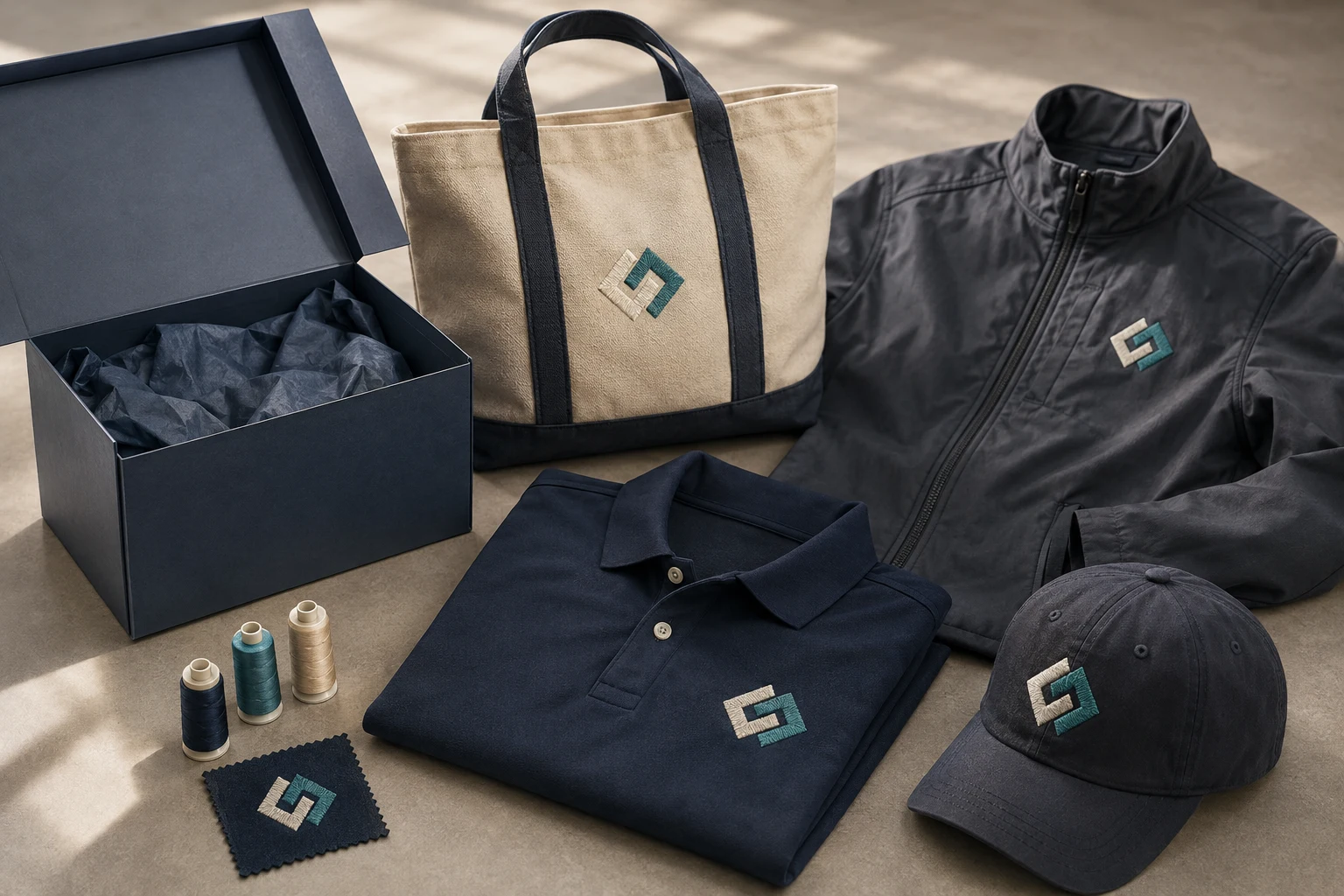
Cover image: AI-generated editorial concept; not a customer project or production proof.
A corporate branding embroidery package is a coordinated project that applies an approved brand identity across uniforms, workwear, hats, bags and gifts. A useful package covers the brand brief, artwork preparation, product selection, stitched samples, production checks and distribution arrangements.
Before ordering, confirm whether the quotation covers digital embroidery files, decorated products or both. Terms such as “exclusive” and “premium” do not define the deliverables. Ask the supplier to specify exactly what is included.
Start with the people and purpose
Decide who will receive the items and how they will use them. Staff uniforms, conference apparel, client gifts and employee welcome packs have different requirements for fit, comfort, presentation and replenishment.
Build the brief around your approved logo, brand colors, intended placements, product quantities and required arrival date. Include the people responsible for approving artwork and physical samples so conflicting feedback does not delay production.
For teams in the US, Canada and UK, request garment measurements rather than relying only on size labels. Specify embroidery dimensions in both inches and millimeters, identify each delivery destination and make the quotation currency explicit. Ask recipients about fit preferences and whether the proposed colors, symbols and placements suit their working environment and audience.
What should the package include?
Use a written scope to compare suppliers and avoid assuming that every stage comes with the embroidery service.
Package element | What to confirm |
|---|---|
Brand consultation | Intended audience, approved logo versions, colors and decision makers. |
Artwork development | Which embroidery adaptations are included and who approves changes. |
Digitizing | Required sizes, product applications, machine formats and revision terms. |
Product sourcing | Garment styles, size ranges, colors, quantities and substitution rules. |
Sampling | Which physical samples are supplied, their cost and approval process. |
Production checks | Agreed criteria for placement, stitching, finishing and quantities. |
Packaging and distribution | Folding, individual packing, gift presentation and delivery destinations. |
Follow-up and reorders | How defects, feedback, replacement items and repeat orders are handled. |
Treat this as a scope to request, rather than a statement that any particular supplier offers a complete package.
Choose products that work together
A coordinated range does not need the same logo size on every item. Aim for a consistent visual identity while allowing each product to suit its purpose.
Polos and shirts may form the everyday uniform, with jackets for outdoor roles and caps or bags for events. Gifts can use a more discreet treatment if that better suits the recipient. For leather goods or other unusual materials, ask the decorator to assess the exact product before including it in the order.
Fabric affects embroidery preparation. Madeira identifies fabric type and stretch as major factors in backing selection, with cut-away stabilizers suited to unstable fabrics such as knits and fleece. Ask the decorator to choose and test the backing for each product rather than specifying one backing for the whole range. Madeira’s embroidery backing guidance
Choose a manageable core range that can be reordered. Record the manufacturer, style code and color of every approved blank, and require approval before substitutions.
Adapt the logo and confirm thread colors
Supply the clearest available original artwork and identify the elements that must remain unchanged. Ask for proposed adaptations if fine details, small text or gradients are difficult to reproduce at the chosen embroidery size. Approve those changes before digitizing proceeds.
Digitizing creates embroidery data from artwork. Wilcom’s documentation distinguishes the source image, the embroidery design and the machine file, and says fabric-related settings such as underlay, density and pull compensation should be checked before production. The practical purchasing implication is to provide the intended product and size with the artwork. Wilcom’s explanation of digitizing and production checks
Select thread colors from physical samples where color consistency matters. Madeira cautions that screen and printed colors may differ from actual thread and recommends a physical color card for precise matching. Record the approved thread manufacturer, range and color numbers. Madeira USA’s color matching guidance
For the file preparation stage, review DigitEMB’s logo embroidery digitizing service. Confirm the deliverables separately from garment sourcing, stitching, packaging and shipping.
Approve a stitched sample before production
Use the artwork proof to agree on appearance and placement, then request a physical sew-out on the intended product or representative material. Wilcom describes its visual embroidery preview as a simulation of stitches; use it to support approval alongside a physical sample. Wilcom’s preview explanation
During sample review, check:
Whether the logo and lettering are readable at the final size.
Whether thread colors work against each garment color.
Whether the placement looks appropriate when the item is worn or carried.
Whether the fabric lies smoothly around the embroidery.
Whether the reverse feels comfortable and is neatly finished.
Agree which product variations require separate samples. Ask for a wash trial using the intended care routine before approving frequently laundered uniforms. Record any changes and approve the revised sample before the production run.
Keep the approved sample and specification as the reference for later deliveries. Embroidery alone does not establish a garment’s service life; evaluate the finished product under its expected use and care conditions.
Compare the complete quotation
Request separate costs for artwork work, digitizing, samples, blanks, embroidery, personalization, packaging and freight. Ask how additional placements, size variants or later revisions affect the total. Avoid comparing a digital-file quotation with a finished-garment quotation as though they cover the same work.
For purchases involving US, Canadian or UK destinations, confirm the currency, shipping origin and who is responsible for any applicable taxes, duties and import charges. Ask for separate estimates for artwork approval, sampling, production and transport rather than one unexplained turnaround figure.
Clarify what happens if an item is unavailable, a sample needs another revision or a delivered piece differs from the approved specification. Keep these arrangements in the order record.
Plan distribution, feedback and reorders
Packaging should suit the use. Everyday staff uniforms may need practical size identification, while client gifts may call for individual presentation. Confirm whether gift boxes, inserts, labels and packing are included or separately supplied.
For multiple offices, prepare an allocation list by destination, product and size. Name a receiving contact at each location and agree how shortages or defects will be reported.
After distribution, collect feedback on fit, comfort, appearance after washing and actual use. This gives the next order a practical basis for improvement. A consistent embroidered range can help create a coordinated presentation, but claims about higher morale, loyalty or sales should not be treated as guaranteed outcomes.
Maintain a reorder record with the approved artwork version, embroidery dimensions, placement measurements, thread codes, garment details and sample approval date. Ask whether digitized files can be supplied to another decorator and whether later changes carry additional charges.
Frequently asked questions
Does an embroidery package include garments?
Only if the quotation says so. Digitizing prepares embroidery files; sourcing and decorating garments are additional tasks that need an explicit scope.
Can the same logo be used on shirts, caps and bags?
The brand artwork can be shared, but ask the decorator to assess each product and intended size. Approve any required design or production changes before ordering the range.
How can we keep colors consistent across reorders?
Record the approved thread range and color numbers, retain the physical sample and require approval for substitutions. Check the embroidery against the actual garment color.
What makes a package “exclusive”?
Ask the supplier to define the term. It might refer to custom artwork, restricted design use or special packaging, but the word alone establishes none of those deliverables. Put any promised exclusivity and artwork usage terms in writing.
Practical details for Corporate Branding Embroidery Packages: A Buyer’s Guide
Use the article above as a starting point, then make the production brief specific to your own design. A stitch file is made for a finished size and material, so the artwork alone is only part of the instruction.
Work through these points in order and keep the answers with the artwork or production request. A short written brief makes it easier to compare a proof with the intended result, ask a useful follow-up question and avoid relying on assumptions made from a screen image alone.
The aim is not to add unnecessary steps. It is to identify the choices that change the final result before work begins. If a requirement is unknown, flag it for confirmation rather than guessing; that keeps the approval process focused on the design, material and use that apply to this particular project. Save the approved brief with the project files for future reorders or revisions.
Confirm the finished use
State the item, placement and finished width and height. A chest logo, cap front and jacket back do not use the same sewing area, even when they start from the same artwork.
Protect the smallest details
Review small lettering, narrow gaps, thin outlines and tiny colour changes at the final size. Simplifying a fragile detail before digitizing is often more reliable than trying to force it into a small sew-out.
Match the file to the machine
Tell the production team the embroidery machine or format required, along with the fabric or garment type. This lets them prepare the right export and make choices that suit the material rather than treating every job alike.
Quick questions to check before you proceed
What should I send with my artwork?
Send the clearest original available, the finished dimensions, placement, fabric or garment type and the required machine format if you know it.
Can the same file be used at every size?
Not always. Scaling changes the relationship between stitch length, detail and fabric, so a design may need review when the finished size or placement changes.
What should I check before production?
Confirm the spelling, colours, final size, placement and any details that must remain readable. A proof or sample is the best point to catch a change.