
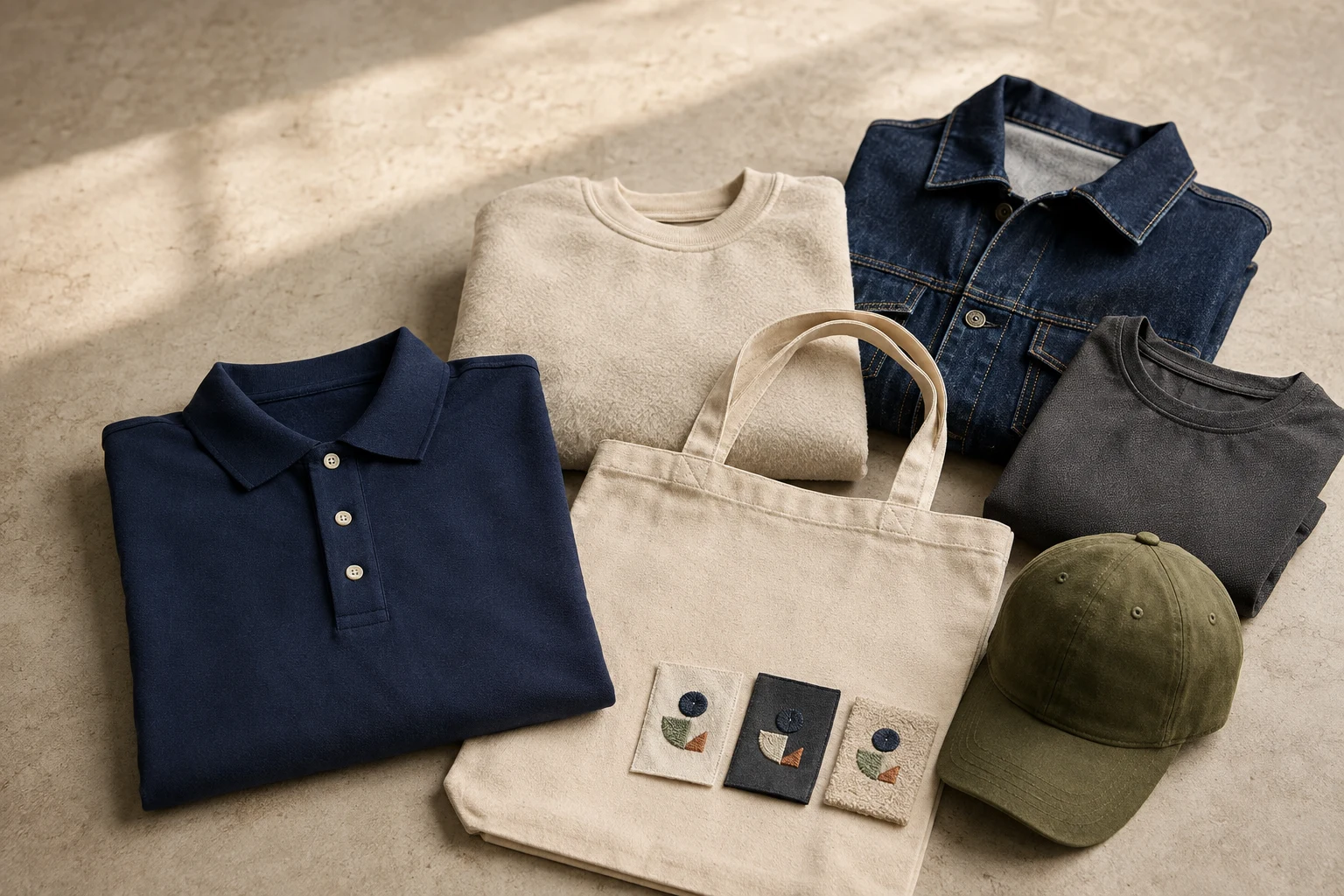
Cover image: AI-generated editorial concept; not a customer project or production proof.
Choose blanks with a stable fabric, a surface suited to your design and enough accessible space for embroidery. Firm woven cotton and cotton-rich garments are useful starting points; stretchy knits, fleece and lightweight fabrics need closer evaluation. Approve a sew-out on the actual blank before committing to a production batch.
A blank is the undecorated garment or accessory. Its construction matters alongside the stitch file: the same artwork may need a different approach on a polo, cap, tote or jacket.
Look beyond the fiber label
“Cotton” or “polyester” alone does not tell you how a blank will behave. Examine its stretch, weave or knit, thickness and surface texture. Madeira’s backing guide distinguishes stable, tightly woven materials from knits and lightweight woven fabrics that need continuing support. It also relates backing weight to the design’s stitch coverage. Madeira’s fabric and backing guide.
For buyers comparing suppliers in the US, Canada and UK, request the exact style number, fabric composition, fabric weight and care instructions. Keep the units attached to weight figures: suppliers may list g/m² or oz/yd². Treat weight as one comparison point, then inspect a sample rather than setting a universal minimum.
Which blanks are good starting points?
Blank type | What to check before choosing it |
|---|---|
Cotton or cotton-rich woven shirts and workwear | Look for a firm embroidery area and enough room clear of pockets, plackets and heavy seams. |
Denim jackets and canvas totes | Consider these for designs with substantial stitch coverage; check thickness and access at the intended placement. |
Polos | Inspect the knit and surface texture. A substantial collar does not tell you how stable the chest fabric will be. |
Twill caps | Have the embroiderer assess the actual cap shape, front panel and available design area. |
Sweatshirts and fleece | Evaluate both fabric stretch and the raised surface, along with how the finished embroidery feels inside. |
Performance tops and lightweight shirts | Request an actual sample before ordering volume, especially for large or heavily filled artwork. |
Denim, canvas and twill are useful candidates for stitch-heavy designs because sturdy, non-stretch fabrics provide support. This is a starting point, not a promise that every garment made from them will suit every design. Urban Threads’ guidance on complex embroidery.
Canvas still benefits from stabilizer despite its strength. A sturdy blank does not eliminate the need for a suitable embroidery setup. Embroidery Library’s canvas tutorial.
Fabrics that need extra care
Stretchy performance knits: Plan for support beneath the embroidery. Cut-away backing is commonly used on unstable knits, and lightweight performance garments may need a low-profile option to avoid a conspicuous backing outline. Ask the embroiderer to evaluate the file and setup together. Madeira’s backing guide.
Fleece and terry: Raised fibers can obscure fine details. Water-soluble topping helps keep stitches above the pile; it complements the backing underneath. Before choosing a plush blank, have small lettering and thin elements assessed at their intended size. Madeira’s topping guidance.
Very lightweight or sheer fabrics: Check the finished sample for puckering, visible backing and changes in drape. Lightweight woven materials may need cut-away support, so discuss how the reverse side will look before selecting them. Madeira’s backing guide.
Check the whole item, not just a swatch
Before placing a bulk order, ask the embroiderer to inspect the intended location on a complete blank. Confirm that the area can be reached and held securely with the available equipment.
Pay particular attention to pockets, linings, zippers, seams and tote openings. Agree whether a pocket must remain usable and whether stitching through a lining is acceptable. For caps, request placement approval on the actual style rather than assuming a flat garment sample proves suitability.
Also consider the wearer. Review the reverse side against the skin, the garment’s drape and whether the decoration feels appropriate for its intended use.
Test before committing to a batch
Make the sew-out part of your buying decision:
Use the actual blank. Record its supplier, style, size, color and composition.
Use the intended artwork and placement. A different sample design will not answer every question about your order.
Inspect the finished item out of the hoop. Look for puckering, obscured detail, fabric damage, backing visibility and uncomfortable stiffness.
Wash and dry a sample according to its care label. Recheck the garment’s shape and the embroidery’s appearance.
Keep an approved reference. Record the blank and embroidery setup so substitutions can be reviewed before production.
If the sample disappoints, discuss whether to change the blank, simplify the artwork or adjust the embroidery setup. Repeat the sample after a material change rather than approving a batch from an earlier result.
When preparing a request for DigitEMB’s embroidery digitizing service, include the blank’s fabric details, intended design dimensions and placement. Supply photographs of the item and any trial sew-out to make the requirements easier to assess.
Frequently asked questions
Is 100% cotton always the best choice?
No. Consider construction and stretch as well as fiber content. Compare the actual blanks and use the finished sew-out to make the decision.
Can fleece and towels hold detailed embroidery?
They can, but raised fibers require attention. Topping helps prevent detail from sinking into the surface; test fine lettering on the actual item before approving it. Madeira’s topping guidance.
Should I buy the full batch before testing?
Where possible, buy samples first. Confirm availability for the planned order, then approve the decorated sample before committing to volume.
Practical details for Choosing Blanks That Hold Embroidery Well
Use the article above as a starting point, then make the production brief specific to your own design. A stitch file is made for a finished size and material, so the artwork alone is only part of the instruction.
Work through these points in order and keep the answers with the artwork or production request. A short written brief makes it easier to compare a proof with the intended result, ask a useful follow-up question and avoid relying on assumptions made from a screen image alone.
The aim is not to add unnecessary steps. It is to identify the choices that change the final result before work begins. If a requirement is unknown, flag it for confirmation rather than guessing; that keeps the approval process focused on the design, material and use that apply to this particular project. Save the approved brief with the project files for future reorders or revisions.
Confirm the finished use
State the item, placement and finished width and height. A chest logo, cap front and jacket back do not use the same sewing area, even when they start from the same artwork.
Protect the smallest details
Review small lettering, narrow gaps, thin outlines and tiny colour changes at the final size. Simplifying a fragile detail before digitizing is often more reliable than trying to force it into a small sew-out.
Match the file to the machine
Tell the production team the embroidery machine or format required, along with the fabric or garment type. This lets them prepare the right export and make choices that suit the material rather than treating every job alike.
Quick questions to check before you proceed
What should I send with my artwork?
Send the clearest original available, the finished dimensions, placement, fabric or garment type and the required machine format if you know it.
Can the same file be used at every size?
Not always. Scaling changes the relationship between stitch length, detail and fabric, so a design may need review when the finished size or placement changes.
What should I check before production?
Confirm the spelling, colours, final size, placement and any details that must remain readable. A proof or sample is the best point to catch a change.