
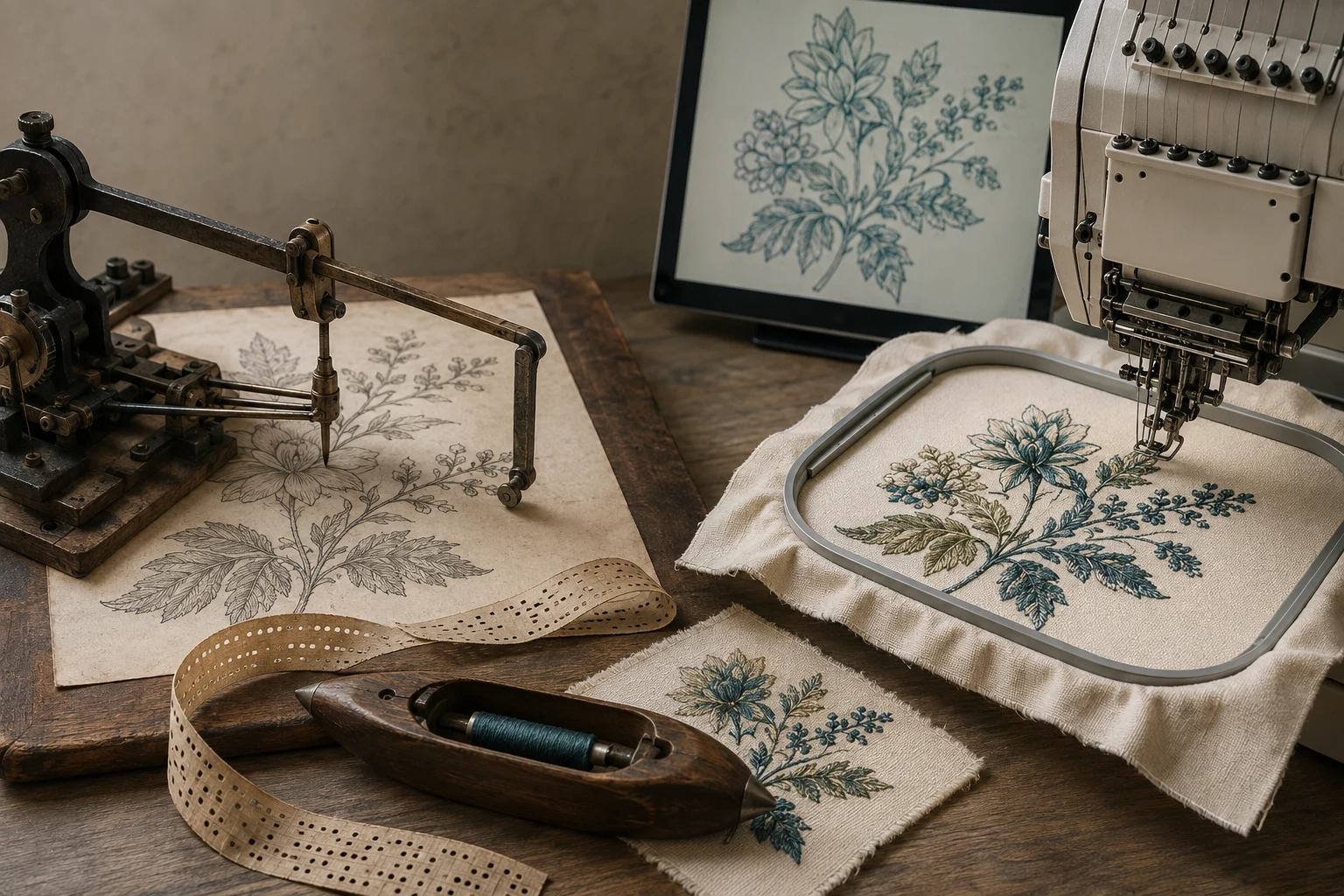
Cover image: AI-generated editorial concept; not a customer project or production proof.
Machine embroidery developed in stages: nineteenth-century machines multiplied an operator’s hand movements, Schiffli machines changed how stitches were formed, and stored patterns eventually gave way to computerized controls and editable files. The familiar embroidered garment is the result of nearly two centuries of changes in how designs reach fabric.
The hand-machine era
In 1828–1829, Josua Heilmann developed an early hand embroidery machine that could repeat a pattern with many needles working simultaneously. Later improvements helped make the machinery suitable for wider production, particularly around St. Gallen in Switzerland. The Textile Museum St. Gallen documents this transition through its drawings, machines and embroidered textiles. Explore the museum’s history of St. Gallen embroidery.
The operator still guided the design. A pantograph—a linked mechanical tracing device—translated movements over a drawn pattern into movements of the fabric frame. It allowed the machine to reproduce a design at a different scale. Flawil’s local museum documents this mechanism through its working hand embroidery machine. See the museum’s pantograph material.
Mechanization also depended on substantial supporting labor. Needles needed threading, fabric needed preparation, and the work needed supervision. The Appenzeller Volkskunde-Museum describes how these tasks involved whole families, including children, in the regional embroidery industry. Read the museum’s account of hand-machine work.
Schiffli: a new way to form stitches
During the 1860s, Isaak Gröbli developed the Schiffli embroidery machine. Kulturmuseum St. Gallen preserves an early working example dated 1864–1865, providing a tangible record of this turning point. View the museum’s Schiffli machine.
The machine combined a needle thread with a second thread carried in a shuttle. Its boat-shaped shuttle gave Schiffli its name: “little boat” in Swiss German. Rows of needles and shuttles could embroider repeated motifs across fabric. Early pattern guidance still involved a pantograph, so the new stitch mechanism and automated design control were separate advances. Read the Textile Research Centre’s explanation.
Punched patterns take over the guidance
Punched media allowed machine movements to be recorded and read mechanically. A surviving Saurer machine photographed at the Saurer Museum shows a punched-card reader that replaced manual pantograph guidance. The pattern could now reside in a physical sequence of holes instead of depending on an operator tracing every movement. See the documented card reader.
Cards and paper tape belong to this longer history of stored instructions, but their use varied between machine systems. Computerization was also gradual: Tajima’s company timeline identifies a 1978 computerized embroidery machine that still read design data from paper tape. See Tajima’s historical timeline.
Multi-head machines and editable files
Multi-head production developed before computers became standard. Tajima dates its own multi-head automatic embroidery machine to 1964. This is a milestone in that manufacturer’s history, rather than the beginning of machine embroidery itself. Read Tajima’s company FAQ.
Computer-based design systems then changed how patterns were prepared and revised. Wilcom records selling its first embroidery system in 1980 and introducing its CED desktop design system in 1983. Its later object-based EMB format brought artwork, embroidery objects and stitches together in an editable file. These developments made revision and reuse central parts of the workflow. Explore Wilcom’s development timeline.
For buyers in the US, Canada and UK, the practical legacy is straightforward: the design file is part of the production process. When discussing an order, specify the finished dimensions, garment or fabric, placement and required machine format. Ask what file will be supplied and how the stitched result will be checked. DigitEMB’s embroidery digitizing service page provides a relevant starting point for that discussion.
Brief FAQs
When did machine embroidery begin?
Its nineteenth-century beginnings include Heilmann’s hand embroidery machine of 1828–1829. Modern computerized embroidery came much later, as the museum and manufacturer histories above show.
Were early embroidery machines automatic?
They mechanized parts of stitching, but operators still guided patterns and performed supporting work. Stored pattern control was a later development.
Did computers introduce multi-head embroidery?
No. Tajima’s 1964 multi-head milestone predates its 1978 computerized model. Computers subsequently changed design preparation, control and transfer.
Practical details for A Short History of Machine Embroidery
Use the article above as a starting point, then make the production brief specific to your own design. A stitch file is made for a finished size and material, so the artwork alone is only part of the instruction.
Work through these points in order and keep the answers with the artwork or production request. A short written brief makes it easier to compare a proof with the intended result, ask a useful follow-up question and avoid relying on assumptions made from a screen image alone.
The aim is not to add unnecessary steps. It is to identify the choices that change the final result before work begins. If a requirement is unknown, flag it for confirmation rather than guessing; that keeps the approval process focused on the design, material and use that apply to this particular project. Save the approved brief with the project files for future reorders or revisions.
Confirm the finished use
State the item, placement and finished width and height. A chest logo, cap front and jacket back do not use the same sewing area, even when they start from the same artwork.
Protect the smallest details
Review small lettering, narrow gaps, thin outlines and tiny colour changes at the final size. Simplifying a fragile detail before digitizing is often more reliable than trying to force it into a small sew-out.
Match the file to the machine
Tell the production team the embroidery machine or format required, along with the fabric or garment type. This lets them prepare the right export and make choices that suit the material rather than treating every job alike.
Quick questions to check before you proceed
What should I send with my artwork?
Send the clearest original available, the finished dimensions, placement, fabric or garment type and the required machine format if you know it.
Can the same file be used at every size?
Not always. Scaling changes the relationship between stitch length, detail and fabric, so a design may need review when the finished size or placement changes.
What should I check before production?
Confirm the spelling, colours, final size, placement and any details that must remain readable. A proof or sample is the best point to catch a change.