
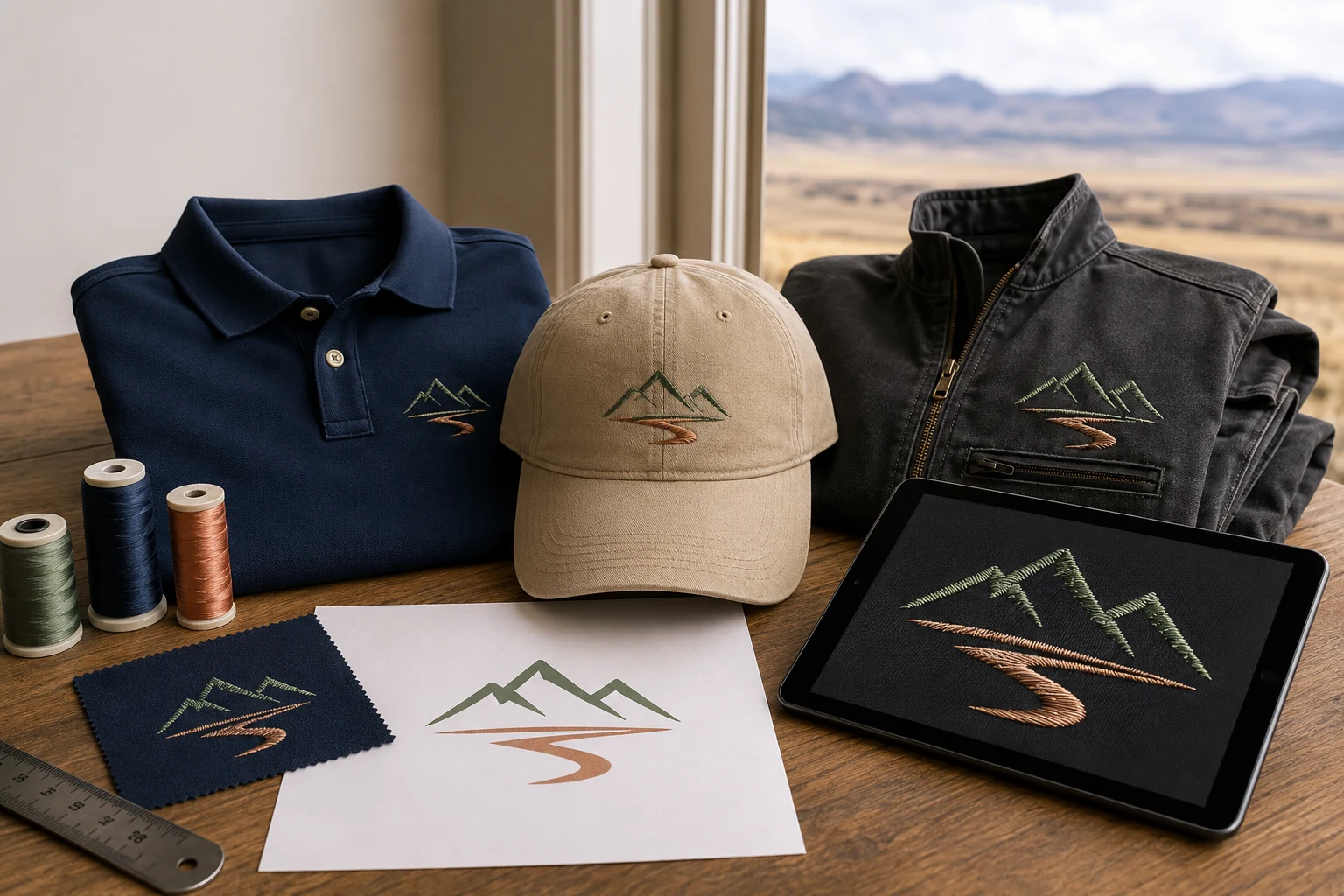
Cover image: AI-generated editorial concept; not a customer project or production proof.
For a Wyoming embroidery project, choose a provider that can prepare your design for the intended garment, finished size and embroidery machine—and explain how the file will be tested. Vector art provides editable, scalable artwork; embroidery digitizing turns artwork into stitch instructions. A clean vector logo still needs digitizing before it can be embroidered.
Cover image: AI-generated concept showing artwork and matching embroidered apparel. The products, emblem and setting are illustrative; they do not depict a DigitEMB facility, customer project or verified Wyoming location.
Whether you are arranging school apparel in Cheyenne, team caps in Casper or business uniforms in Laramie, begin by deciding what you need delivered: artwork, an embroidery file or finished garments. That distinction makes quotes easier to compare and helps prevent gaps between the designer and the shop doing the stitching.
What embroidery digitizing and vector art each provide
Vector graphics describe shapes using mathematical paths, while raster images such as JPEGs and PNGs use pixels. Vector artwork retains crisp edges when resized, making it useful for logos shared across apparel artwork, printed materials and signage. That scalability describes the artwork; it does not guarantee that every detail will reproduce in thread. Adobe explains raster and vector images.
Digitizing adds decisions about how the design will be stitched. For example, embroidery software can assign different stitch treatments to filled areas and outlines, arrange the color sequence and match artwork colors to thread charts. Both vector and bitmap artwork can be used as inputs; vector conversion is not a mandatory first step for every project. Hatch’s digitizing documentation describes these inputs and settings.
Service | Deliverable to confirm |
|---|---|
Vector conversion | Editable artwork in the format requested by your designer or printer. |
Embroidery digitizing | A stitch file prepared for your specified size, fabric, placement and machine requirements. |
Garment embroidery | Physical items stitched by an embroiderer, with garment supply and sample approval agreed separately. |
For a logo appearing on both printed promotional materials and embroidered jackets, request the vector artwork and embroidery file as separate deliverables. Ask whether future artwork edits and additional embroidery sizes are included.
Choosing a provider for a Wyoming project
A local shop may be convenient when you want to inspect garments, discuss placement in person or collect finished items. A remote digitizer can also be part of the workflow if your chosen embroiderer accepts externally prepared files. Confirm that arrangement before paying for digitizing.
For projects in Gillette, Riverton or elsewhere in Wyoming, ask prospective providers the same questions so you can compare their answers fairly:
Can you show sewn examples with similar lettering, garment materials and placements?
Will you supply digital files, finished items or both?
Who will stitch and approve the sample?
What happens if the first sample needs a file adjustment?
Which file formats and supporting information will you deliver?
Who should receive production feedback—the digitizer, the embroiderer or one project contact?
Use referrals from local businesses or community organizations to build a shortlist, then assess each provider’s relevant work and written scope. A portfolio is more useful when it shows the kind of project you are ordering.
If you already have an embroiderer, DigitEMB’s embroidery digitizing service is a starting point for discussing file preparation. Send the embroiderer’s requirements with your artwork so the quote addresses the actual production job. If the same logo also needs editable artwork for print or signage, discuss raster-to-vector conversion as a separate deliverable.
Prepare a brief that covers the whole order
Send your clearest original artwork and explain which elements must remain recognizable. Ask the provider to flag any proposed simplification before proceeding, especially for small text or detailed emblems.
Information to send | What to specify |
|---|---|
Artwork | Original design files when available, plus a reference image showing the intended appearance. |
Finished size | Width and height, with units clearly stated; for example, 3 inches wide or 76.2 mm wide. |
Product and placement | Cap front, polo chest, jacket back, bag panel or patch, including the garment model if known. |
Fabric | Material and construction details supplied by the garment vendor or embroiderer. |
Colors | Garment color and requested thread references, with any acceptable substitutions. |
Machine requirements | The embroiderer’s requested file format and available embroidery area. |
Schedule | Sample approval date, production deadline and delivery or collection date. |
Fabric information matters because embroidery settings may need to change with the material. Hatch’s documentation, for example, describes fabric presets that adjust settings such as pull compensation to help reduce stitching defects. Hatch’s auto fabric guidance explains this relationship.
For orders coordinated between Wyoming and buyers or suppliers in Canada or the UK, state dimensions, quote currency and the time zone for approval deadlines explicitly. Confirm whether delivery means an emailed file or shipped goods.
Compare quotes and timelines on equal terms
Request a written breakdown covering artwork cleanup, digitizing, additional sizes, revisions and sample work. If you are ordering finished apparel, ask for garment and embroidery charges separately from file preparation.
A useful quote also explains what counts as a revision. Correcting a production issue, changing the logo and preparing a second placement may be treated differently. Confirm whether you receive an editable source file as well as the machine file, and whether the files can be supplied to your chosen embroiderer.
For a school event, team order or business launch, work backward from the date the items are needed. Allow separate time for artwork approval, digitizing, sample review, any corrections, garment production and shipping or collection. Ask the provider to confirm the schedule for your specific order.
Review a sewn sample before production
A screen preview helps you review layout and spelling, but a sewn sample shows how the design behaves on fabric. Fabric, hooping, stabilizer, design size and stitch construction can all affect distortion. Hatch’s guide to pull compensation explains why a test stitch-out can reveal gaps that require adjustment.
Arrange a sample using the intended garment or a closely comparable material and production setup. Check that lettering is readable, outlines meet their fills, placement is correct and the surrounding fabric lies acceptably flat. Also confirm the thread colors against the garment.
If something needs correction, send clear photographs and the production details to the digitizer and embroiderer. Keep the approved file version, dimensions and thread information together so the shop can identify the correct version for production and repeat orders.
FAQs
Do I need vector artwork before ordering digitizing?
Not always. Embroidery software can use bitmap or vector artwork. Send your best available original and ask whether cleanup or redrawing is needed before authorizing an additional service. Hatch documents both artwork inputs.
Can the same logo be used for caps, shirts and jackets?
You can use the same visual identity, but ask the digitizer to review each intended size, fabric and placement. Specify all products at the quotation stage rather than assuming one embroidery file covers the entire order.
How much does embroidery digitizing cost in Wyoming?
Request a project-specific quote. Compare the same deliverables, including artwork preparation, sizes, revisions and sample arrangements. Keep file preparation costs separate from garment production costs.
How long should I allow?
Ask for dates covering both the initial file and the sample review process. If you need finished garments, confirm their production and delivery schedule separately.
Does my digitizer need to be based in Wyoming?
Choose based on your workflow. Local access can help with garment inspection and collection; remote file preparation can work when your embroiderer agrees to use the files and responsibility for testing and revisions is clear.
Practical details for Wyoming Embroidery Digitizing and Vector Art: A Buyer’s Guide
Use the article above as a starting point, then make the production brief specific to your own design. A stitch file is made for a finished size and material, so the artwork alone is only part of the instruction.
Work through these points in order and keep the answers with the artwork or production request. A short written brief makes it easier to compare a proof with the intended result, ask a useful follow-up question and avoid relying on assumptions made from a screen image alone.
The aim is not to add unnecessary steps. It is to identify the choices that change the final result before work begins. If a requirement is unknown, flag it for confirmation rather than guessing; that keeps the approval process focused on the design, material and use that apply to this particular project. Save the approved brief with the project files for future reorders or revisions.
Confirm the finished use
State the item, placement and finished width and height. A chest logo, cap front and jacket back do not use the same sewing area, even when they start from the same artwork.
Protect the smallest details
Review small lettering, narrow gaps, thin outlines and tiny colour changes at the final size. Simplifying a fragile detail before digitizing is often more reliable than trying to force it into a small sew-out.
Match the file to the machine
Tell the production team the embroidery machine or format required, along with the fabric or garment type. This lets them prepare the right export and make choices that suit the material rather than treating every job alike.
Quick questions to check before you proceed
What should I send with my artwork?
Send the clearest original available, the finished dimensions, placement, fabric or garment type and the required machine format if you know it.
Can the same file be used at every size?
Not always. Scaling changes the relationship between stitch length, detail and fabric, so a design may need review when the finished size or placement changes.
What should I check before production?
Confirm the spelling, colours, final size, placement and any details that must remain readable. A proof or sample is the best point to catch a change.