
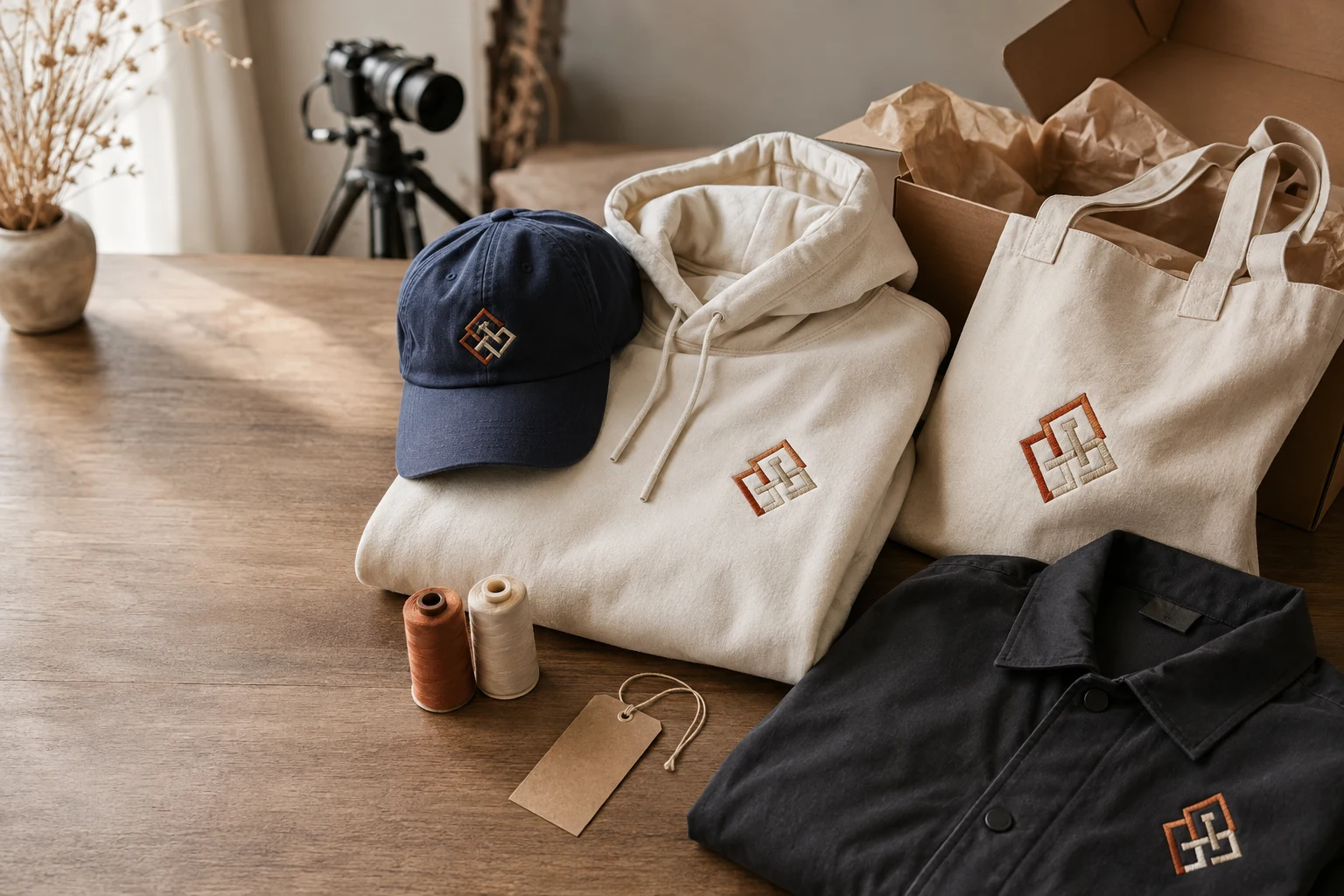
Cover image: AI-generated editorial concept; not a customer project or production proof.
White-label embroidery lets influencers and small brands sell embroidered merchandise under their own brand while an outside supplier handles the agreed production work. It can remove the need to buy embroidery equipment, but you still need to choose products, approve samples and manage the customer experience. Garment labels, branded packaging and direct shipping are separate features to confirm with each supplier.
Cover image: AI-generated concept of a coordinated embroidered merchandise collection and plain packaging. It is not a customer project or a photograph of products supplied by DigitEMB.
For a first collection, start with a small range your audience would use, one clear design and a physical sample of every product you intend to sell.
What does white-label embroidery include?
A typical arrangement combines a supplier’s existing products with your embroidered artwork. The supplier may also offer packing and shipping, but the term “white-label” alone does not define the full service.
For example, Printful describes its shipments as free of Printful branding, while noting that some fulfillment partners cannot support custom packing slips or mailers. This illustrates why branding details need checking at the product and fulfillment-location level. Printful’s packaging policy.
Clarify these distinctions before choosing a provider:
Service | What to establish |
|---|---|
Embroidery digitizing | Who prepares the machine stitch file, and whether your production supplier accepts outside files. |
Product decoration | Who supplies the blanks, stitches the design and checks finished items. |
Garment branding | Whether original manufacturer branding remains and what custom label options are available. |
Packaging | Whether orders use plain packaging, your packaging or a combination. |
Fulfillment | Whether the supplier ships to you in bulk or directly to individual customers. |
White-label branding and print on demand describe different parts of the arrangement: branding determines how the product is presented, while on-demand production determines when items are made. Ask about both instead of assuming one includes the other.
Why choose embroidery for your merchandise?
Embroidery gives a logo or small illustration visible thread texture. A consistent symbol, color palette or short phrase can connect hats, clothing and bags into a recognizable collection.
Outsourcing production also lets you concentrate on product direction, photography and communication with your audience. However, samples, setup, stock commitments and customer service still require resources. Neither low costs nor strong sales follow automatically from using a white-label supplier.
Think about why someone would wear the product beyond supporting your brand. A discreet emblem may suit everyday clothing; a phrase associated with your content may suit a limited collection. Ask followers about preferred products, fits and colors before committing to a large range. Treat poll responses as interest to investigate, rather than confirmed orders.
Choose products that fit your audience
The original appeal of branded merchandise is its usefulness. Build around your audience’s routines, then check whether your supplier can decorate the exact product and placement you have in mind.
Product idea | What to assess in the sample |
|---|---|
Caps and beanies | Fit, embroidery position and how the design looks when worn. |
Hoodies and sweatshirts | Garment weight, sizing, decoration comfort and overall finish. |
T-shirts and polos | Fabric feel, logo scale and whether the decorated area sits comfortably. |
Totes and gym bags | Carrying comfort, usable storage and placement clear of functional parts. |
Jackets | Fit over layers, lining finish and suitability for your audience’s climate. |
Towels or home accessories | Whether the item fits your brand’s everyday use and gifting appeal. |
A fitness creator could explore a hoodie and gym bag; a lifestyle brand could test a cap and tote. These are possible collection directions, not evidence of demand. Launching with fewer combinations makes it easier to inspect samples and explain the range clearly.
Prepare artwork for thread
Embroidery digitizing converts artwork into machine instructions, including stitch types, density and thread paths. An image file is not itself a production stitch file. The same design may need a different digitized version when the product, placement or embroidery technique changes. Printful’s digitization explanation.
For conventional flat embroidery, begin with clear shapes and readable lettering. Fine lines and crowded details can lose definition, and smooth printed gradients should not be assumed to reproduce in standard thread colors. Follow the chosen product’s embroidery template and the supplier’s technique-specific limits. Printful’s embroidery design guidelines.
Give the supplier a concise production brief:
The exact product, fabric and garment color.
Artwork dimensions in inches and millimeters.
Placement and orientation, supported by a simple visual reference.
Preferred thread colors and acceptable substitutions.
Details that must remain recognizable if the artwork needs simplifying.
Keep the same visual identity across the collection, while allowing adjustments for each item. A cap emblem and a hoodie chest design do not have to be identical in size to feel connected.
If you need separate file preparation, explore DigitEMB’s embroidery digitizing services. Confirm your decorator’s file requirements before ordering digitizing; a file-preparation service does not by itself establish a garment production or fulfillment arrangement. For example, Printful says it does not accept customer-supplied DST, PES or EXP stitch files and requires standard artwork for its own digitizing process. Printful’s stitch-file policy.
Compare suppliers beyond the headline quote
Send prospective suppliers the same brief so their responses are comparable. Ask for written answers about minimum quantities, sample costs, setup charges, additional placements, packaging and shipping.
Establish who handles artwork revisions, defective items, stock substitutions and customer returns. Ask whether you receive the stitch file and whether it can be used elsewhere. Keep the approved artwork version and sample details with the order record.
For sales to the US, Canada and UK, request example shipping quotes to your actual destinations. Confirm the dispatch country, available delivery services, tracking and return address. Ask how duties, taxes and any customer-paid import charges will be communicated before checkout. Separate production estimates from transit estimates when planning your launch.
If custom garment labels matter to your brand, request an example of the finished label arrangement. Do not assume a plain shipping package means the garment itself has no manufacturer branding.
Approve samples before announcing a launch
Order the exact product and design combination you plan to offer. Printful also recommends reviewing a physical embroidery sample before listing a product. Embroidery sample guidance.
Examine lettering, color contrast, placement, loose threads and the inside finish. Wear or use the item, then wash it according to its care instructions and assess it again. Photograph the approved sample so your listing shows the actual product.
Record the blank product code, color, size, embroidery dimensions and artwork version. Ask the supplier to contact you before making substitutions. Revisit sample approval when changing the garment or decoration significantly.
Plan the launch and customer experience
Compare a small bulk order with an on-demand arrangement against your own priorities. For bulk production, consider stock storage and unsold sizes. For on-demand production, consider the supplier’s ongoing stock availability, order handling and packaging options.
Build your budget from the complete quote: product, decoration, setup allocation, packing, shipping and selling fees. Allow room for samples and replacement orders before deciding whether the range is workable.
Prepare product pages with garment measurements, materials, decoration close-ups, care information and clear shipping and return terms. Use a currency label such as USD, CAD or GBP where a dollar sign or price could otherwise be ambiguous.
Introduce the collection through your website, social channels and email list. Show fit, texture and practical use through photographs or short videos. If customers share pictures, ask permission before reusing them. Expand the range after reviewing actual purchases, sizing questions and feedback.
FAQs
Can I start without buying an embroidery machine?
Yes. A production supplier can stitch your merchandise. Confirm whether its quote includes blanks, digitizing, sampling, packing and shipping, since these may be separate items.
Is there always no minimum order?
No. Ask for minimums for each product and branding option. Do not assume that single-item embroidery also means single-item custom labels or packaging.
Can one logo work across hats, hoodies and bags?
The visual identity can remain consistent, but the digitized file may need adjustment for the product or placement. Have the production supplier confirm suitability before reusing it. Digitization and design reuse.
Does white-label embroidery include custom neck labels?
Confirm this separately. Request a sample showing the garment labels, packaging and packing slip together so you understand the complete customer presentation.
Practical details for White-Label Embroidery for Influencers & Small Brands
The best next step is to translate the topic in this article into a short, specific brief. That gives everyone involved the same reference before a file, proof or finished product is prepared.
Work through these points in order and keep the answers with the artwork or production request. A short written brief makes it easier to compare a proof with the intended result, ask a useful follow-up question and avoid relying on assumptions made from a screen image alone.
The aim is not to add unnecessary steps. It is to identify the choices that change the final result before work begins. If a requirement is unknown, flag it for confirmation rather than guessing; that keeps the approval process focused on the design, material and use that apply to this particular project. Save the approved brief with the project files for future reorders or revisions.
State the intended outcome
Describe where and how the finished item will be used, who it is for and the result that matters most. This helps separate a useful requirement from a visual preference.
Collect the source material
Provide the clearest artwork, references and text available. Mark anything that cannot change, such as a logo, spelling, colour or placement requirement.
Review the final details
Before approving work, check the real size, material, format and any production constraints. Confirm the details that affect how the design will look in use, not only on a screen.
Quick questions to check before you proceed
What should I prepare first?
Start with the artwork, its intended use, finished size and any requirements that cannot change.
Why is a proof important?
A proof is the shared reference for checking details before production. It is the best time to correct a size, spelling, colour or placement issue.
What makes a useful request?
A clear request explains the goal, provides the best available source material and identifies the details that need approval.