
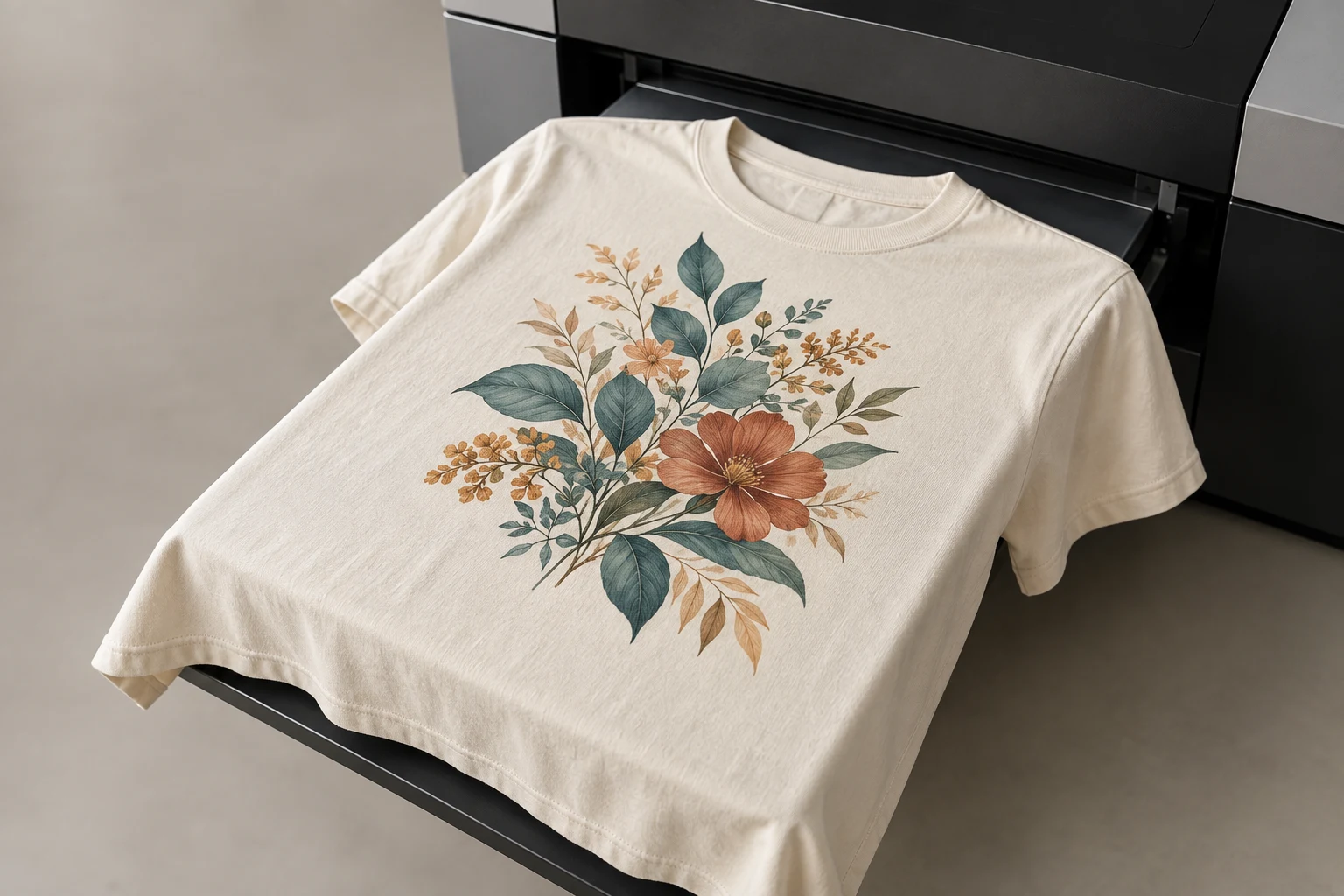
Cover image: AI-generated editorial concept; not a customer project or production proof.
Direct-to-garment (DTG) printing uses an inkjet printer to apply a digital design directly onto a garment. It can reproduce photographs, gradients and multicolor artwork without making a separate screen for each color. The available colors still depend on the printer’s ink set. Brother’s DTG and screen printing explanation.
For buyers, the key decisions are the garment fabric, design, print placement and quantity. This guide explains the process, suitable materials, benefits and limitations, and the questions to resolve before ordering.
How does direct-to-garment printing work?
1. Prepare the artwork and placement
Supply the best original artwork and specify its finished width and height. Ask the printer which file format, resolution and color settings its workflow requires. Check small text and fine detail at the intended size, and identify any areas that should remain unprinted.
A vector file is not a universal requirement: Brother’s GTX baby-platen instructions, for example, specify PNG artwork for GTX Graphics Lab. Follow the chosen printer’s requirements. Brother’s artwork and platen setup guidance.
If a logo needs rebuilding, explore DigitEMB’s raster-to-vector services. Confirm the garment printer’s final export requirements before commissioning artwork preparation.
2. Pretreat the fabric when required
Pretreatment prepares the print area for the selected ink system. White-ink printing commonly requires it; some color-only workflows also use pretreatment to improve the result. Requirements vary with the fabric, ink and equipment, so there is no single recipe for every shirt. Brother’s pretreatment guidance.
The operator applies and dries or cures the specified pretreatment before printing. Incorrect preparation can affect the finished result, so request a sample on the actual garment rather than relying on a sample printed on another fabric.
3. Load the garment and print
The garment is positioned on a platen, the support that holds the print area in place. Its size and shape affect where the artwork can go. Specialty placements may require dedicated platens or inserts; sleeves, pockets, seams and zippers should be discussed before approving a layout. Brother’s placement and platen guidance.
A white underbase can support the colors on dark garments. Whether it is needed depends on the garment and print setup; it is not an automatic requirement for every nonwhite shirt.
4. Cure the ink
DTG includes a heat-curing stage. The operator uses the ink system’s specified equipment and settings to fix the print. Pretreatment curing and ink curing can require different conditions.
A print that looks good immediately after production can still develop washing problems if curing is incomplete. Avoid treating one temperature, pressure or time as suitable for every fabric and machine. Brother’s ink and pretreatment curing instructions.
Which fabrics work best for DTG?
Cotton is a useful starting point, but DTG is not limited to 100% cotton. Fabric compatibility belongs to the complete printing system, including pretreatment and curing.
Fabric | What to confirm |
|---|---|
100% cotton | Ask the printer to approve the exact garment and provide a sample. |
Cotton/polyester blends and tri-blends | Confirm the blend and required preparation; results can differ from cotton. |
100% polyester | Confirm that the equipment and pretreatment support it. Do not assume every DTG workflow does. |
Coated or water-repellent fabric | Request explicit compatibility confirmation and testing before production. |
Linen or other less familiar textiles | Have the exact material evaluated instead of assuming all natural fibers behave alike. |
Brother identifies restrictions for blends and coated materials and recommends testing new substrates. Epson explicitly supports polyester and polyester/cotton blends on its SureColor F2270 with the appropriate workflow. These are equipment-specific examples, not universal fabric guarantees. Brother’s substrate guidance, Epson’s polyester printing guidance.
DTG applications extend beyond adult T-shirts to suitable hoodies, bags, caps and shoes, while smaller platens can accommodate infant and toddler garments. Product shape and access to the print area matter alongside fiber content. Confirm each item separately. Brother’s printable-item examples, Brother’s small-garment platen guidance.
DTG printing advantages and limitations
DTG’s strengths include detailed imagery, multicolor designs and convenient artwork setup for short runs or on-demand production. It avoids the separate screen preparation associated with screen printing.
Its limitations include the ink set’s color range, fabric compatibility and preparation requirements. For large quantities of the same simple design, compare screen printing as well. Brother’s comparison of the two processes.
Ask to handle a physical sample if print softness, coverage or color matters. A digital preview cannot establish how the finished garment will feel.
Minimum quantities, prices and lead times are supplier policies. There is no universal order threshold at which DTG becomes cheaper, and the process does not eliminate artwork preparation, garment handling or curing. Request comparable quotes for your actual order.
How does DTG compare with other printing methods?
Screen printing
Screen printing pushes ink through prepared screens. It can suit repeated designs with relatively few colors, particularly at larger quantities. DTG offers a different setup for detailed digital artwork. Compare samples and quotes instead of assuming either method always produces better quality. Brother’s process comparison.
Heat transfers and DTF
Transfer workflows first place the design on a carrier before applying it to the garment. DTF is one example: the design is printed onto film, combined with hot-melt adhesive powder and transferred using a heat press. DTG applies the design directly to the garment, although it also needs curing. Epson’s DTG and DTFilm explanation.
For a buyer, compare the proposed fabric compatibility, print feel and sample results. The broad term “heat transfer” does not identify one consistent finish or level of quality.
Dye sublimation
Dye sublimation uses a different ink and transfer system. Standard apparel sublimation is suited to white or light-colored polyester; it does not use white ink. This makes the garment choice central to the comparison with DTG. Epson’s sublimation material guidance.
What to confirm before ordering
Send a complete brief so suppliers can evaluate the same job:
Garment style, exact fabric composition, color and size breakdown.
Artwork version, print locations and finished dimensions with units.
Quantity per design and any individual variations.
Color references and requirements for a physical sample.
Required date and delivery destination.
For US, Canadian and UK orders, label measurements clearly in inches or millimeters and identify the quote currency as USD, CAD or GBP. Confirm which shipping costs and other charges are included, and distinguish production time from transit time.
Before approving the full quantity, assess a sample on the intended garment. Check placement, detail, color and feel, then wash it according to the supplied care instructions and inspect the result. Retain the approved artwork and garment specification for repeat orders.
Frequently asked questions
Is DTG suitable for a single shirt?
It can suit one-off and short-run work, but ask the supplier about its minimum quantity and any artwork or sample charges. Technical suitability does not establish a supplier’s ordering policy.
Can DTG print on polyester?
Yes, on compatible systems. Epson’s F2270 guidance describes polyester DTG printing with polyester pretreatment. Have the printer confirm the exact garment and workflow. Epson’s polyester FAQ.
How long does a DTG print last?
There is no reliable universal wash count. Fabric, preparation, curing and care affect the result. Request care instructions and assess a washed sample; Brother specifically links incomplete curing to wash-durability problems. Brother’s curing guidance.
Practical details for What Is Direct-to-Garment Printing? Process, Fabrics, Pros and Cons
Vector artwork is built from editable paths rather than a fixed grid of pixels. The clearest result starts with a specific intended use, because a file prepared for print, cutting and embroidery may need different checks.
Work through these points in order and keep the answers with the artwork or production request. A short written brief makes it easier to compare a proof with the intended result, ask a useful follow-up question and avoid relying on assumptions made from a screen image alone.
The aim is not to add unnecessary steps. It is to identify the choices that change the final result before work begins. If a requirement is unknown, flag it for confirmation rather than guessing; that keeps the approval process focused on the design, material and use that apply to this particular project. Save the approved brief with the project files for future reorders or revisions.
Start with the best source
Provide the largest, clearest original you have and include any brand colours, fonts or reference files. A small or blurry image can still be traced, but missing edges and lettering need careful confirmation.
Define the final use
Say whether the artwork is for print, cutting, screen printing, embroidery reference or a digital asset. This tells the artist which details, colour separations and file formats matter most.
Review paths, text and colour
Before using the finished file, check that lettering is correct, shapes are closed where required and colours match the approved artwork. Keep a master editable file as well as the delivery format used by production.
Quick questions to check before you proceed
Is a vector file the same as an embroidery file?
No. A vector is editable artwork; an embroidery file contains stitch instructions. Vector art can be useful source material for digitizing, but it still needs to be digitized for machine embroidery.
Can a blurry logo be converted?
Often, yes, but the result depends on what can be verified. Supply a clearer reference, font name or brand guide whenever possible.
Which details need approval?
Check spelling, line weight, enclosed spaces, colour choices and the shape of any logo elements before the file goes to print or production.