
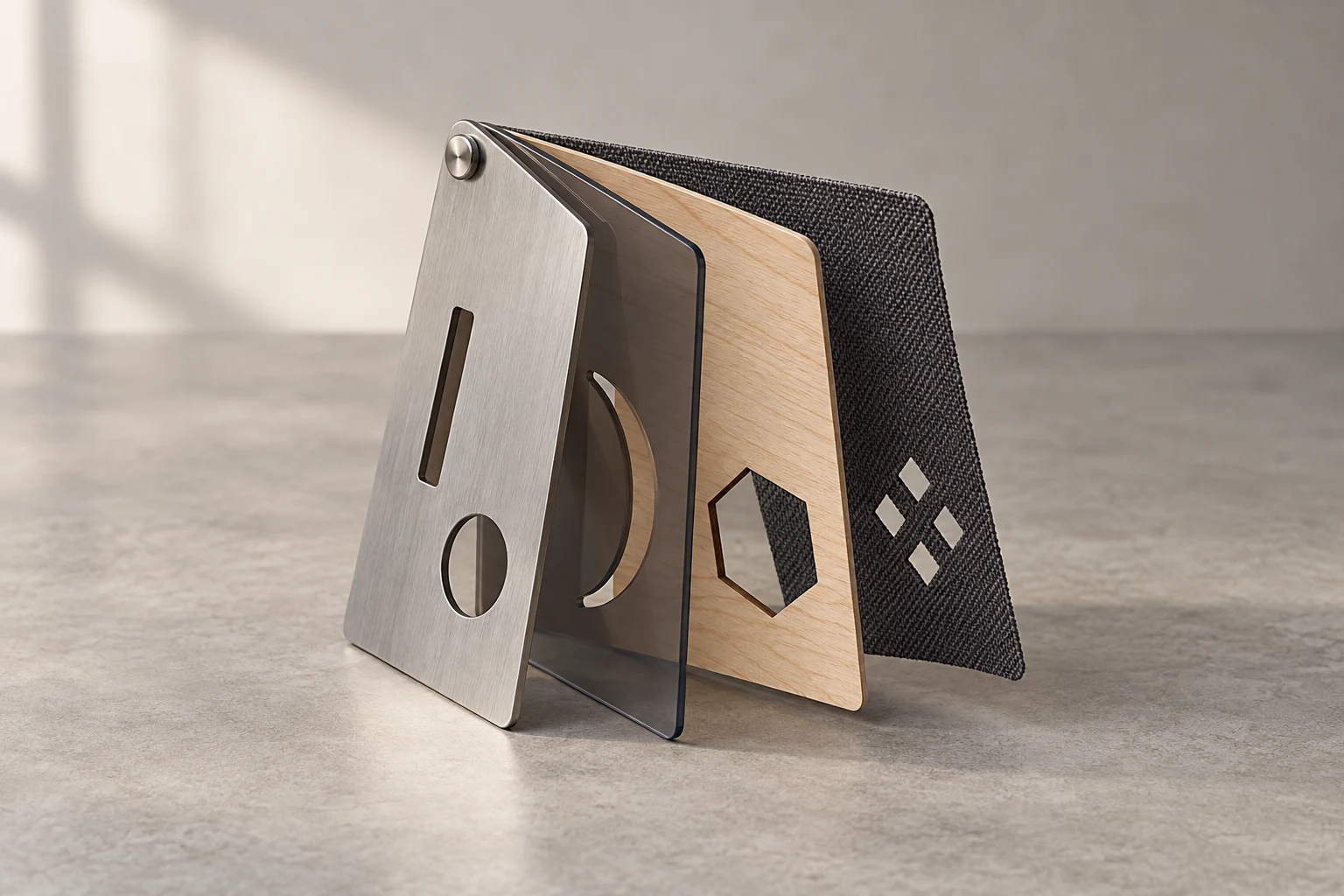
Cover image: AI-generated editorial concept; not a customer project or production proof.
Choose laser cutting services by matching the provider’s equipment to your exact material, thickness and finished-part requirements. Then compare quotes for the same work and agree on a sample or inspection process before production. A machine’s advertised power or speed alone does not establish whether it can deliver your project.
This approach applies to metal components, textile patterns, signage and architectural decoration. For buyers in the US, Canada and UK, clear dimensions, acceptance criteria and delivery details make proposals easier to compare.
Understand what the service includes
Laser cutting uses a focused beam to separate material along a programmed path. Depending on the process, material melts, burns or vaporizes; cutting gas can help remove material from the cut. Cutting speed, material thickness and other settings affect edge quality. See TRUMPF’s laser cutting explanation.
Cutting creates an outline or opening through the material. Engraving produces surface detail. Identify both operations separately when requesting a quote, and ask whether artwork preparation, finishing and assembly are included.
A typical order moves through design review, material and process selection, cutting, any additional finishing, and inspection. Agree on who handles each stage, especially when an artwork supplier and a fabrication shop are separate businesses.
Match the material to the provider
CO₂ systems commonly cut suitable wood, acrylic, paper and textiles. Industrial fiber systems are commonly used for metal cutting. Crystal sources such as YAG and vanadate also exist, but their names do not establish superior results for every job. Ask about the shop’s demonstrated capability with your material and thickness. Trotec’s laser cutter overview explains these source families.
Use the following questions to define the work before requesting comparable proposals.
Project type | What to specify and review |
|---|---|
Manufacturing and automotive components | Exact metal grade, thickness, critical dimensions, mating features and required finishing. Request inspection of the features that control fit. |
Acrylic signage and retail displays | Acrylic specification, color, thickness, visible edges, engraving and mounting details. Review a sample under the intended lighting. |
Wood models and decorative panels | Wood or board specification, thickness, grain direction where relevant, visible faces and acceptable edge appearance. |
Fashion, textiles and appliqué | Fiber composition, coatings, backing, pattern dimensions and edge requirements. Test the actual construction before a production run. |
Architectural screens and interior features | Overall size, panel joints, attachment details, finish and intended use. Identify who is responsible for the complete design and installation. |
For textiles, appearance and behavior vary with composition. Trotec describes different responses from natural and synthetic fibers, including melting in some thin synthetic materials during engraving. Review edge feel, discoloration and the smallest pattern details on a sample. See Trotec’s textile processing guidance.
Do not assume every plastic, leather or composite is suitable. Trotec identifies PVC, certain resins and leather containing chromium VI among materials unsuitable for laser processing. Provide the material specification, including coatings and additives, for the shop to assess. Trotec’s unsuitable-materials guidance explains the concern.
Define precision through acceptance criteria
Replace “high precision” in your brief with the dimensions and visible qualities that matter. A decorative panel may need consistent openings and an acceptable finish; a mating component may need specific hole positions and clearances.
Kerf is the width of material removed by the cut. Confirm who accounts for it, particularly for tabs, slots and fitted assemblies. Ask the supplier to state achievable tolerances for the selected material and thickness, rather than transferring a tolerance from an unrelated project.
Edges are not automatically ready for use. TRUMPF notes that unsuitable cutting speeds can increase roughness and burr formation. Ask whether deburring, cleaning or another finishing step is needed and included. TRUMPF’s process guidance connects these results to cutting conditions.
For repeated parts, agree on what will be inspected and how results will be recorded. Repeatable machine motion does not replace checking finished work against the agreed requirements.
Prepare a concise project brief
Send enough information for the fabricator to assess both feasibility and scope:
Intended use and the features that matter most.
Exact material, thickness and any coating or backing.
Finished dimensions with inches or millimeters explicitly identified.
Quantity per design and a clear file revision name.
Separate identification of cutting, engraving and finishing requirements.
Critical dimensions, acceptable appearance and sample requirements.
Delivery country, postal or ZIP code and required arrival date.
Ask which file formats and drawing conventions the shop accepts. Supply clean geometry at the intended scale and resolve duplicate paths, open contours and text handling according to its requirements. Confirm kerf compensation before adding offsets yourself. SendCutSend’s sheet cutting guidelines provide a practical example of supplier-specific file and geometry requirements; use your chosen shop’s rules for your order.
If an image needs rebuilding into vector artwork, DigitEMB’s raster-to-vector service is relevant to that preparation stage. Share the fabricator’s specifications with the artwork provider and have the fabricator review the resulting file before cutting. Vector conversion alone does not establish material suitability or finished-part performance.
Compare the complete quote
Ask each provider to quote the same material, design revision, quantity and finish. Separate artwork preparation, material supply, cutting, engraving, secondary operations, inspection, packing and transport so omissions are visible.
For US, Canadian and UK orders, confirm the quote currency and which shipping charges, taxes or import charges are included. Distinguish production time from transit time, and ask when the production schedule starts: receipt of files, material availability or approval of a sample.
Ask how revisions and rejected samples affect cost and timing. Avoid choosing solely on the lowest cutting charge when another proposal includes preparation or finishing you still need.
Review a sample before committing to the run
Use the intended material and final file revision for a meaningful sample. Check dimensions, fit, visible edges, engraving and finish. For textiles, also assess flexibility and edge feel; for displays, review the assembled appearance and mounting arrangement.
Record the approved sample and any agreed changes. If a revision changes material, thickness, geometry or finish, ask whether another sample is needed. A screen rendering can confirm layout, but it cannot demonstrate the physical edge or assembly fit.
Assess waste and automation with evidence
Ask how the shop arranges parts on stock, whether usable offcuts can be retained, and what happens to scrap. If environmental performance affects your decision, request evidence about the proposed material and production route. A laser-cut product is not automatically environmentally preferable.
When a supplier promotes automation, ask what it changes for your order: file review, loading, inspection or scheduling. Evaluate the resulting quote and sample against the same requirements you would use for any provider.
Frequently asked questions
Can one laser cutting shop handle every material?
No. Equipment and accepted materials vary. Confirm the exact material, thickness and operation; the ability to engrave a surface does not establish the ability to cut through it.
Does laser cutting always produce smooth, finished edges?
No. Material and process settings affect the result. Specify the required edge condition and confirm whether finishing is included.
Can I start with a JPG or PNG?
You can supply it as an artwork reference, but cutting may require prepared vector or CAD geometry. Ask who will create and approve that geometry before production.
How should I choose between two similar quotes?
Compare the complete scope, material specification, acceptance criteria, sample process and delivery arrangements. Resolve any differences before comparing the totals.
Practical details for Choosing Laser Cutting Services: Materials, Quotes and Quality Checks
Vector artwork is built from editable paths rather than a fixed grid of pixels. The clearest result starts with a specific intended use, because a file prepared for print, cutting and embroidery may need different checks.
Work through these points in order and keep the answers with the artwork or production request. A short written brief makes it easier to compare a proof with the intended result, ask a useful follow-up question and avoid relying on assumptions made from a screen image alone.
The aim is not to add unnecessary steps. It is to identify the choices that change the final result before work begins. If a requirement is unknown, flag it for confirmation rather than guessing; that keeps the approval process focused on the design, material and use that apply to this particular project. Save the approved brief with the project files for future reorders or revisions.
Start with the best source
Provide the largest, clearest original you have and include any brand colours, fonts or reference files. A small or blurry image can still be traced, but missing edges and lettering need careful confirmation.
Define the final use
Say whether the artwork is for print, cutting, screen printing, embroidery reference or a digital asset. This tells the artist which details, colour separations and file formats matter most.
Review paths, text and colour
Before using the finished file, check that lettering is correct, shapes are closed where required and colours match the approved artwork. Keep a master editable file as well as the delivery format used by production.
Quick questions to check before you proceed
Is a vector file the same as an embroidery file?
No. A vector is editable artwork; an embroidery file contains stitch instructions. Vector art can be useful source material for digitizing, but it still needs to be digitized for machine embroidery.
Can a blurry logo be converted?
Often, yes, but the result depends on what can be verified. Supply a clearer reference, font name or brand guide whenever possible.
Which details need approval?
Check spelling, line weight, enclosed spaces, colour choices and the shape of any logo elements before the file goes to print or production.