
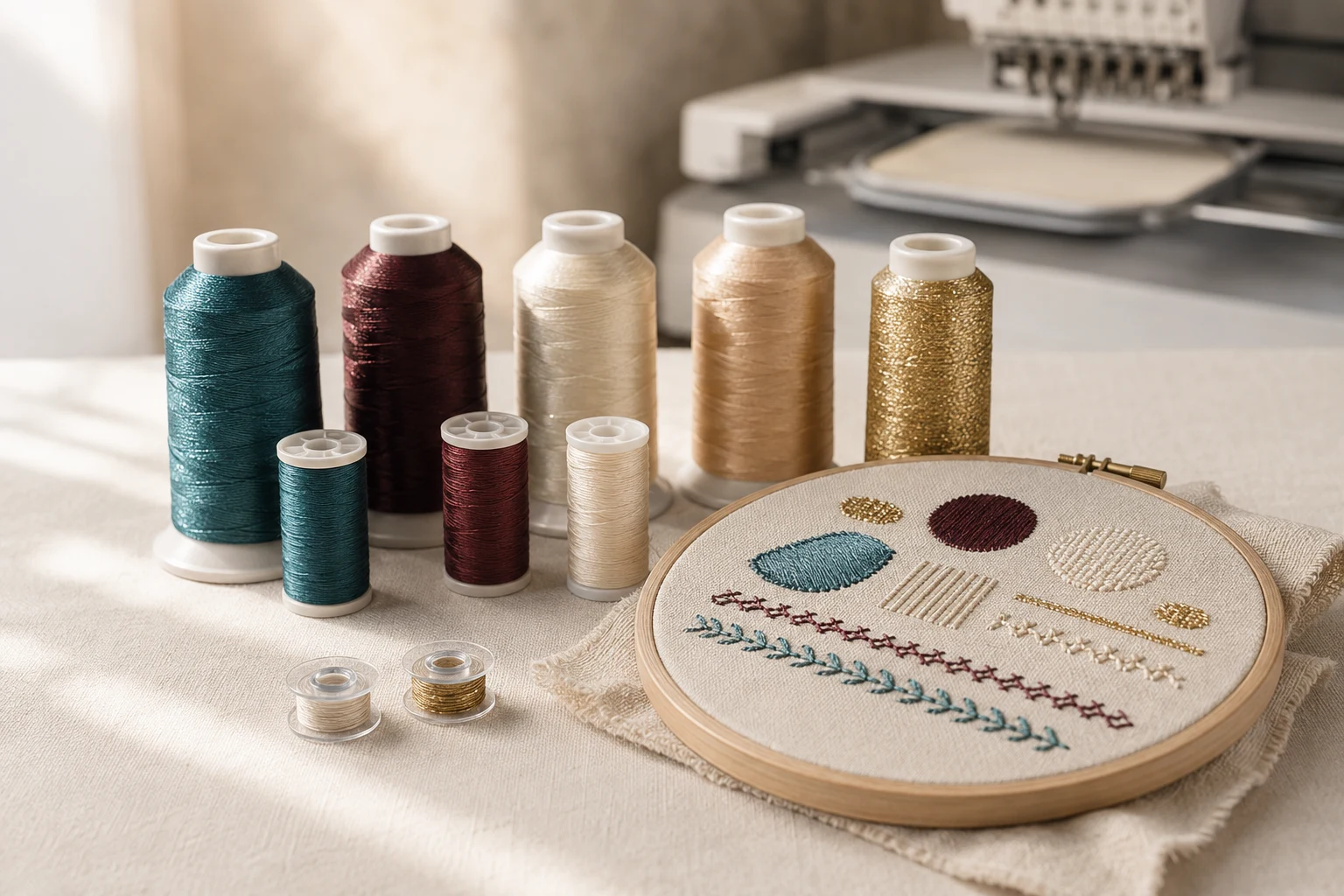
Cover image: AI-generated editorial concept; not a customer project or production proof.
For most everyday machine embroidery, 40-weight polyester is a practical starting point, especially for frequently washed garments. Rayon is another useful general-purpose choice when softness and sheen matter. Cotton, silk and metallic threads offer different decorative effects, while bobbin thread must suit your machine’s requirements. Madeira identifies 40-weight rayon and polyester as general-use options. Madeira rayon guide and polyester guide.
The right choice depends on the finished item, its care routine and the design’s intended thread weight. This guide covers the main options for home embroiderers and buyers ordering embroidered clothing, accessories or home textiles in the US, Canada and UK.
Machine embroidery thread types at a glance
Thread labels describe different things: polyester, rayon, cotton and silk identify fibers; metallic describes an effect and construction; bobbin identifies the thread’s role in the machine.
Thread option | Main reason to consider it |
|---|---|
Polyester | Everyday embroidery and garments needing frequent laundering; check the specific product’s care rating. |
Rayon or viscose | Soft embroidery with a glossy finish, where the care routine suits the thread. |
Cotton | Decorative stitching and a more understated surface appearance. |
Silk | Specialty decorative work where natural luster is part of the design. |
Metallic | Reflective highlights and ornamental details. |
Bobbin thread | The lower thread, selected according to the machine manual. |
Polyester embroidery thread
Polyester is a useful first choice for workwear, team clothing and other regularly washed items. As one documented example, Madeira describes its Polyneon polyester as durable, glossy and resistant to chlorine bleach. That product-specific resistance should not be treated as permission to bleach every polyester thread or embroidered garment. Madeira Polyneon.
Its main advantage is the combination of a bright finish and practical wash performance. The limitation is that the fiber name alone does not establish the finished item’s care limits. Check the thread specification alongside the garment label before choosing washing, drying or pressing conditions.
Polyester also comes in different constructions and finishes. If you want a subdued appearance, ask to see a matte sample instead of assuming all polyester looks the same. Superior, for example, describes its polyester Superior Spirit as having a matte finish. Superior thread guide.
Rayon embroidery thread
Rayon, also called viscose, is valued for its smooth sheen and soft feel. It suits decorative clothing, monograms and home textiles when the intended laundering matches the product’s instructions. Madeira’s Classic Rayon range includes 40 weight for general embroidery, 60 for fine detail and 30 for heavier decorative coverage. Madeira Classic Rayon.
Rayon is not universally non-colorfast. Madeira describes its rayon as suitable for normal detergent laundering without whiteners, brighteners or bleach. Its care restrictions are a reason to check the exact product, rather than dismiss the entire fiber category. Madeira rayon product guidance.
Choose rayon when its appearance and feel suit the project. For garments entering a demanding laundry routine, compare the documented care performance of the available threads before deciding.
Cotton embroidery thread
Cotton can give decorative work a less glossy appearance than high-sheen filament threads. It is worth considering for quilt embellishment, appliqué and designs where the stitching should have a quieter finish. Superior’s machine thread overview.
Choose a cotton product explicitly suitable for machine embroidery. Aurifil lists machine embroidery, machine appliqué and machine lace among the uses for its 40-weight cotton. This confirms that cotton is a valid option, but does not make every cotton sewing thread interchangeable. Aurifil Cotton 40wt.
The advantage is a different decorative character; the tradeoff is that you need to confirm the particular thread’s recommended setup. Avoid treating hand-quilting cotton, stranded floss and cotton-wrapped polyester as equivalent to a specified cotton machine-embroidery thread.
Silk embroidery thread
Silk offers natural luster and a smooth finish, but select it by its stated application. Silk products may be intended for hand embellishment, sewing, quilting or machine decorative work. Superior’s silk guide, for example, distinguishes hand-use buttonhole silk from threads intended for decorative stitching by machine. Superior’s silk thread guide.
For machine embroidery, confirm suitability with the thread supplier and test the actual design before committing to the finished fabric. Do not assume that a silk thread marketed for hand embroidery will run through your machine, or that one weight is best for every silk project.
Its main attraction is its finish. The practical limitation is the need to match the exact product, machine and design rather than choosing on fiber alone.
Metallic embroidery thread
Metallic thread adds reflective highlights to ornamental stitching, festive designs and decorative clothing. Constructions vary: Superior’s Glitter, for example, is a flat metallized polyester thread intended for embroidery and decorative stitching. Superior thread guide.
Needle choice deserves particular attention. SCHMETZ explains that its metallic needle has an elongated eye that reduces stress as the thread passes through it. Use a needle system compatible with your machine; a household metallic needle is not automatically suitable for a commercial embroidery machine. SCHMETZ metallic needles.
The benefit is a distinctive reflective finish. The tradeoff is more attention to product-specific needle, tension and feeding recommendations. Run a sample before placing metallic thread throughout a large design, and check its pressing and laundering instructions.
Bobbin thread: follow the machine specification
Bobbin thread does not generally need to match the top thread’s weight. Brother’s guidance for sewing and embroidery combination machines specifies 40–50-weight embroidery thread on top and 60-weight bobbin thread. Its separate guidance lists 90-weight bobbin thread for certain embroidery-only models. These examples show why the exact machine manual matters. Brother combination-machine guidance and embroidery-only guidance.
Before purchasing bobbins, check both the thread specification and physical bobbin compatibility. Matching only the thread weight is insufficient: Brother’s prewound bobbin listings also identify bobbin size and compatible machines. Brother prewound bobbin specifications.
What do 30, 40 and 60 weight mean?
Within the embroidery ranges discussed here, 30 weight is thicker than 40, while 60 is finer. Read those numbers within the manufacturer’s range rather than assuming every brand and labeling system produces an identical diameter.
Weight | Typical purpose in Madeira’s Classic Rayon range |
|---|---|
30 | Heavier decorative stitching and filling larger areas. |
40 | General-purpose machine embroidery. |
60 | Fine detail and small lettering. |
Changing thread thickness may require changes to the needle and digitizing density. A finer thread is therefore a design decision, not simply a spool substitution. Madeira provides different needle and density guidance for its 40- and 60-weight rayon threads. Madeira thread selection and setup guidance.
How to choose thread for your project
Start with use and care. Tell the embroiderer whether the item is everyday clothing, workwear, a decorative textile or an occasional-use accessory. State any required laundry process.
Choose the finish. Compare stitched samples for gloss, texture and how the thread looks against the actual fabric.
Confirm the design’s thread weight. Ask what weight the file was prepared for before substituting a finer, thicker or specialty thread.
Record the exact color. Keep the manufacturer, thread range and color code with the order. Madeira cautions that screen and printed colors may differ from actual thread; use a physical thread card when color matching matters. Madeira color resources.
Approve a representative sample. Request the intended thread, fabric and finished size. If wash performance matters, agree on a sample wash test before a larger run.
For orders across the US, Canada and UK, specify dimensions with units—for example, 3 inches (76.2 mm) wide—and describe the expected care routine clearly. This makes the request easier to interpret without relying on regional assumptions.
When requesting DigitEMB’s embroidery digitizing service, include the finished dimensions, fabric, placement, machine file format and intended thread type and weight. Mention metallic accents or fine-thread details before the file is prepared.
Thread care and storage
Keep spools protected from dust and unsuitable storage conditions. Madeira recommends storing rayon in a cool, dry environment, away from heat and humidity. Routine refrigeration is not part of that guidance. Madeira rayon storage advice.
Keep product labels and care instructions with your supplies. For the finished embroidery, check the garment and every thread used before selecting a care process; a durable main thread does not establish the limits of a metallic accent or delicate fabric.
Frequently asked questions
Is polyester or rayon better for machine embroidery?
Choose according to the project. Polyester with documented wash resistance is practical for regularly laundered items; rayon offers a soft, glossy finish when its care requirements suit the garment. Compare the specific products and stitched samples.
Can I use cotton thread for machine embroidery?
Yes, if the product is intended for it and suits your machine. Aurifil’s 40-weight cotton is one documented example. Follow the product guidance and test your design.
Should top and bobbin thread be the same weight?
Usually, that is not the required combination. Follow your machine manual’s separate top-thread and bobbin-thread specifications.
Will 60-weight thread automatically improve small lettering?
No. Finer thread can help with detail, but the file and needle must suit it. Confirm the intended thread weight with the digitizer and assess a sample at the final size.
Practical details for Machine Embroidery Thread Guide: Types, Weights and How to Choose
Use the article above as a starting point, then make the production brief specific to your own design. A stitch file is made for a finished size and material, so the artwork alone is only part of the instruction.
Work through these points in order and keep the answers with the artwork or production request. A short written brief makes it easier to compare a proof with the intended result, ask a useful follow-up question and avoid relying on assumptions made from a screen image alone.
The aim is not to add unnecessary steps. It is to identify the choices that change the final result before work begins. If a requirement is unknown, flag it for confirmation rather than guessing; that keeps the approval process focused on the design, material and use that apply to this particular project. Save the approved brief with the project files for future reorders or revisions.
Confirm the finished use
State the item, placement and finished width and height. A chest logo, cap front and jacket back do not use the same sewing area, even when they start from the same artwork.
Protect the smallest details
Review small lettering, narrow gaps, thin outlines and tiny colour changes at the final size. Simplifying a fragile detail before digitizing is often more reliable than trying to force it into a small sew-out.
Match the file to the machine
Tell the production team the embroidery machine or format required, along with the fabric or garment type. This lets them prepare the right export and make choices that suit the material rather than treating every job alike.
Quick questions to check before you proceed
What should I send with my artwork?
Send the clearest original available, the finished dimensions, placement, fabric or garment type and the required machine format if you know it.
Can the same file be used at every size?
Not always. Scaling changes the relationship between stitch length, detail and fabric, so a design may need review when the finished size or placement changes.
What should I check before production?
Confirm the spelling, colours, final size, placement and any details that must remain readable. A proof or sample is the best point to catch a change.