
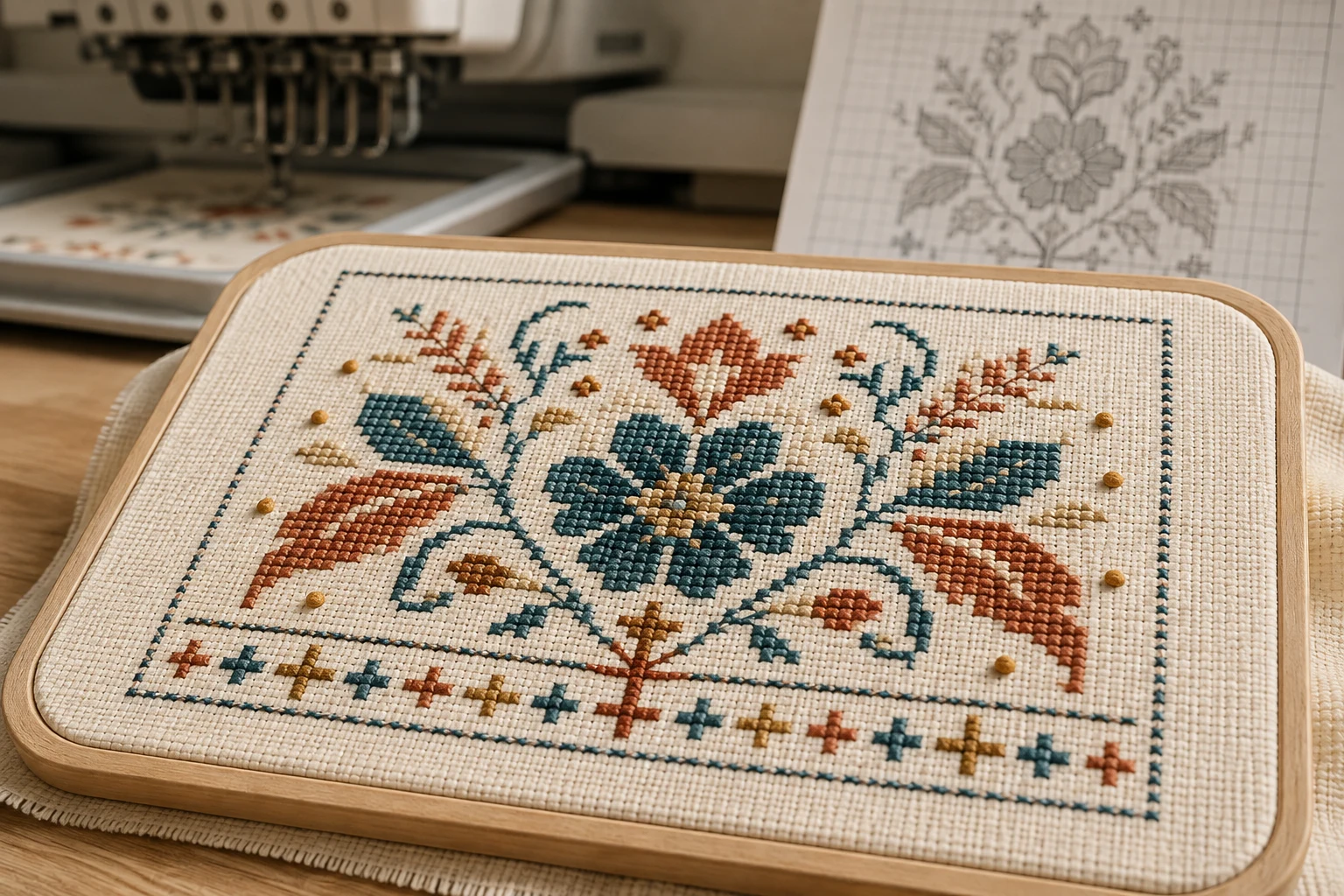
Cover image: AI-generated editorial concept; not a customer project or production proof.
The main cross stitch types are full, half, quarter and three-quarter stitches. Decorative variations include mini, upright, double and elongated crosses. Together, they provide different ways to build filled areas, shape edges and add detail in embroidery. French knots and single-line outlines are companion stitches rather than X-shaped crosses. Wilcom’s cross stitch reference illustrates these forms.
Cross stitch types at a glance
Think of each stitch as occupying all or part of a square on a design grid.
Stitch type | Shape and typical use |
|---|---|
Full cross | Two crossing diagonals form an X; useful for main design areas. |
Half cross | One diagonal across a square; useful for lighter shading. |
Quarter cross | A diagonal from a corner to the center; adds partial-square detail. |
Three-quarter cross | A half cross plus a quarter stitch; helps shape curved edges. |
Mini cross | A complete small X within one-quarter of a square; adds fine detail. |
Upright cross | A horizontal and vertical stitch form a plus sign. |
Double cross | An X and an upright cross overlap to make a star-like motif. |
Elongated cross | A narrow or flattened X; adds rectangular detail. |
In Wilcom’s grid terminology, horizontal elongated crosses occupy half a square’s height; vertical ones occupy half its width. French-knot effects add raised dots, such as flower centers. These definitions follow the Wilcom Cross Stitch Supplement.
Cross stitch fills
A cross stitch fill repeats a selected stitch type inside a shape. In Wilcom ES Cross Stitch, the digitizer defines the boundary, chooses the thread color and stitch type, and sets the orientation where required. Fractional stitches can face different corners, changing the resulting pattern. See Wilcom’s fill instructions.
For a floral motif, consider full crosses for the main petals, half crosses for a lighter background and fractional stitches around the edges. Treat this as a design starting point: judge the balance of thread and visible fabric in a sample at the intended size.
Grid size and stitch density
Cross size and repeated stitching are separate decisions. A finer grid creates smaller crosses, while repeated passes place more thread along their paths. Closely packed cross stitches can pull the fabric and produce visible gaps. Wilcom’s density control offers single, double and triple stitching; its “Threads” values describe those repetitions. See Wilcom’s density guidance.
Ask for a test sew-out before committing to production, especially where small crosses or multiple layers meet. Review whether individual crosses remain recognizable and whether the fabric lies flat.
Cross stitch borders and outlines
A border can follow a motif’s edge or frame the whole design. Choose its appearance alongside the fill so it does not overwhelm small details.
Border option | When to consider it |
|---|---|
Single-line outline | When you want a fine contour or a small detail to remain clear. |
Row of full crosses | When you want a visibly stitched, decorative frame. |
Combined outline and crosses | When selected edges need extra emphasis; review the result at finished size. |
Software may handle these elements differently. In Wilcom ES Cross Stitch, cross-stitched borders belong to the fill category, while single-line borders have separate erasing behavior. A border that looks continuous on screen is therefore not necessarily one removable object. Check the relevant tool before editing. Wilcom’s border-editing instructions explain this distinction.
Variations in direction and color
Combining stitches within a square expands the available detail. Two differently colored half crosses can form a two-color X. Quarter and three-quarter stitches can share a square, while mini crosses, elongated crosses and outlines offer additional combinations. Wilcom’s combination-stitch documentation shows how these elements work together.
Use these variations selectively. For example, reserve a contrasting fractional stitch for the boundary between a leaf and a petal, instead of adding extra colors throughout the design.
For hand stitching, keep the top diagonal of ordinary full crosses consistent unless the pattern deliberately calls for a different effect. This helps the surface look even. Crosstitch.com’s stitching instructions describe both completing each X individually and working rows of diagonals before crossing them on the return pass.
What to specify for machine embroidery
When requesting cross stitch digitizing, describe the visual result as well as the artwork. Buyers in the US, Canada and UK can use the same practical brief:
Finished size: Give width and height with explicit units, ideally both inches and millimeters.
Application: Identify the garment or textile, fabric and placement.
Appearance: Specify visible crosses, lighter shading, decorative borders and any fine details that matter.
Equipment: Provide the embroidery machine model, required file format and available hoop area.
Sample review: Agree how the stitched result will be checked before the production run.
You can use DigitEMB’s embroidery digitizing service page to discuss the project. Ask specifically whether the proposed cross stitch treatment suits your artwork and intended dimensions.
Frequently asked questions
Is a quarter stitch the same as a mini cross?
No. A quarter stitch is one short diagonal arm. A mini cross is a complete small X. Their different placement options are illustrated in Wilcom’s fill guide.
Does double cross mean stitching the same X twice?
No. Double cross describes the star-like shape made by overlapping diagonal and upright crosses. Repeating a stitch is a density choice, covered separately in Wilcom’s density settings.
Which stitch should I choose first?
Start by reviewing a full-cross sample at your intended size. Then consider half stitches where you want lighter coverage, fractional stitches around detailed edges and decorative crosses where the motif needs texture. Choose the combination by its stitched appearance, rather than by how many stitch types it includes.
Practical details for Types of Cross Stitch: Fills, Borders and Embroidery Digitizing
Use the article above as a starting point, then make the production brief specific to your own design. A stitch file is made for a finished size and material, so the artwork alone is only part of the instruction.
Work through these points in order and keep the answers with the artwork or production request. A short written brief makes it easier to compare a proof with the intended result, ask a useful follow-up question and avoid relying on assumptions made from a screen image alone.
The aim is not to add unnecessary steps. It is to identify the choices that change the final result before work begins. If a requirement is unknown, flag it for confirmation rather than guessing; that keeps the approval process focused on the design, material and use that apply to this particular project. Save the approved brief with the project files for future reorders or revisions.
Confirm the finished use
State the item, placement and finished width and height. A chest logo, cap front and jacket back do not use the same sewing area, even when they start from the same artwork.
Protect the smallest details
Review small lettering, narrow gaps, thin outlines and tiny colour changes at the final size. Simplifying a fragile detail before digitizing is often more reliable than trying to force it into a small sew-out.
Match the file to the machine
Tell the production team the embroidery machine or format required, along with the fabric or garment type. This lets them prepare the right export and make choices that suit the material rather than treating every job alike.
Quick questions to check before you proceed
What should I send with my artwork?
Send the clearest original available, the finished dimensions, placement, fabric or garment type and the required machine format if you know it.
Can the same file be used at every size?
Not always. Scaling changes the relationship between stitch length, detail and fabric, so a design may need review when the finished size or placement changes.
What should I check before production?
Confirm the spelling, colours, final size, placement and any details that must remain readable. A proof or sample is the best point to catch a change.