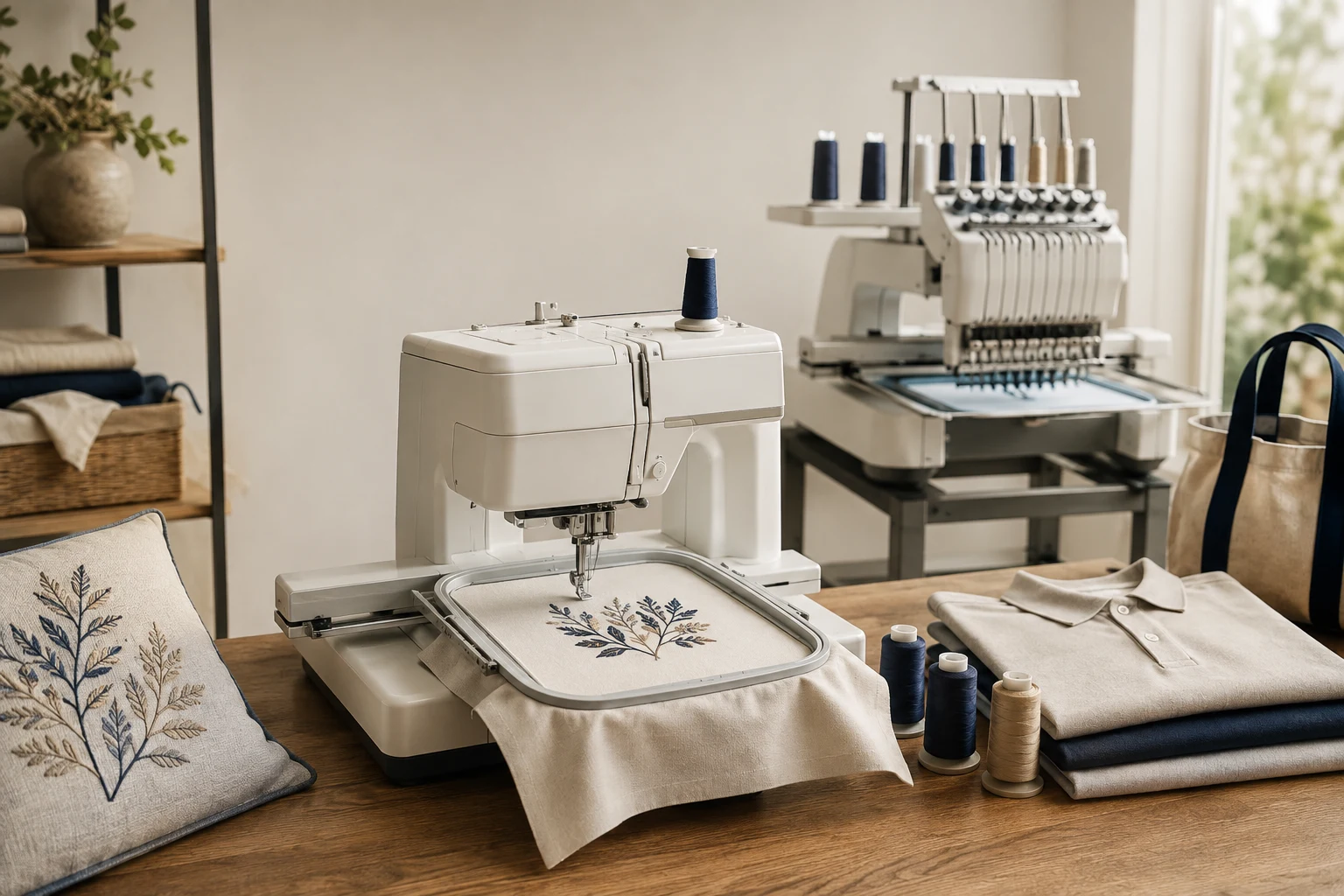
Cover image: AI-generated editorial concept; not a customer project or production proof.
The best embroidery machine for a home business is one that fits your products, design sizes and workload, with service available nearby. A single-needle machine can suit small batches of personalized items; a multi-needle model deserves consideration when repeated color changes take too much operator time. Choose the embroidery field first, then compare the complete workflow and ownership cost.
The five models below illustrate different buying needs. These are specification-based comparisons, not hands-on rankings. Some are discontinued models that buyers may encounter used or as remaining dealer stock.
Five machines and where they fit
Machine | Potential fit and main limitation |
|---|---|
Brother PE535 | Small designs within a 4 × 4-inch field; discontinued on Brother’s US site. |
Brother SE1900 | Sewing plus embroidery within a 5 × 7-inch field; discontinued on Brother’s US site. |
Janome Memory Craft 500E | Larger flat projects within a 200 × 280 mm field; discontinued on Janome’s US site. |
bernette b79 | Sewing and embroidery with a 260 × 160 mm field; one machine must share both tasks. |
Brother PR680W | Six-needle embroidery for repeated multicolor work; requires more space and a suitable equipment budget. |
The model sections below link to the supporting manufacturer specifications. Availability, accessory bundles and warranty terms should be checked in the country where you will use the machine.
Brother PE535: small designs and an existing-machine starting point
Brother lists a maximum embroidery area of 4 × 4 inches, 80 built-in designs and nine fonts. It is an embroidery-only model, and Brother’s US product listing marks it discontinued. Brother PE535 specifications.
Its practical role is limited-size personalization: small motifs, initials and designs that fit comfortably within the field. If you already own one, use your actual product samples to decide whether it can handle your first orders.
Before buying a used unit, test a design, inspect the hoop and embroidery carriage, and confirm that replacement accessories and servicing remain available. A low purchase cost is less useful if your intended designs exceed its field.
Brother SE1900: sewing and embroidery in one machine
The SE1900 combines sewing and embroidery, with a maximum 5 × 7-inch embroidery field, 138 built-in embroidery designs and 240 sewing stitches. Brother’s US page marks this model discontinued. Brother SE1900 specifications.
Consider this type of combination machine if you plan to construct items such as bags or cushion covers and then personalize them. Its larger field offers more design space than the PE535.
The workflow tradeoff is scheduling: you cannot sew another item on the same machine while it embroiders. For a used purchase, ask to see both functions demonstrated and check that the embroidery unit, compatible hoop and required feet are included.
Janome Memory Craft 500E: larger flat embroidery projects
The Memory Craft 500E is an embroidery-only machine with a maximum field of 200 × 280 mm, approximately 7.9 × 11 inches. Janome lists four included hoops, USB design import, 160 built-in designs and six monogramming fonts. Its US product page states that the model is discontinued. Janome Memory Craft 500E specifications.
Its larger field makes it worth assessing for flat bag panels, home textiles and larger motifs. It is a single-needle model; do not confuse the Memory Craft name with a multi-needle production machine.
Check the exact model and included hoop sizes when comparing listings. Allow working space for the embroidery carriage and fabric, and confirm local service support before committing to discontinued equipment.
bernette b79: a larger field with sewing capability
The b79 combines sewing and embroidery. Its maximum embroidery area is 260 × 160 mm, approximately 10.2 × 6.3 inches. The manufacturer lists three included hoops, a five-inch color touchscreen, 208 embroidery designs and 500 sewing stitches. bernette b79 specifications.
This makes it a candidate for a business that needs both product construction and personalization. Compare the shape of the embroidery field with your artwork: a long design and a wide design may create different fit problems even when their overall areas seem similar.
As with the SE1900, plan for switching between sewing and embroidery. During a demonstration, practice changing modes, loading a design and restarting after an interruption.
Brother PR680W: six needles for repeated multicolor work
The PR680W has six needles and a maximum embroidery area of 8 × 12 inches, approximately 203 × 305 mm. Brother lists USB and wireless connectivity, along with cap-frame capability. Brother PR680W specifications.
Multiple needles let you keep several thread colors loaded, reducing manual rethreading within that set of colors. This is worth evaluating when repeat orders make color changes a significant part of your working day. Six needles do not mean six garments stitch simultaneously.
Before buying, obtain a demonstration using your garment and artwork. For caps, confirm the exact compatible frame and driver, whether they are included, and the usable embroidery area for that setup. Include the stand, training and servicing arrangements in your comparison.
Why the JUKI HZL-F600 is not on this embroidery shortlist
JUKI describes the HZL-F600 as a computerized sewing and quilting machine. It offers decorative stitches and free-hand embroidery with the feed dogs lowered, but it is not a hoop-driven machine for automatically stitching imported embroidery designs. It may serve a product-construction role alongside an embroidery machine. JUKI HZL-F600 product information.
What to check before buying
Match the embroidery field to products you can sell
Write down the finished width and height of several designs you expect to offer. Compare those measurements with the machine’s maximum embroidery field and the compatible hoop you will actually use.
Do not assume that buying a physically larger hoop increases the machine’s stitchable area. Ask the dealer to load your largest intended design and demonstrate its placement. Also check whether seams, pockets or the shape of a finished garment prevent practical hooping.
Compare operator time, not just stitching speed
Time an entire sample: preparation, hooping, loading, stitching, thread changes, trimming and inspection. Maximum stitches per minute does not tell you how many finished items you can complete in an afternoon.
A multi-needle machine may reduce rethreading, but it still requires setup and supervision. A single-needle machine may be sufficient when orders are small and designs use few colors. Let timed samples guide the decision.
Allow room for equipment and handling
Measure the machine with its embroidery unit attached and allow clearance throughout the carriage’s movement. Include space for fabric support, hooping, thread storage and maintenance access.
If you need portability for classes or events, check the assembled weight and the manufacturer’s transport instructions. For a permanent home setup, assess the table or stand, vibration and operating noise during a demonstration.
Check file transfer and design preparation
Ask the seller to demonstrate importing a compatible embroidery file through the machine’s supported transfer method. Confirm the required format, design dimensions and any software requirements before purchasing.
For custom artwork, DigitEMB’s embroidery digitizing service is a relevant option for preparing a stitch file. Supply the machine model, available hoop, finished design size, fabric and placement. Test the resulting file on matching material before using saleable blanks.
Build a complete budget
Compare written equipment quotes alongside the recurring costs of making your products.
Cost area | What to include |
|---|---|
Equipment | Machine, embroidery unit, required hoops, stand and product-specific attachments. |
Supplies | Thread, bobbins, needles, stabilizer and test blanks. |
Design preparation | Digitizing, revisions and any software you need. |
Support | Training, routine servicing, repairs and transport to a service center. |
Production time | Hooping, color changes, finishing, inspection and unsuccessful samples. |
Avoid choosing a machine on built-in design counts alone. Bring examples of the custom work you intend to produce and check that the complete setup handles them.
Buying in the US, Canada or UK
The product links above establish model features; they do not establish local stock or identical regional bundles. Buyers in each country should request a written quote for the exact locally supplied model.
Confirm the electrical rating on the actual unit, local support, included accessories and the warranty terms that apply to business use. For imported or secondhand equipment, ask whether the local service center accepts that model and whether any warranty transfers.
For discontinued machines, prioritize condition and support over the original feature list. Ask for a sew-out, service history and an itemized accessory list. Missing hoops or an embroidery unit can materially change the value of the purchase.
A useful dealer demonstration
Bring a small lettering design, a multicolor design and the largest design you expect to sell, plus representative fabric or garments. Ask to perform the following steps yourself:
Import the file and confirm that it fits the selected hoop.
Hoop the item and check the design position.
Stitch the sample, including its color changes.
Practice recovering from a stopped run using the machine’s instructions.
Inspect the finished sample and record total working time.
Choose the setup that handles these tasks comfortably, fits your space and has accessible support. Features become useful when they solve a problem in your own production process.
Frequently asked questions
Can I start with a single-needle embroidery machine?
Yes, if your products fit its embroidery field and timed samples show that you can handle the workload. Consider moving to multiple needles when repeated rethreading becomes a meaningful constraint.
Is a sewing and embroidery combination machine better?
It can suit a business that also constructs products. If sewing and embroidery regularly need to happen at the same time, separate machines may make scheduling easier.
Should I buy a discontinued model?
Only after checking condition, accessories and service availability. The PE535, SE1900 and Memory Craft 500E are marked discontinued on the linked US manufacturer pages; remaining stock and used-machine condition require individual checks.
Can any embroidery machine handle finished caps?
Do not assume so. Require a demonstration with the exact machine, compatible cap attachment and cap style you intend to use. The PR680W lists cap-frame capability, but you should confirm the complete attachment package and its working limits with the dealer.
Practical details for 5 Embroidery Machines to Compare for a Home Business
Use the article above as a starting point, then make the production brief specific to your own design. A stitch file is made for a finished size and material, so the artwork alone is only part of the instruction.
Work through these points in order and keep the answers with the artwork or production request. A short written brief makes it easier to compare a proof with the intended result, ask a useful follow-up question and avoid relying on assumptions made from a screen image alone.
The aim is not to add unnecessary steps. It is to identify the choices that change the final result before work begins. If a requirement is unknown, flag it for confirmation rather than guessing; that keeps the approval process focused on the design, material and use that apply to this particular project. Save the approved brief with the project files for future reorders or revisions.
Confirm the finished use
State the item, placement and finished width and height. A chest logo, cap front and jacket back do not use the same sewing area, even when they start from the same artwork.
Protect the smallest details
Review small lettering, narrow gaps, thin outlines and tiny colour changes at the final size. Simplifying a fragile detail before digitizing is often more reliable than trying to force it into a small sew-out.
Match the file to the machine
Tell the production team the embroidery machine or format required, along with the fabric or garment type. This lets them prepare the right export and make choices that suit the material rather than treating every job alike.
Quick questions to check before you proceed
What should I send with my artwork?
Send the clearest original available, the finished dimensions, placement, fabric or garment type and the required machine format if you know it.
Can the same file be used at every size?
Not always. Scaling changes the relationship between stitch length, detail and fabric, so a design may need review when the finished size or placement changes.
What should I check before production?
Confirm the spelling, colours, final size, placement and any details that must remain readable. A proof or sample is the best point to catch a change.