
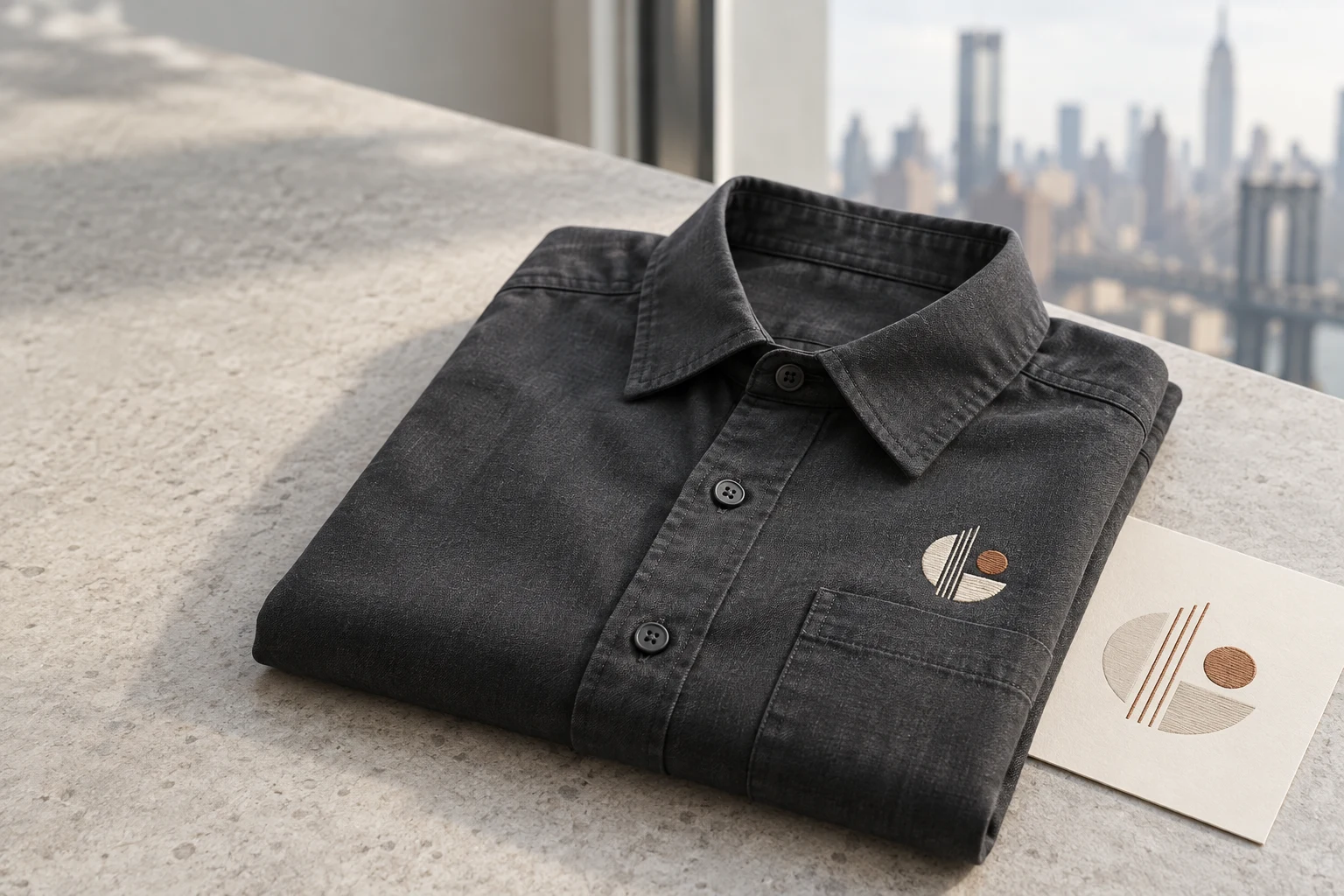
Cover image: AI-generated editorial concept; not a customer project or production proof.
For New York buyers, choosing an embroidery digitizing and vector art service starts with the intended products. Look for a provider that can explain the required files, show relevant work and agree on sampling, revisions and delivery dates. Approve the artwork and a physical embroidery sample before committing to a production run.
A coordinated brief helps whether you are planning staff uniforms, fashion pieces, team apparel or promotional merchandise. A logo used on a shirt, a printed bag and an event display needs consistent design decisions, with separate preparation for each production method.
Decide which services your project needs
Embroidery digitizing prepares artwork as machine stitch instructions for an agreed size and application. DigitEMB’s embroidery digitizing services include applications such as logos, caps and jacket designs. Establish whether your order covers digital files, finished garments or both.
Vector art uses mathematical points, curves and shapes. Those shapes can be enlarged without the pixelation associated with enlarging raster artwork, making a vector master useful for business cards, packaging and larger signs. Adobe’s explanation of vector art describes this distinction.
Project requirement | What to request |
|---|---|
An embroidered uniform logo | A stitch file prepared for the garment, placement and finished dimensions |
Scalable artwork for printed materials | Vector artwork in the printer’s requested format |
Coordinated apparel and print | Separate embroidery and vector deliverables based on one approved design |
Finished hats, shirts or bags | A garment decoration quote that identifies artwork preparation, sampling and production |
DigitEMB’s raster-to-vector services provide a starting point for discussing artwork reconstruction and vector deliverables. Ask which files your printer needs before ordering.
A vector master is artwork rather than a completed embroidery program. Have the digitizer assess how it should be translated into stitches, and identify both deliverables in the quote when you need both services.
Choose a local or remote arrangement for your New York project
Start with what you need to handle in person. If garment selection, placement review or collection matters, ask a nearby decorator whether it offers appointments and physical samples. Confirm the actual location and available services before traveling; accepting New York orders does not establish a local production shop.
If you already have an embroiderer, a remote digitizer can supply the digital part of the project. Establish who will stitch the sample, who will send feedback and who will approve changes. Ask whether you will receive the files for future use with another decorator.
For a project split between a New York buyer and a New Jersey decorator, give both parties the same garment details and artwork version. Identify the production and collection locations explicitly. Apply the same approach when coordinating work elsewhere in New York State: the buyer’s address, digitizer’s location and garment destination may be different.
For US, Canadian or UK production partners, label dimensions in inches or millimeters and specify quote currency. Write approval deadlines with a date and time zone, using New York local time where appropriate. Agree separately on digital file delivery and any garment shipping schedule.
Evaluate embroidery quality through relevant evidence
Review samples at a comparable size
Ask for photographs of actual embroidery similar to your proposed work. A large decorative jacket design does not demonstrate how a small uniform logo will look. Request the sample’s dimensions and fabric, then examine lettering, outlines and boundaries between colors.
Use the portfolio discussion to assess the provider’s judgment. Ask which details in your artwork need review at the intended size and request approval of any simplification before digitizing begins. Software names and years in business are less useful to this decision than clear answers about your own design.
Discuss the fabric and application
Stitches can draw fabric inward. Stitch spacing, underlay and pull compensation must work together for the fabric and design; unsuitable settings can contribute to gaps or puckering. Hatch’s fabric guidance explains these relationships.
Supply the garment style, material, color and placement. If an order includes polos, caps and jackets, list them as separate applications for review. Ask whether the proposed sizes and materials require different versions rather than assuming one file covers the full order.
Arrange a physical sew-out
Agree on a test using the intended garment or a representative material. Record who performs it and whether sampling carries a separate charge. Check the result against the approved artwork and finished dimensions, then send clear photographs and specific observations if corrections are needed.
A screen preview cannot establish the final stitched result. Fabric, hooping, stabilizer and other production choices affect the outcome, and a test can reveal areas requiring adjustment. Hatch’s pull compensation guidance recommends test stitch-outs to identify refinements.
If a provider advertises a quality guarantee, ask what it covers: file corrections, sample review, revision limits and the process for resolving a problem. Assess the written scope alongside the sample.
Confirm file compatibility and future reuse
Have the embroiderer specify the machine format and usable embroidery field before work starts. DST and PES are examples of machine formats; an editable working file is a separate consideration. Hatch identifies EMB as its working format and explains that exported machine files retain less information, with some unable to retain colors. See its file format documentation.
Ask for a delivery list covering the agreed machine files, dimensions, color sequence and preview. Confirm whether an editable source file is included and what later changes will cost. Record each approved version by garment and size so the decorator can identify the correct file for a reorder.
Keep embroidery and vector artwork consistent
For a New York event or merchandise launch, nominate one person to approve the core artwork across suppliers. Give the digitizer and printer the same spelling, proportions and color references. If an embroidery adaptation changes small details, retain that as a clearly identified version alongside the print master.
Review vector delivery separately from the sew-out. Check the curves, spacing, spelling and agreed colors against the original. Ask the printer to confirm that the supplied file meets its requirements for the intended printed item.
For example, a hypothetical apparel launch might include an embroidered chest emblem and a larger printed display. Approve the chest emblem at its actual stitched size and the display through the printer’s proof process. Keeping both tied to the same approved artwork helps prevent different suppliers from rebuilding the design independently.
Compare quotes, revisions and schedules
Send each provider the same scope. A lower total is difficult to assess if one proposal includes artwork reconstruction and sampling while another covers only a single digital file.
Quote detail | What to clarify |
|---|---|
Artwork preparation | Whether cleanup, redrawing or vector conversion is included |
Design versions | Which sizes, garments and placements are covered |
Deliverables | Machine formats, vector formats, previews and editable source files |
Revisions | Included corrections, revision limits and charges for a changed brief |
Sampling | Who stitches the sample and how feedback reaches the digitizer |
Schedule | Dates for artwork review, first files, sampling and corrections |
Finished goods | Separate garment, decoration and delivery charges, where applicable |
Work backward from the date the finished goods must be available. Leave room for artwork approval, a sew-out, corrections and garment production. Ask for availability for your actual order instead of relying on a general turnaround statement.
Use the quote exchange to evaluate communication. Useful responses should address your supplied artwork, garment and deadline directly. Keep the agreed scope and approval record available to everyone involved in production.
Prepare your project brief
Include these details with your request:
The best original artwork available and the approved spelling.
Intended products, garment materials, colors and decoration placements.
Finished width and height, with units stated.
Machine format and field limits supplied by the embroiderer.
Print applications and file requirements supplied by the printer.
Color references and any requested specialty embroidery treatment.
Required file versions, sampling arrangements and approval contact.
Digital file deadline and, if applicable, finished goods destination and required date.
If something is undecided, identify it explicitly. A provider can then explain what must be resolved before giving a firm scope. Use DigitEMB’s digitizing service page and vector service page to select the relevant service, then submit the artwork with your project requirements.
Frequently asked questions
Does the digitizer need to be based in New York?
No. Choose the arrangement that supports your review and production needs. For remote digitizing, agree on who performs the sew-out and how corrections will be communicated. Confirm appointments and collection facilities when local access matters.
Should I order vector conversion before digitizing?
Have the provider assess the original artwork first. Request a vector master when you need scalable artwork for other uses, and specify the embroidery stitch file separately. Do not assume both services are included in one quote.
Can I reuse the same design on uniforms and merchandise?
You can share the approved artwork across the project. Have each size, garment and production method reviewed before reusing a production file, and retain the approved versions for future orders.
What demonstrates quality before a large order?
Relevant stitched samples, clear technical answers and a satisfactory sew-out provide practical evidence. Combine them with an agreed file list, revision policy and production schedule before approving the order.
Practical details for Embroidery Digitizing and Vector Art in New York: A Buyer’s Guide
Use the article above as a starting point, then make the production brief specific to your own design. A stitch file is made for a finished size and material, so the artwork alone is only part of the instruction.
Work through these points in order and keep the answers with the artwork or production request. A short written brief makes it easier to compare a proof with the intended result, ask a useful follow-up question and avoid relying on assumptions made from a screen image alone.
The aim is not to add unnecessary steps. It is to identify the choices that change the final result before work begins. If a requirement is unknown, flag it for confirmation rather than guessing; that keeps the approval process focused on the design, material and use that apply to this particular project. Save the approved brief with the project files for future reorders or revisions.
Confirm the finished use
State the item, placement and finished width and height. A chest logo, cap front and jacket back do not use the same sewing area, even when they start from the same artwork.
Protect the smallest details
Review small lettering, narrow gaps, thin outlines and tiny colour changes at the final size. Simplifying a fragile detail before digitizing is often more reliable than trying to force it into a small sew-out.
Match the file to the machine
Tell the production team the embroidery machine or format required, along with the fabric or garment type. This lets them prepare the right export and make choices that suit the material rather than treating every job alike.
Quick questions to check before you proceed
What should I send with my artwork?
Send the clearest original available, the finished dimensions, placement, fabric or garment type and the required machine format if you know it.
Can the same file be used at every size?
Not always. Scaling changes the relationship between stitch length, detail and fabric, so a design may need review when the finished size or placement changes.
What should I check before production?
Confirm the spelling, colours, final size, placement and any details that must remain readable. A proof or sample is the best point to catch a change.