
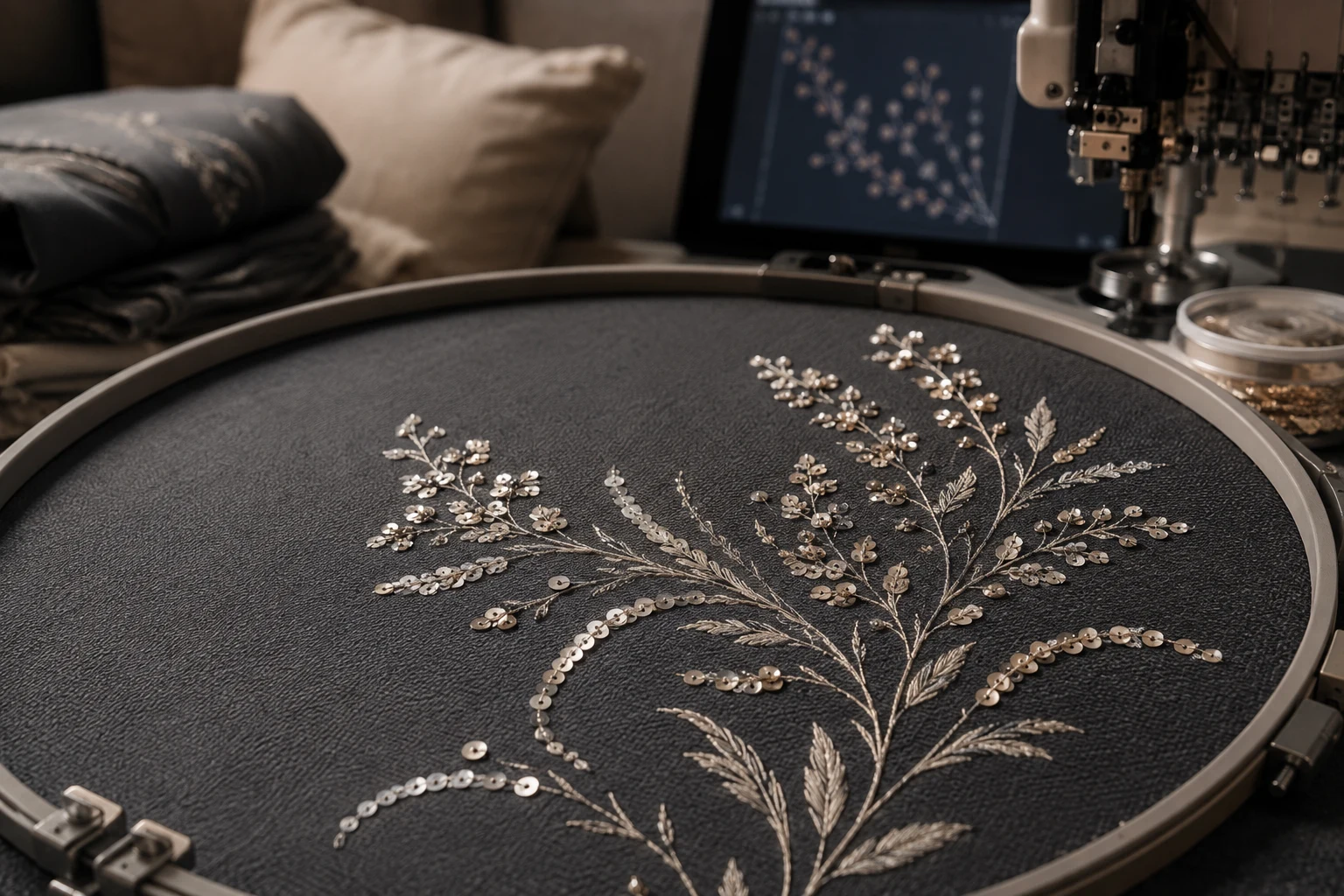
Cover image: AI-generated editorial concept; not a customer project or production proof.
Sequin embroidery digitizing creates the placement commands and fixing stitches needed to attach sequins with a compatible embroidery machine. A successful design requires the artwork, sequin supply, machine attachment and exported file to work together. Wilcom EmbroideryStudio provides sequin tools for this purpose. Wilcom’s sequin embroidery overview
This guide covers decorative work for dresses, tops, jackets, bags and home décor, from planning the design to checking a production sample.
What is sequin embroidery?
Sequin embroidery combines decorative sequins with stitches that hold them on fabric. On an appropriately equipped machine, a device feeds and drops sequins as the design stitches. Digitizing determines both where those drops occur and how the thread secures them. Wilcom’s sequin embroidery overview
For a buyer, the first decision is the intended effect: a fine sparkling outline, scattered accents or a broader decorated area. Share a visual reference and identify which parts should use sequins and which should remain ordinary thread embroidery.
Which machines can embroider sequins?
Automatic sequin embroidery requires a compatible sequin device and a machine configured to operate it. Confirm the exact model and installed attachment before commissioning a file. For example, Tajima lists a sequin device as a factory option for its TMBP2-SC; that listing does not establish that every machine of that model already has the attachment. Tajima TMBP2-SC specifications
Devices differ in the number of sequin types they can handle. Some feed one type, others support twin or multiple supplies, and some permit stacking several sequins under one fixing sequence. These capabilities must match the design. Wilcom’s machine capability guide
Sequin size is also attachment-specific. Tajima, for example, lists different diameter ranges for its ESQ-C, Device IV and Device III Twin Type. Ask the embroiderer to confirm the actual sequins their attachment can feed, including shape and size. Tajima sequin device options
How to digitize a sequin design
1. Establish the production specifications
Before placing sequins, agree on the finished dimensions, fabric, decoration area and machine setup. For US, Canadian and UK orders, label dimensions clearly in millimetres or inches; include millimetres for sequin diameter to reduce ambiguity.
In Wilcom, select a machine format that supports sequin output. An unsupported selection can produce fixing stitches without the sequin-drop functions. A visible palette alone does not confirm a usable sequin setup. Wilcom’s sequin output guidance
2. Create automatic or manual sequin runs
A sequin run places sequins along a path. In the documented EmbroideryStudio workflow, Sequin Run Auto generates placements along a digitized line, while Sequin Run Manual lets you specify individual drop positions. Both generate connecting and fixing stitches. Menu placement may differ by software version. Wilcom’s sequin run instructions
Automatic runs suit repeated outlines; manual placement is useful where individual positions matter. Review curves, corners and endpoints at the intended production size.
Wilcom measures run spacing from centre to centre. Exact uses the nominated spacing and may leave an endpoint gap. Expand to fit or Contract to fit distributes placements along the path. Switching a manual run back to exact spacing recalculates its drops and loses manual placements. Wilcom’s spacing controls
3. Choose and size the fixing stitches
Fixing stitches secure each sequin. In EmbroideryStudio, open the run’s object properties, use the chooser in the Fixing field and select a suitable pattern. The documented sizing methods are:
Setting | What it controls |
|---|---|
Match sequin | Sizes the fixing around the sequin with a specified margin. |
Set manually | Sets fixing size independently of sequin size, measured from the centre. |
Wilcom’s version 28 help gives a manual size range of 2.50–30.00 mm and a matching margin range of 0.20–2.00 mm. These are software input limits, not recommended settings for every job. It also provides fixing orientation controls and adaptation to eccentric shapes. Wilcom’s fixing stitch instructions
4. Review connections and reinforcement
Wilcom supports Backtrack/Repeat on sequin runs, producing manual stitches while leaving other functions intact. This can help reinforce a run or connect objects without a jump. Use it selectively and inspect the resulting stitch path. Wilcom’s guidance on sequin reinforcement
Ask the machine operator to review the feed direction, attachment clearances and operating settings against the machine documentation before testing.
Which file formats support sequin embroidery?
The required output depends on the selected machine definition and controller. Wilcom’s published e4 sequin output documentation includes these mappings; treat them as documented export examples, then confirm support in your installed software and production machine.
Machine definition | Documented sequin output |
|---|---|
Dahao | DST with Dahao-specific sequin encoding |
Schiffli | ESS |
SWF | DST |
SWF Twin Sequin | EBD |
Tajima | DST |
Tajima TBF | TBF |
ZSK | ZSK |
A .dst extension alone does not establish compatibility: Wilcom distinguishes Dahao multi-sequin encoding from Tajima’s interpretation. Give the digitizer the controller and attachment details along with the requested extension. Wilcom’s sequin output formats
What to send with a digitizing request
Prepare a brief that lets the digitizer and embroiderer agree on the same result:
Artwork and a marked reference showing sequin areas and thread-only areas.
Finished width, height and placement on the garment or décor item.
Fabric description and, where possible, a sample for testing.
Machine model, controller, attachment model and available sequin supplies.
Sequin diameter, shape, colours and any requested stacking.
Required output format and the intended wear and care conditions.
You can start with DigitEMB’s embroidery digitizing service and ask whether the specific sequin setup can be supported. Confirm the deliverables and who will produce the physical sample before placing the order.
Check a sample before production
Request a test on the intended fabric using the planned sequins, thread and backing. Assess placement, attachment security, visible connecting threads, fabric distortion and the feel of the decorated area. For clothing, consider contact with skin and nearby fabric; for home décor, consider where the decoration will sit during use.
If anything changes after testing, record the revision and test the affected area again. Supply the operator with thread and sequin information alongside the machine file; Wilcom specifically recommends a production worksheet for this handoff. Wilcom’s production output guidance
Frequently asked questions
Can a regular embroidery machine automatically attach sequins?
Only if its manufacturer supports the necessary sequin attachment and configuration. Check the exact equipment; Tajima notes that available options vary by model. Tajima attachment guidance
Does a DST file guarantee sequin compatibility?
No. The file must contain commands appropriate to the controller and sequin device. Wilcom documents different sequin encoding requirements for Dahao and Tajima DST output. Wilcom’s output guidance
Can sequin designs be resized?
Wilcom allows automatic sequin runs to be scaled, but the resulting placements need review. Specify the intended finished size before digitizing and request another sample when a size change affects the layout. Wilcom’s sequin run guidance
Practical details for Sequin Embroidery Digitizing: A Guide to Designs, Machines and Files
Use the article above as a starting point, then make the production brief specific to your own design. A stitch file is made for a finished size and material, so the artwork alone is only part of the instruction.
Work through these points in order and keep the answers with the artwork or production request. A short written brief makes it easier to compare a proof with the intended result, ask a useful follow-up question and avoid relying on assumptions made from a screen image alone.
The aim is not to add unnecessary steps. It is to identify the choices that change the final result before work begins. If a requirement is unknown, flag it for confirmation rather than guessing; that keeps the approval process focused on the design, material and use that apply to this particular project. Save the approved brief with the project files for future reorders or revisions.
Confirm the finished use
State the item, placement and finished width and height. A chest logo, cap front and jacket back do not use the same sewing area, even when they start from the same artwork.
Protect the smallest details
Review small lettering, narrow gaps, thin outlines and tiny colour changes at the final size. Simplifying a fragile detail before digitizing is often more reliable than trying to force it into a small sew-out.
Match the file to the machine
Tell the production team the embroidery machine or format required, along with the fabric or garment type. This lets them prepare the right export and make choices that suit the material rather than treating every job alike.
Quick questions to check before you proceed
What should I send with my artwork?
Send the clearest original available, the finished dimensions, placement, fabric or garment type and the required machine format if you know it.
Can the same file be used at every size?
Not always. Scaling changes the relationship between stitch length, detail and fabric, so a design may need review when the finished size or placement changes.
What should I check before production?
Confirm the spelling, colours, final size, placement and any details that must remain readable. A proof or sample is the best point to catch a change.