
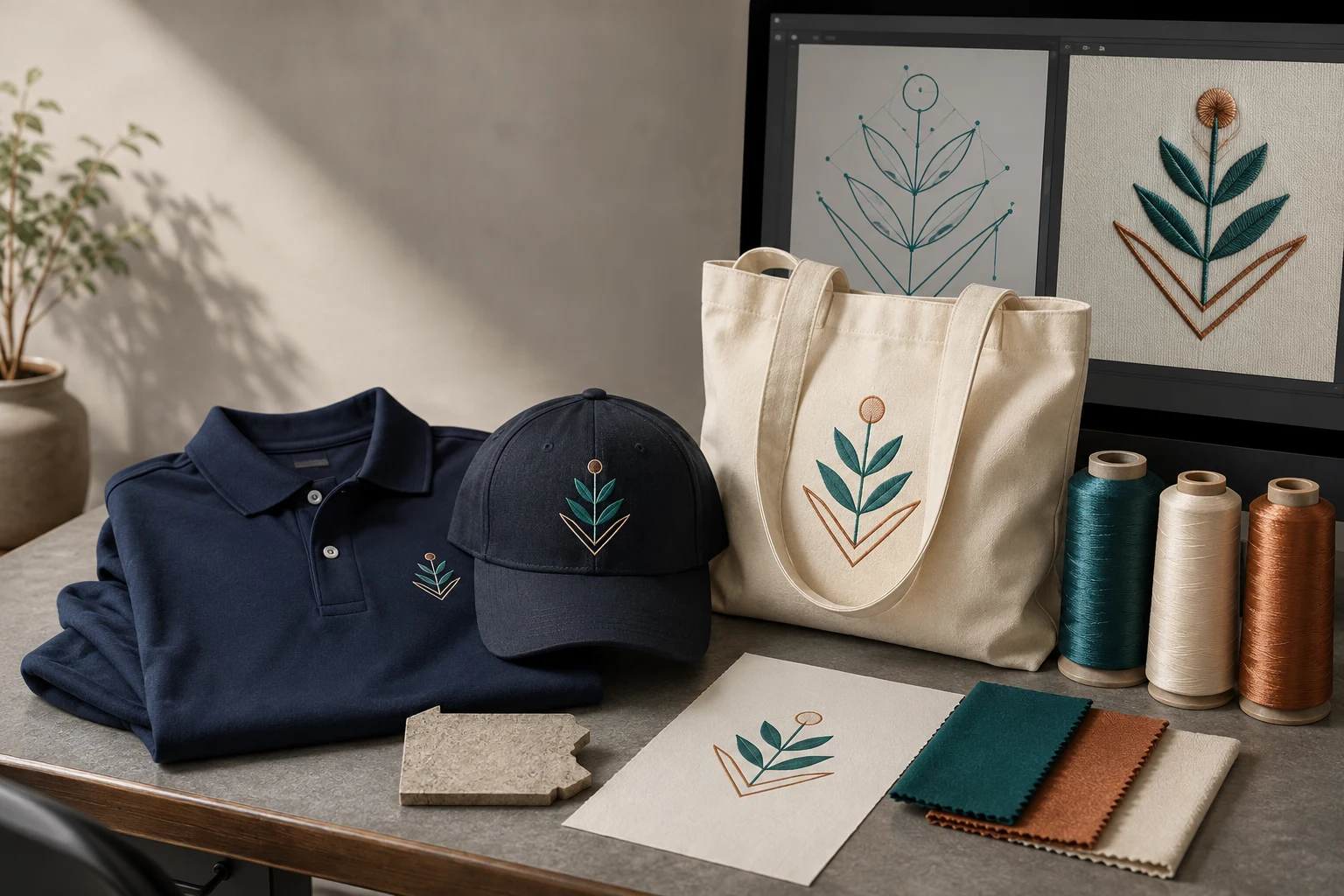
Cover image: AI-generated editorial concept; not a customer project or production proof.
For embroidery digitizing and vector art projects in Pennsylvania, choose a provider by its suitability for your artwork, intended product and production requirements. Request embroidery digitizing for machine stitch instructions, vector conversion for scalable artwork, or both when a design will appear on stitched apparel and printed materials. Confirm the deliverables and sample approval process before ordering.
This guide helps Pennsylvania businesses, schools, teams, artists and individuals compare services for uniforms, caps, jackets, gifts and promotional materials. The same ordering principles apply when coordinating with decorators in Canada or the UK.
Choose the service your project needs
Embroidery digitizing and vector conversion produce different kinds of files. A vector logo can provide artwork for digitizing, but it does not contain the finished stitch instructions simply because it has clean outlines.
Vector graphics use paths and curves and can scale without the pixelation associated with enlarging raster images. A document can also combine vector and raster content, so ask what the delivered artwork actually contains. Adobe’s image essentials guide explains these distinctions.
Embroidery digitizing creates an embroidery design from artwork, with settings governing how it will stitch. Wilcom’s explanation of image-to-embroidery conversion distinguishes source images, embroidery design data and exported machine files.
Your intended result | Service to discuss |
|---|---|
A stitched logo on a polo, cap or jacket | Embroidery digitizing for the specified size, fabric and placement. |
Scalable logo artwork for signs or printed merchandise | Vector conversion, with the printer’s output requirements. |
Artwork for screen printing or vinyl cutting | Vector preparation plus any required separations or cutting setup. |
The same identity across embroidery and print | Separate embroidery and vector deliverables based on one approved artwork reference. |
DigitEMB’s embroidery digitizing services and raster-to-vector services provide relevant starting points for discussing those file requirements.
Compare local and remote options in Pennsylvania
Start by deciding whether you need digital files, decorated goods or both. Ask who will supply the garments, run the embroidery or printing, and approve the production sample. These responsibilities should be explicit even when one supplier coordinates the project.
If you want an in-person consultation or sample collection in Pennsylvania, confirm the provider’s actual address, appointment arrangements and available services. A page mentioning Pennsylvania does not establish a local workshop or collection point.
For remote work, identify the person who will receive the files and test them. Agree on communication hours and deadlines using a named time zone. Keep artwork approval, file delivery, sample testing and finished-goods delivery as separate milestones.
For a school order, nominate one person to approve the crest and any names. For a business uniform order, have the decorator confirm each garment and placement before the digitizer prepares the files. These steps make responsibility clearer regardless of the supplier’s location.
What to assess in embroidery digitizing
Fabric and placement
Give the provider the actual garment style and material. Include whether the design belongs on a cap front, left chest, sleeve, jacket back, bag or towel. Ask whether each application needs a separate file or adjustment.
Stitch spacing, underlay and pull compensation must suit the design and fabric. Underlay supports the top stitching; pull compensation accounts for distortion caused as stitches draw fabric inward. Wilcom describes their relationship in its underlay and pull compensation guidance.
Software names alone are insufficient evidence of a suitable result. Ask the provider to explain how it will assess your particular application.
Detail and color
Ask which fine lines, small letters or crowded areas need simplifying at the intended size. Approve any changes to the artwork before the file is finalized. Do not assume every detail visible in an enlarged preview will remain readable in thread.
Supply color references and ask the decorator to confirm the proposed thread range and color codes. When appearance is important, review a physical sample under suitable lighting rather than relying entirely on a screen preview.
Special effects
Discuss 3D puff, appliqué and metallic or other specialty threads at the start of the project. Ask whether the proposed technique is suitable for the artwork and whether the decorator can produce it. Request a representative sample before committing to a larger order.
Machine files and samples
Have the decorator specify the required machine file format and usable embroidery area. Ask whether delivery includes a color sequence, design dimensions, preview and editable source file, or whether any of these are separate deliverables.
Arrange a test sew-out on the intended material with the planned production setup. Check lettering, outline alignment, coverage and fabric appearance. Wilcom recommends testing new designs on a sample of the intended fabric in its fabric stretch guidance.
If the sample needs changes, send the file version and clear photographs to both the digitizer and decorator. Agree on the next adjustment and repeat the sample review before authorizing the production run.
What to assess in vector art services
Ask for a deliverable matched to its intended use. A scalable master logo, a screen-print separation file and a vinyl-cutting file have different preparation requirements.
Send the best original artwork available. If only a blurry image exists, identify uncertain lettering or shapes and provide another reference where possible. Ask to approve the reconstructed artwork before it becomes the production reference.
Confirm these points with the designer and production supplier:
The required file format and whether an editable master is included.
Whether the artwork contains raster images or linked assets.
How fonts should be supplied or converted to outlines.
The required color setup and any separation work.
Any cutting requirements for narrow gaps or isolated shapes.
Review spelling, proportions, curves and intended detail at the actual output size. Keep the approved master and any production-specific versions clearly labeled. Adobe’s paths overview explains the paths and anchor points underlying vector artwork.
Prepare a brief that supports comparable quotes
Send the same brief to each provider so that differences in scope are visible.
Information to supply | What to specify |
|---|---|
Artwork | Best original file, approved wording and references for unclear details. |
Finished dimensions | Width and height with units clearly marked as inches or millimeters. |
Application | Garment, fabric, placement, print process or cutting use. |
Colors and effects | Color references, proposed threads and any specialty treatment. |
Deliverables | Machine format, vector format, editable files and preview requirements. |
Approval process | Who reviews the artwork and who produces the physical sample. |
Schedule | Dates for files, sample approval and finished items. |
Destination | Pennsylvania delivery or collection details; destination country for overseas goods. |
For orders shared between US, Canadian and UK teams, keep measurements consistent and state the quote currency. If physical goods are included, ask which delivery charges are included. Distinguish digital file delivery from shipping finished products.
Compare scope, support and value
Request an itemized quote that separates artwork reconstruction, digitizing, additional versions, samples and physical production where applicable. Ask what revisions are included and whether changing the design size, fabric or technique creates additional work.
Review examples similar to your project. For embroidery, ask whether the examples are photographs of sewn samples or digital previews. For vector work, request an example that shows the type of cleanup or production preparation you need.
Agree on how sample problems will be reported, who will review them and how revised files will be identified. Keep the approved artwork, final files and sample photographs together for repeat orders.
If environmental considerations are part of your brief, request information about the specific materials and production process being offered. Avoid treating a general sustainability statement as evidence for every garment, thread or print method.
Frequently asked questions
Do I need vector artwork before ordering embroidery digitizing?
Not necessarily. Ask the digitizer to review your original image first. Wilcom documents image-based digitizing workflows; separate vector reconstruction may be useful when you also need scalable artwork for printing or other uses. Wilcom’s conversion explanation describes that workflow.
Can one embroidery file be used on every garment?
Have the digitizer and decorator review each application. A change in fabric, dimensions or placement may require adjustments and another sample. Wilcom’s Auto Fabric Assistant example shows how underlay, stitch spacing and compensation can differ between fabrics.
Does choosing a Pennsylvania provider guarantee faster delivery?
Location alone does not establish availability or completion time. Confirm the schedule for artwork, revisions, sampling and any physical delivery before placing the order.
Does digitizing include embroidered clothing?
Confirm the scope. An order for digital design files should identify those files explicitly; garments and physical decoration need to be included separately if required.
Start with the artwork and production requirements
Prepare your artwork, dimensions, material, placement and required date, then have the production supplier confirm the output format and sample process. Explore DigitEMB’s embroidery digitizing or vector conversion services and request a scope matched to your Pennsylvania project.
Practical details for Embroidery Digitizing and Vector Art in Pennsylvania: A Buyer’s Guide
Use the article above as a starting point, then make the production brief specific to your own design. A stitch file is made for a finished size and material, so the artwork alone is only part of the instruction.
Work through these points in order and keep the answers with the artwork or production request. A short written brief makes it easier to compare a proof with the intended result, ask a useful follow-up question and avoid relying on assumptions made from a screen image alone.
The aim is not to add unnecessary steps. It is to identify the choices that change the final result before work begins. If a requirement is unknown, flag it for confirmation rather than guessing; that keeps the approval process focused on the design, material and use that apply to this particular project. Save the approved brief with the project files for future reorders or revisions.
Confirm the finished use
State the item, placement and finished width and height. A chest logo, cap front and jacket back do not use the same sewing area, even when they start from the same artwork.
Protect the smallest details
Review small lettering, narrow gaps, thin outlines and tiny colour changes at the final size. Simplifying a fragile detail before digitizing is often more reliable than trying to force it into a small sew-out.
Match the file to the machine
Tell the production team the embroidery machine or format required, along with the fabric or garment type. This lets them prepare the right export and make choices that suit the material rather than treating every job alike.
Quick questions to check before you proceed
What should I send with my artwork?
Send the clearest original available, the finished dimensions, placement, fabric or garment type and the required machine format if you know it.
Can the same file be used at every size?
Not always. Scaling changes the relationship between stitch length, detail and fabric, so a design may need review when the finished size or placement changes.
What should I check before production?
Confirm the spelling, colours, final size, placement and any details that must remain readable. A proof or sample is the best point to catch a change.