
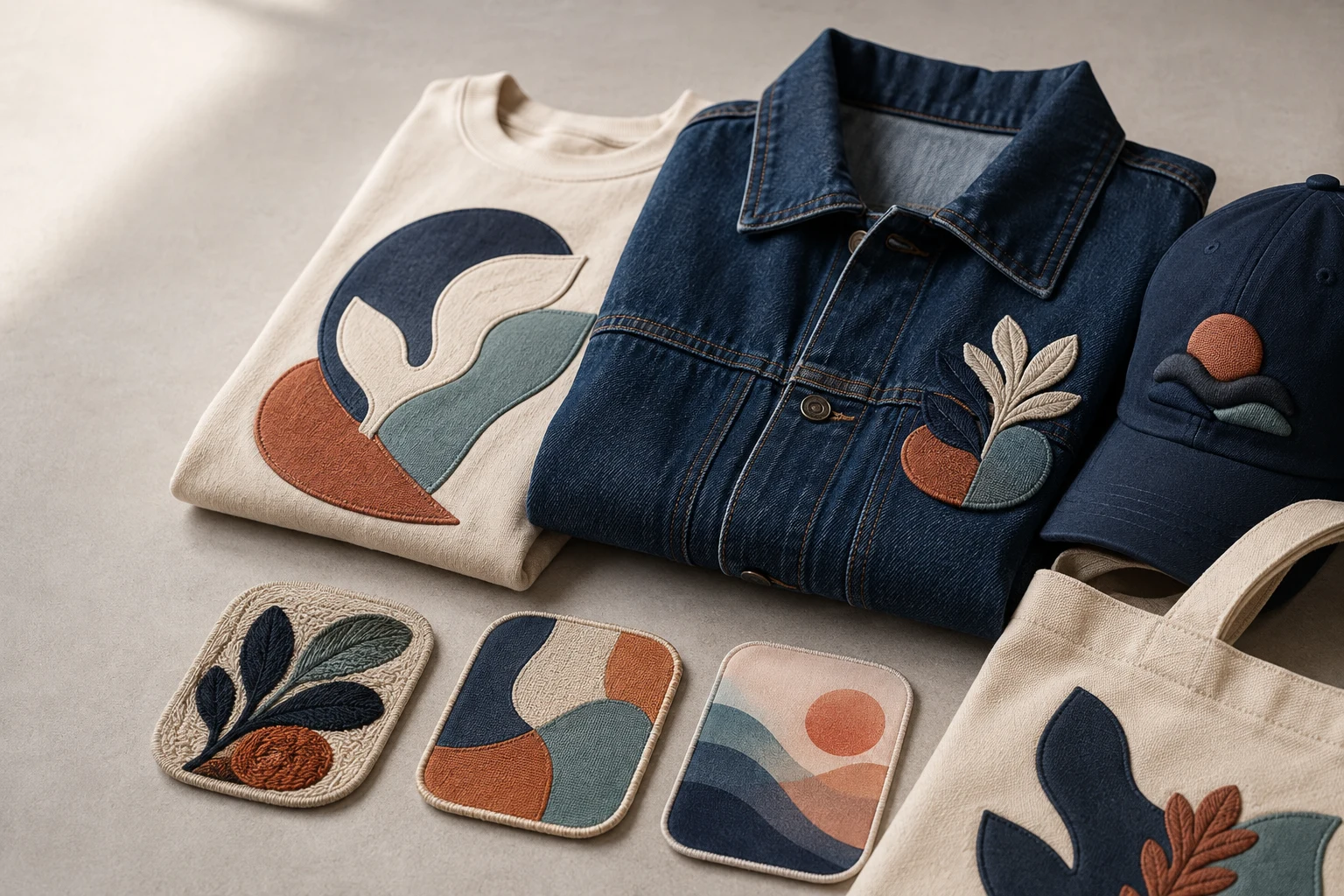
Cover image: AI-generated editorial concept; not a customer project or production proof.
Patches are separate emblems attached to a garment or accessory; appliqué is a technique that attaches shaped fabric pieces to a fabric base. Choose patches for repeatable badges and logos, and consider appliqué when fabric shapes, lettering or layered texture are central to the design. The terms can overlap: an appliqué design can also be made as a separate patch.
Both options can personalize clothing, identify a team or business, decorate merchandise and cover small areas of wear. The right choice depends on the artwork, garment, attachment method and expected care.
How patches and appliqués differ
A patch is made separately before being attached to a jacket, shirt, cap or bag. Its design may be embroidered, woven or printed. Its backing determines how it attaches; an embroidered patch is not automatically an iron-on patch.
Appliqué uses pieces of fabric to form part of the design. In machine appliqué, a design can guide fabric cutting and placement before stitching secures the piece to the base. Brother illustrates this sequence in its embroidery appliqué instructions.
For buyers, the useful distinction is the finished result: a separate emblem ready for attachment, or fabric decoration worked onto the item. Confirm which deliverable your supplier is quoting.
Common styles and their uses
Style | Appearance and practical fit |
|---|---|
Embroidered patch | Thread stitched onto a fabric base gives visible texture. Consider it for straightforward logos, badges and decorative motifs. |
Woven patch | A woven design offers a flatter appearance and can accommodate fine detail and small lettering. Review a sample at the intended size. |
Printed patch | Printing, including dye sublimation, can reproduce gradients and photographic imagery that would need substantial simplification for stitching. |
Fabric appliqué | Shaped fabric forms the design, with stitching securing it to the base. Consider it for larger letters, contrasting fabrics and decorative shapes. |
3D puff embroidery | Foam beneath the stitching creates raised areas. It needs artwork and an embroidery file suited to the technique. |
Penn Emblem documents fine-detail applications for woven emblems and photographic reproduction for dye-sublimated emblems. These are examples of production capabilities, not universal minimum lettering sizes or performance guarantees.
For raised embroidery, Madeira specifies foam and designs prepared for 3D stitching on stable fabrics. Its 3D foam guide is a useful reference when discussing a puff design with a decorator.
Where to use them
Uniforms and workwear: A consistent logo or name patch can help identify staff. Specify placement, garment style and the actual laundry process when requesting a sample.
Sports teams and clubs: Badges, names and fabric lettering can bring a coordinated design to teamwear. Ask the decorator to assess the proposed decoration on the exact jersey or jacket before ordering a full set.
Fashion and personal accessories: A patch can become a focal point on a denim jacket, cap or canvas bag. Appliqué offers scope for contrasting fabric, decorative shapes and larger compositions across a garment.
Events and merchandise: Separate patches can be offered as keepsakes or attached to event apparel. Decide whether recipients will sew them on, heat-apply them or use a compatible removable fastening.
Small-business products: Start with a sample on the intended hat, bag or garment. Evaluate the decoration as part of the finished product, including its position and feel.
Covering wear: A decorative patch may conceal a small worn area, but covering damage and repairing it are different tasks. Have the underlying fabric assessed before relying on a patch as a repair.
Choose attachment and care together
Sew-on, heat-applied and hook-and-loop options serve different needs. Sewing requires access to the attachment area. Heat application requires a compatible garment and adhesive system. Hook-and-loop attachment requires matching components on both the patch and the item.
Avoid applying a generic temperature or pressing time to every patch. Penn Emblem publishes different settings for different products, fabrics and equipment in its technical support guidance. Obtain instructions for the specific patch backing and check that the garment can tolerate the process.
Ask for written washing and drying guidance for the finished combination. A patch’s face material alone does not establish how the decorated garment should be cleaned. Product specifications may distinguish home-laundry backings from industrial-laundry options, as shown in Penn Emblem’s sublimated emblem specifications.
For a repeat order, arrange a sample attachment and laundering trial using the intended garment and care routine before approving production.
Prepare a useful project brief
Give the supplier enough information to assess the design in context:
Artwork: Supply the clearest original file available, plus the exact wording and preferred colors.
Finished dimensions: State width and height, including the border. For US, Canadian and UK suppliers, include inches and millimeters to avoid ambiguity; 3 inches equals 76.2 mm.
Garment and placement: Identify the fabric, garment model and decoration location. Include a placement photograph if helpful.
Construction: Specify a separate patch or direct appliqué, the desired texture, attachment method and edge appearance.
Quantity and variations: List changes in names, colors or sizes separately.
Care and destination: Explain expected washing, the delivery country and the date the finished items are needed.
View the artwork at its actual finished size. If lettering is difficult to read, ask whether it should be enlarged, simplified or produced using another method. For color-sensitive work, request a physical reference: Penn Emblem notes that screen and printer colors may differ from production samples in its color-chart guidance.
How to compare suppliers and quotes
Ask to see relevant physical samples or close-up photographs showing both the face and reverse. Look for readable lettering, consistent outlines, secure fabric edges and a sample that sits as intended on the garment.
Clarify what the order includes. Artwork preparation, an embroidery stitch file, finished patches and garment application are separate deliverables. A digital proof helps assess layout; a physical sample lets you evaluate texture, attachment and the finished appearance.
For buyers in the US, Canada and UK, request the quote currency and an itemized total. Ask which charges include artwork, sampling, application and shipping, and whether any destination charges remain payable. Confirm production and shipping estimates separately, including when timing starts after proof approval.
DigitEMB’s custom patch service is the relevant starting point for finished patch enquiries. If your own decorator will run the embroidery, review the embroidery digitizing service and confirm the required file format and project specifications.
Frequently asked questions
Is an appliqué the same as an embroidered patch?
Not necessarily. Appliqué describes attaching shaped fabric to a base; a patch describes a separate piece attached to an item. A patch can incorporate appliqué, so ask to see the proposed construction.
Can every patch be ironed on?
No. It needs a suitable heat-activated backing, a compatible garment and the specified application equipment. Confirm the supplier’s instructions before applying heat.
Which option suits a detailed logo?
Consider woven construction for fine linework and printed construction for photographic detail or gradients. If embroidered texture is the priority, ask what changes will make the design readable at the chosen size.
Can patches and appliqués be washed?
Many can, but follow the care instructions for the garment, decoration and attachment system together. Confirm the intended laundry process with the supplier and test a sample before a larger order.
Should I order a stitch file or finished patches?
Order a stitch file when you or your decorator will produce the embroidery. Request finished patches when you need physical emblems, and confirm separately whether garment attachment is included.
Practical details for Patches and Appliqués: Types, Uses and How to Choose
A patch works best when its artwork, size, border and attachment method are chosen together. Use the guidance in this article to create a production brief that is clear enough for a proof review.
Work through these points in order and keep the answers with the artwork or production request. A short written brief makes it easier to compare a proof with the intended result, ask a useful follow-up question and avoid relying on assumptions made from a screen image alone.
The aim is not to add unnecessary steps. It is to identify the choices that change the final result before work begins. If a requirement is unknown, flag it for confirmation rather than guessing; that keeps the approval process focused on the design, material and use that apply to this particular project. Save the approved brief with the project files for future reorders or revisions.
Choose the patch type for the artwork
Consider whether embroidered, woven, chenille or PVC construction best suits the amount of detail, texture and finish you want. Fine lettering and small shapes should be assessed at the real patch size.
Set the size and edge treatment
Give the finished width and height, including any outline or border. A merrowed edge, hot-cut edge or shaped outline changes the usable design area and how the patch reads from a distance.
Select the backing for the use case
Iron-on, sew-on, hook-and-loop and other backings serve different garments and applications. Confirm the item surface and whether the patch must be removable before approving the proof.
Quick questions to check before you proceed
What should be on a patch order brief?
Include the artwork, finished size, quantity, patch type, border preference, backing choice and the product or garment where it will be used.
Why can small text change on a patch?
Patch construction has physical limits. At a small size, very thin lettering or tight spaces may need adjustment so the finished patch stays legible.
When should I approve the proof?
Approve only after checking spelling, dimensions, border, colours, backing and every detail that must be visible in the finished patch.