
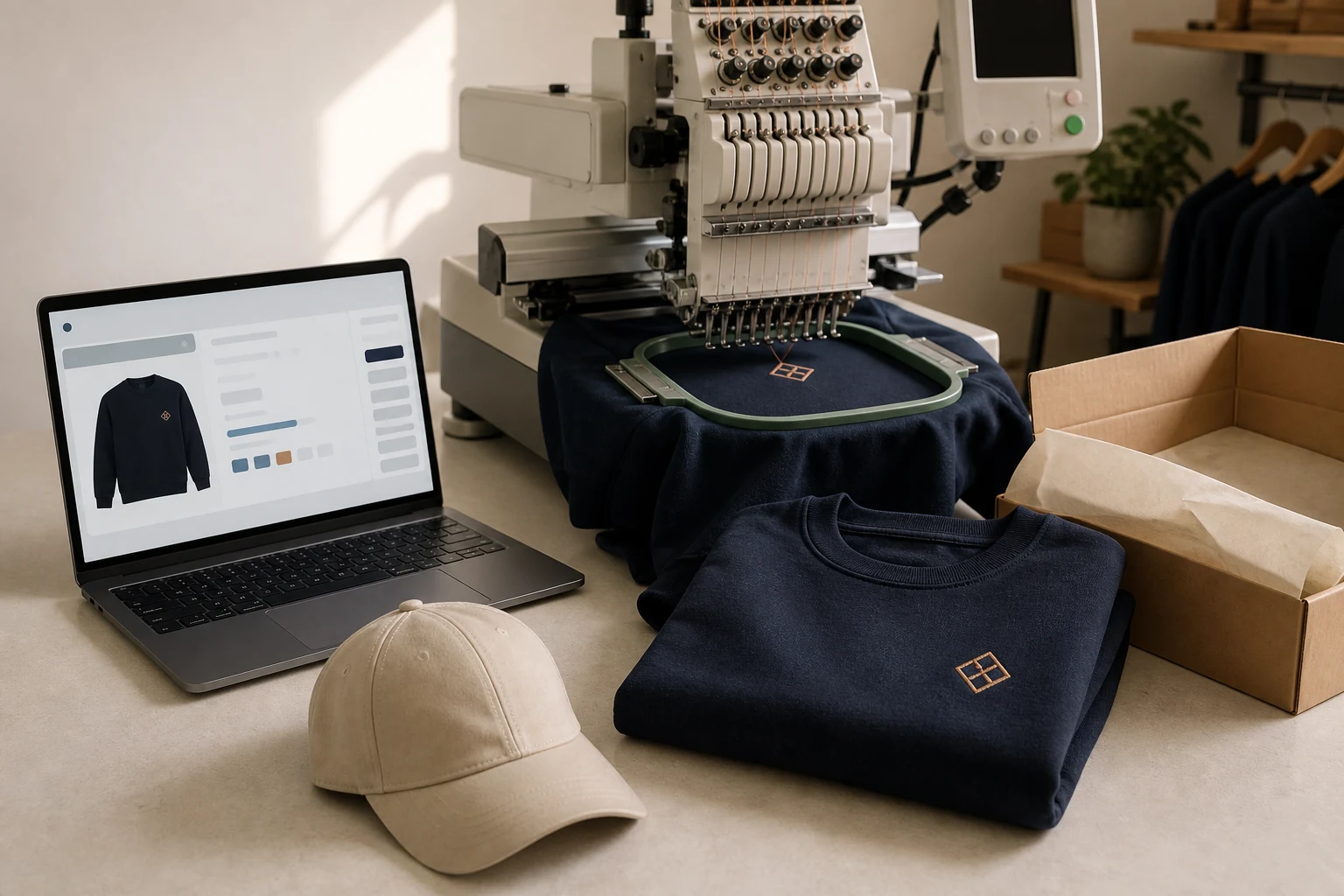
Cover image: AI-generated editorial concept; not a customer project or production proof.
You can fulfill embroidered apparel orders without storing finished products yourself by using a print-on-demand partner. A customer orders from your store, the partner decorates an available blank and ships the finished item directly to the customer. You manage the storefront and customer relationship. Printful’s fulfillment overview illustrates this model.
This reduces the need to buy finished merchandise before it sells. It does not remove every cost or risk: artwork preparation, samples, unavailable blanks, delivery problems and returns still need a plan.
The lifecycle of an order
1. Set up the product before selling
Choose the garment, available sizes and colors, embroidery placement and design dimensions. Confirm who prepares the stitch file and what the production partner accepts.
Order a physical sample before opening sales. Check the embroidery, placement, garment fit and packaging. A digital mockup cannot prove how the finished stitching will look; Printful’s digitization guidance explicitly recommends sampling.
2. A customer buys from your store
The order needs to identify the exact product variant, quantity, approved design and delivery address. With a supported store integration, order details can transfer to the fulfillment partner automatically. Other arrangements may require manual submission.
Customer payment and supplier payment are separate transactions. For example, Printful charges the seller for the product, fulfillment and shipping. Confirm when your chosen partner takes payment and when your storefront releases funds. See the order and payment workflow.
3. Artwork clears production requirements
Embroidery requires a machine-readable stitch file. Do not assume every order should arrive with an externally digitized file attached: Printful, for example, requires standard artwork uploads and does not accept outside DST, PES or EXP files. Designs needing changes may pause for approval before production. Check its embroidery file policy.
For a production partner that accepts outside files, agree on the format, finished dimensions, placement and thread choices first. DigitEMB’s embroidery digitizing service is relevant to this preparation stage. Confirm physical garment production and fulfillment separately with the provider handling those tasks.
4. The partner stitches, checks and packs
The production stage turns the selected blank into the ordered product. Before launch, ask the partner how it checks garment selection, design placement, stitching and packing accuracy.
Also confirm what customers will see on the parcel. Plain packaging, branded packing slips, custom labels and inserts are different options; request the specific arrangement you need instead of assuming they are all included.
5. The parcel ships to the customer
Production time and carrier transit time are separate. Use an estimated delivery window that includes both, and send tracking when it becomes available. Orders containing different products may arrive in separate parcels. Printful’s shipping guidance explains these distinctions and states that delivery estimates are not guarantees.
What you handle and what to confirm with the partner
Area | Responsibility to agree before launch |
|---|---|
Storefront and sales | You manage listings, product information, marketing and customer communication. |
Artwork and digitizing | Confirm who prepares the file, approves changes and maintains the production version. |
Blanks and embroidery | Confirm the partner’s available variants and process for unavailable items. |
Quality and packaging | Agree on inspection expectations and the packaging customers receive. |
Dispatch and tracking | Confirm who ships the parcel and how tracking reaches your store. |
Complaints and returns | You communicate with customers; agree how the partner handles faults, replacements and returned parcels. |
The trade-offs worth knowing
Compare a single-item fulfillment quote with a bulk production quote. On-demand production can carry a higher cost per piece, while bulk purchasing commits money to merchandise before you know whether it will sell. On-demand orders also need production time before shipping; ready-made stock can be dispatched without that step.
Include samples, design setup, storefront fees, shipping and potential replacements when assessing the model. Avoid describing the difference between the retail price and the production charge as your final profit.
You also depend on the partner’s blank availability. Have a process for pausing an unavailable variant and contacting affected customers rather than silently substituting a different garment.
Planning deliveries to the US, Canada and UK
Check the actual fulfillment route for each product and destination. Offering delivery to a country does not establish that the item will be made there.
For US, Canadian and UK orders, confirm the production estimate, transit estimate, tracking coverage and any cross-border charges before setting customer expectations. Printful notes that shipments from another region may attract handling or customs fees. Use the selected product and destination to check the current options in its shipping information.
Test the full journey with a sample order: purchase, order transfer, any artwork approval, tracking notification and arrival. This gives you practical evidence for your product descriptions and support process.
FAQs
Does selling without inventory mean no upfront spending?
No. You can avoid buying a batch of finished products, but samples, artwork preparation and store setup may still cost money. Confirm supplier billing before accepting orders.
Can I use one embroidery file with any fulfillment provider?
Do not assume so. Ask whether the provider accepts outside stitch files and whether the file suits the selected product and placement. Some platforms perform their own digitizing.
Who handles a wrong-size order or a faulty item?
Your customer needs a clear contact through your store. Agree on the supplier’s remedy process in advance: Printful, for example, distinguishes manufacturing problems from wrong-size choices and buyer’s remorse in its return and refund policy. A supplier’s reimbursement policy is separate from your store’s obligations to customers.
Practical details for Order Fulfillment Without Holding Inventory
The best next step is to translate the topic in this article into a short, specific brief. That gives everyone involved the same reference before a file, proof or finished product is prepared.
Work through these points in order and keep the answers with the artwork or production request. A short written brief makes it easier to compare a proof with the intended result, ask a useful follow-up question and avoid relying on assumptions made from a screen image alone.
The aim is not to add unnecessary steps. It is to identify the choices that change the final result before work begins. If a requirement is unknown, flag it for confirmation rather than guessing; that keeps the approval process focused on the design, material and use that apply to this particular project. Save the approved brief with the project files for future reorders or revisions.
State the intended outcome
Describe where and how the finished item will be used, who it is for and the result that matters most. This helps separate a useful requirement from a visual preference.
Collect the source material
Provide the clearest artwork, references and text available. Mark anything that cannot change, such as a logo, spelling, colour or placement requirement.
Review the final details
Before approving work, check the real size, material, format and any production constraints. Confirm the details that affect how the design will look in use, not only on a screen.
Quick questions to check before you proceed
What should I prepare first?
Start with the artwork, its intended use, finished size and any requirements that cannot change.
Why is a proof important?
A proof is the shared reference for checking details before production. It is the best time to correct a size, spelling, colour or placement issue.
What makes a useful request?
A clear request explains the goal, provides the best available source material and identifies the details that need approval.