
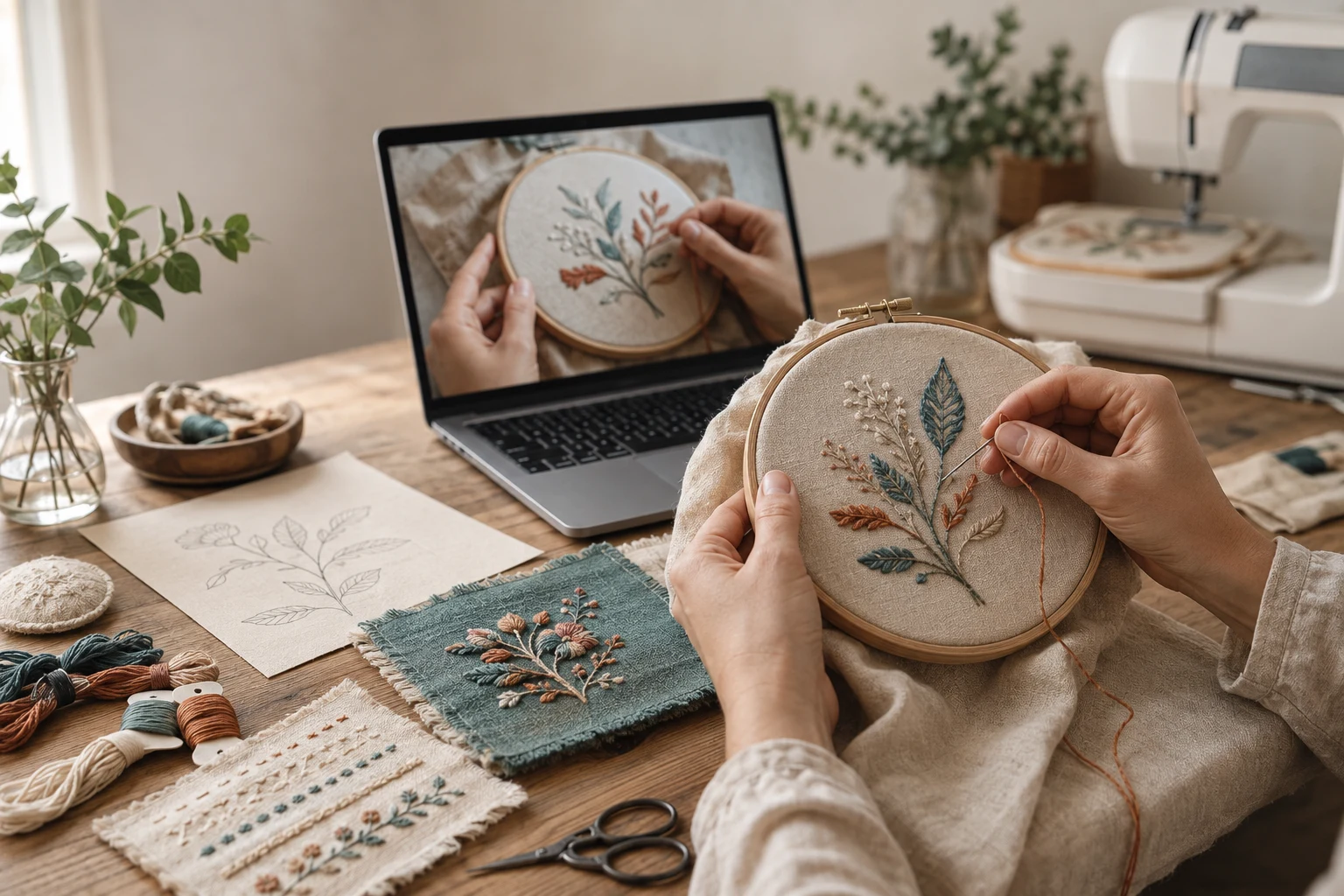
Cover image: AI-generated editorial concept; not a customer project or production proof.
Online embroidery workshops teach stitching through live demonstrations, recorded videos or scheduled written lessons. Choose one that matches your experience, the techniques you want to learn and the support you need. Before booking, confirm the materials, lesson access period and opportunities for feedback.
For a first hand embroidery class, look for basic stitches and a manageable project. More experienced stitchers can explore shading, raised embroidery or decorative materials. Machine embroidery and digitizing courses provide a separate learning path, so check what the workshop actually teaches.
Compare workshop formats
Online learning can save travel and make specialist teaching easier to access. Its flexibility depends on the format: a live class still requires attendance at a set time, while recorded lessons may have an access deadline.
Workshop format | What to check before booking |
|---|---|
Live online class | Session times, class size, opportunities to ask questions and whether a recording is included. |
Self-paced video course | Access duration, close-up demonstrations, captions and whether instructor feedback is available. |
Scheduled written course | Lesson release dates, downloadable instructions and the period during which the tutor answers questions. |
Project-based workshop | Required skills, materials and how much work you will need to finish between sessions. |
Project-based learning can use any of these delivery formats. A downloadable pattern alone may offer no teaching or feedback.
For concrete examples, the Royal School of Needlework describes both small-group live online classes and video courses. Its live sessions run at different times to accommodate different time zones. RSN class formats
The Embroiderers’ Guild of America offers Online Studio courses with downloadable lessons and class discussion groups. Its published guidance sets limits on teacher participation and discussion-group access, showing why support duration deserves attention before registration. EGA Online Studio
Match the content to your experience
Beginners: learn the foundations
Look for a syllabus that explains needle, thread and fabric selection, preparing a hoop, transferring a pattern, starting and finishing threads, and following a stitch diagram. A small sampler or simple floral motif gives you room to practice without committing to a large piece.
Running stitch, back stitch and French knots are useful topics to look for. The Royal School of Needlework includes these in its basic stitch collection, which also provides a reference for exploring other stitches. RSN Stitch Bank basic stitches
Choose a class that demonstrates the steps clearly enough to repeat. A sample lesson is more useful for judging teaching style than an attractive photograph of the finished project alone.
Returning and advanced stitchers: choose a specific challenge
Identify what you want to improve: stitch consistency, color choices, shading, texture or finishing. Then read the prerequisites for that particular technique. Experience with one style does not necessarily prepare you for every advanced workshop.
The RSN self-paced catalog includes introductions to silk shading, goldwork, appliqué and stumpwork, alongside next-step courses. This offers a useful distinction between being new to embroidery and being new to a technique. RSN online course catalog
For portrait work, bead embroidery or dimensional projects, look for detailed process images and feedback on work in progress. The course description should explain which materials and techniques the project uses.
Creative projects, gifts and seasonal themes
A wall hanging, clothing embellishment or gift can give practice a clear purpose. Seasonal motifs are another option, but leave time after the teaching sessions for stitching and finishing. Ask whether finishing instructions are included rather than assuming the class ends with a display-ready piece.
If you want to work with leftover fabric or thread, check substitutions with the tutor before buying a kit. Reusing supplies can be a practical project choice without relying on broad environmental claims.
Hand embroidery, machine embroidery or digitizing?
Read beyond the word “embroidery” in the title. Hand stitching, operating an embroidery machine and creating designs in software require different lessons and equipment.
Learning goal | Suitable course focus |
|---|---|
Stitch decorative designs by hand | Needlework techniques, pattern transfer, thread handling and finishing. |
Use an embroidery machine | Machine operation, hoops, fabrics, supplies and compatible designs. |
Create or edit machine embroidery designs | Software tools, design planning, stitch types and file output. |
Hatch Academy separates machine embroidery basics from introductory digitizing and offers lessons covering formats, fabrics and hoops. Use the syllabus to check whether a course fits your equipment and software experience. Hatch Academy embroidery basics
For designers and small business owners, choose training around a specific task you want to perform. If your immediate need is having artwork prepared for machine embroidery, you can review DigitEMB’s embroidery digitizing service. Keep that purchasing decision separate from choosing a workshop for your own learning.
What US, Canadian and UK learners should check
Before paying, review these practical details on the individual course page:
Local session time: Confirm every session in your own time zone, especially for courses spanning seasonal clock changes.
Total cost: Include tuition, required materials, shipping and any software or membership requirements. Check whether the displayed currency is USD, CAD or GBP.
Kit arrangements: Confirm delivery to your country, dispatch timing and whether you can source the materials locally.
Access and accessibility: Check lesson expiry, downloads, captions, written instructions and whether demonstrations are clear on your device.
Feedback: Find out who answers questions, where to submit project photographs and when support ends.
Booking terms: Read the cancellation, transfer and missed-session provisions before registering.
A low tuition fee does not necessarily mean a lower total cost. Compare what you will receive and use, including whether essential supplies are already in your sewing box.
Get more from each session
Prepare the listed materials and test the lesson platform before the first class. Arrange a well-lit workspace with the screen visible while you stitch. For live feedback, practice taking a sharp close-up photograph of your work.
During practice, keep a small sample beside the main project. Note the thread, fabric and technique used so you can repeat useful results. When asking for help, describe the step you attempted and include a photograph of the problem.
If a class offers a student group, use it to share progress and discuss techniques. Participation can add a social element to learning at home, but choose a workshop whose teaching would still meet your needs if the group is quiet.
Frequently asked questions
Do I need an embroidery machine?
A hand embroidery workshop does not require one. For machine embroidery classes, check the equipment list and supported models. Software-focused lessons may let you practice design work before stitching, but confirm their requirements.
Is a live class better than a recorded course?
A live class suits learners who want scheduled practice and opportunities to ask questions during teaching. Recorded lessons suit those who need to pause and repeat demonstrations. Check feedback arrangements separately; video access alone does not establish that tutor support is included.
Are supplies always included?
No. Some courses include a kit, some offer one separately and others provide a shopping list. Confirm the contents before ordering additional tools or materials.
Can a complete beginner join a specialist technique course?
Sometimes. Read the stated prerequisites rather than judging by the project photograph. A course labeled “introduction” may introduce a technique while assuming you already know basic embroidery.
Will I finish the project during the workshop?
That depends on the project, your experience and the time available. Ask about expected independent stitching and finishing work, particularly if the piece is intended for a gift or event.
Practical details for Online Embroidery Workshops: Choose a Class and Build Your Skills
Use the article above as a starting point, then make the production brief specific to your own design. A stitch file is made for a finished size and material, so the artwork alone is only part of the instruction.
Work through these points in order and keep the answers with the artwork or production request. A short written brief makes it easier to compare a proof with the intended result, ask a useful follow-up question and avoid relying on assumptions made from a screen image alone.
The aim is not to add unnecessary steps. It is to identify the choices that change the final result before work begins. If a requirement is unknown, flag it for confirmation rather than guessing; that keeps the approval process focused on the design, material and use that apply to this particular project. Save the approved brief with the project files for future reorders or revisions.
Confirm the finished use
State the item, placement and finished width and height. A chest logo, cap front and jacket back do not use the same sewing area, even when they start from the same artwork.
Protect the smallest details
Review small lettering, narrow gaps, thin outlines and tiny colour changes at the final size. Simplifying a fragile detail before digitizing is often more reliable than trying to force it into a small sew-out.
Match the file to the machine
Tell the production team the embroidery machine or format required, along with the fabric or garment type. This lets them prepare the right export and make choices that suit the material rather than treating every job alike.
Quick questions to check before you proceed
What should I send with my artwork?
Send the clearest original available, the finished dimensions, placement, fabric or garment type and the required machine format if you know it.
Can the same file be used at every size?
Not always. Scaling changes the relationship between stitch length, detail and fabric, so a design may need review when the finished size or placement changes.
What should I check before production?
Confirm the spelling, colours, final size, placement and any details that must remain readable. A proof or sample is the best point to catch a change.