
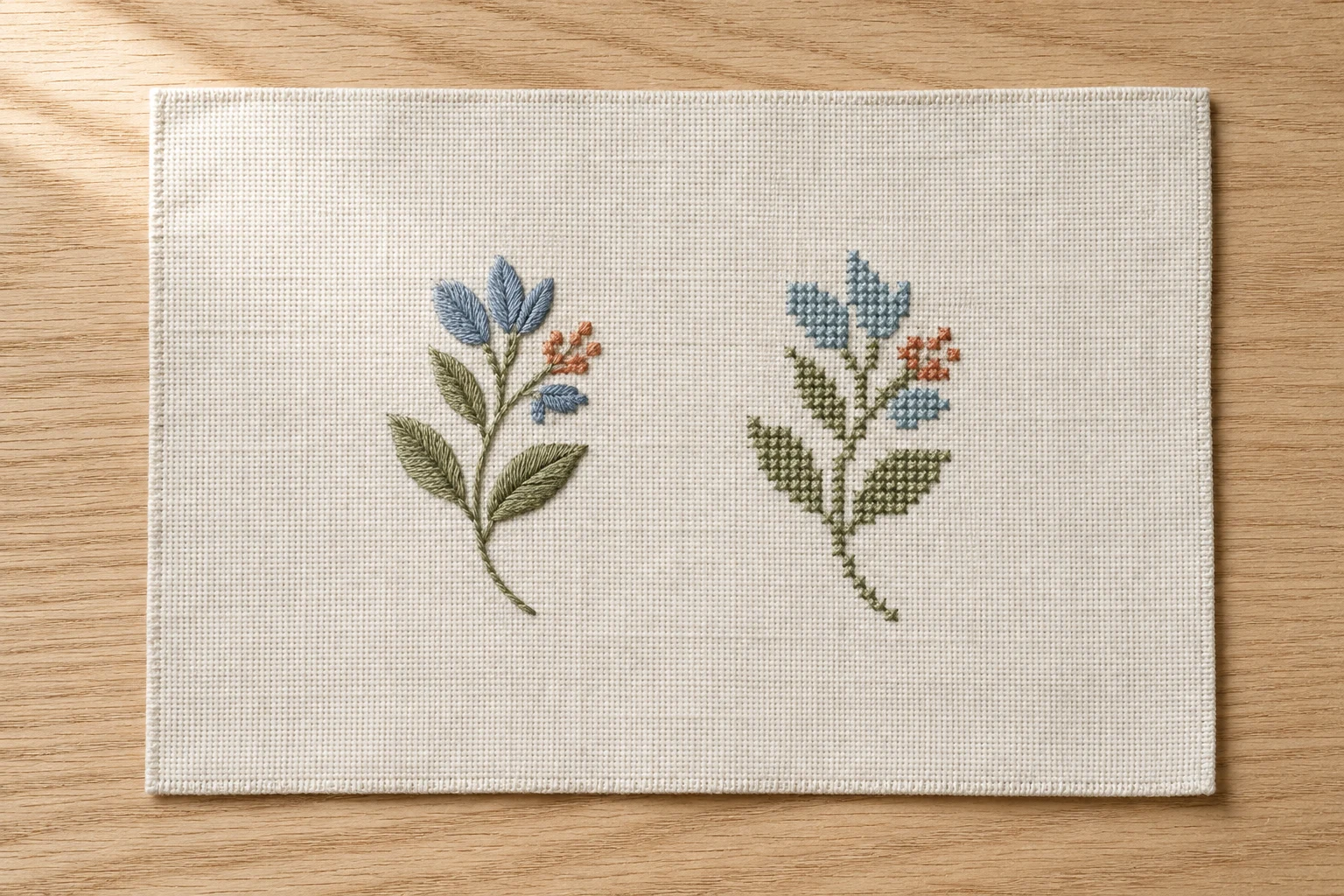
Cover image: AI-generated editorial concept; not a customer project or production proof.
Cross stitch is a type of embroidery. Embroidery is the broader craft of decorating fabric with stitches; cross stitch creates designs using recognizable X-shaped stitches. When people compare the two, they usually mean surface hand embroidery versus counted cross stitch. The Royal School of Needlework documents cross stitch within its embroidery reference, RSN Stitchbank.
Choose surface embroidery if you enjoy flowing outlines and varied stitch textures. Choose counted cross stitch if you enjoy following a chart and building a picture on a regular grid. Both can suit beginners, depending on the project.
What is embroidery?
Embroidery uses thread stitched into fabric to create decoration. It includes many techniques, including cross stitch, and can be worked by hand or machine. This comparison focuses mainly on handwork so you can choose a craft, pattern or kit.

In surface hand embroidery, you can follow a transferred outline or develop the design as you stitch. Clothing, accessories, home furnishings and framed artwork are all possible projects. DMC’s introduction to embroidery describes these creative uses and the basic equipment.
Different stitches create different effects. Satin stitch fills shapes with closely placed parallel stitches, making it useful for petals, leaves and suitable monograms. See the RSN satin stitch guide. Other choices include chain stitch and French knots; the RSN stitch collection provides illustrated references for exploring them.
What is cross stitch?
A full cross stitch consists of two diagonal stitches crossing to form an X. In counted cross stitch, you follow a chart and count positions on the fabric to place the design. Aida and evenweave fabrics provide a regular structure for this work. Cross stitch can also appear in surface embroidery, so counting is not its only possible application. See the RSN cross stitch reference.

Aida is a practical starting fabric because its holes make stitch placement clear. Its count describes stitches per inch when working one cross over each square: a higher count produces smaller stitches. DMC recommends 14-count Aida for beginners in its cross stitch introduction.
For example, a design 70 stitches wide measures 5 inches, or 12.7 cm, on 14-count Aida. That is the stitched design width; you still need extra fabric for handling and finishing.
How the techniques compare
Surface hand embroidery | Counted cross stitch |
|---|---|
Placement follows an outline or your own decisions. | Placement follows counted positions on a chart. |
Stitch length, direction and texture can vary throughout the design. | Repeated crosses create a regular, visibly gridded texture. |
A useful option for flowing botanical shapes and varied surfaces. | A useful option for geometric motifs, lettering and charted pictures. |
You learn the stitches needed for the chosen pattern. | You learn to form crosses and keep your place on the chart. |
A small outline project can be manageable for a beginner. | A small chart with few colors can be manageable for a beginner. |
These are starting points for choosing a project. Either approach can produce simple decoration or demanding, detailed artwork.
Fabric, thread and tools
For surface embroidery, start with the fabric recommended by your pattern. A plain woven cotton or linen can be a practical choice for a first sample; choose the needle and thread to suit that fabric. You will also need small scissors, a pattern or drawing, and usually a hoop. A transfer method is useful when the outline is not already marked. DMC lists these essentials in its embroidery toolkit.
For cross stitch on Aida, use a blunt tapestry or cross stitch needle that passes through the existing holes. Stranded embroidery floss, scissors, a chart and a hoop complete a basic setup. Follow the pattern’s strand instructions rather than assuming every project uses the same thickness. DMC’s cross stitch toolkit explains the needle and fabric combination.
Before buying a kit in the US, Canada or UK, check what is included. Confirm whether the listing supplies only a downloadable pattern or also fabric, thread, needle and hoop. Check finished dimensions and units, fabric count, and whether finishing materials are separate.
Which should you try first?
Try counted cross stitch if you like a clear sequence. Look for a small chart with a limited palette and clearly separated symbols. Before buying, check whether it requires additional stitch techniques beyond full crosses.
Try surface embroidery if you like drawing and choosing textures. Look for a small design that teaches a few stitches, with clear instructions and an outline you can transfer or stitch directly.
A helpful experiment is to make a small leaf motif in each technique. Notice whether you prefer counting positions or deciding how stitches follow a shape. Choose your next project around the process you enjoy.
Avoid judging difficulty by the craft name alone. A densely stitched cross stitch picture can demand more patience than a simple embroidered outline. Compare the actual pattern, its instructions and the amount of work involved.
Buying finished work or arranging machine embroidery
When commissioning a gift or decorative item, specify the appearance you want: visible crosses, flowing outlines, smooth filled shapes or raised details. Ask whether the work will be stitched by hand or machine, and request dimensions and close-up examples relevant to the technique.
For a kit, the deliverable is a project you will stitch. For a finished item, confirm the fabric, finishing and care instructions. For a digital file, confirm what equipment or software it is intended for before ordering.
If your project requires machine embroidery preparation, explore DigitEMB’s embroidery digitizing services. Describe the intended item and desired stitch appearance, and confirm the deliverables with the provider.
Frequently asked questions
Is cross stitch easier than embroidery?
It can feel easier if you enjoy following a grid. Surface embroidery may feel more natural if you prefer following drawn lines. Start with a small pattern designed to teach the required skills.
Can I use the same supplies for both?
Some supplies, such as floss, scissors and hoops, can serve both. Match the fabric and needle to the technique: a blunt needle suited to Aida is not automatically the right needle for surface work.
Must every top cross stitch face the same direction?
For a consistent appearance, keep the top diagonal pointing the same way throughout an ordinary cross stitch area. The RSN method guide illustrates this principle.
Is cross stitch only for framed pictures?
No. It can also decorate clothing and other fabric items. Choose a pattern, fabric and finishing method suited to the item’s intended use; DMC’s cross stitch overview includes clothing decoration among its applications.
Practical details for Embroidery vs. Cross Stitch: Differences and How to Choose
Use the article above as a starting point, then make the production brief specific to your own design. A stitch file is made for a finished size and material, so the artwork alone is only part of the instruction.
Work through these points in order and keep the answers with the artwork or production request. A short written brief makes it easier to compare a proof with the intended result, ask a useful follow-up question and avoid relying on assumptions made from a screen image alone.
The aim is not to add unnecessary steps. It is to identify the choices that change the final result before work begins. If a requirement is unknown, flag it for confirmation rather than guessing; that keeps the approval process focused on the design, material and use that apply to this particular project. Save the approved brief with the project files for future reorders or revisions.
Confirm the finished use
State the item, placement and finished width and height. A chest logo, cap front and jacket back do not use the same sewing area, even when they start from the same artwork.
Protect the smallest details
Review small lettering, narrow gaps, thin outlines and tiny colour changes at the final size. Simplifying a fragile detail before digitizing is often more reliable than trying to force it into a small sew-out.
Match the file to the machine
Tell the production team the embroidery machine or format required, along with the fabric or garment type. This lets them prepare the right export and make choices that suit the material rather than treating every job alike.
Quick questions to check before you proceed
What should I send with my artwork?
Send the clearest original available, the finished dimensions, placement, fabric or garment type and the required machine format if you know it.
Can the same file be used at every size?
Not always. Scaling changes the relationship between stitch length, detail and fabric, so a design may need review when the finished size or placement changes.
What should I check before production?
Confirm the spelling, colours, final size, placement and any details that must remain readable. A proof or sample is the best point to catch a change.