
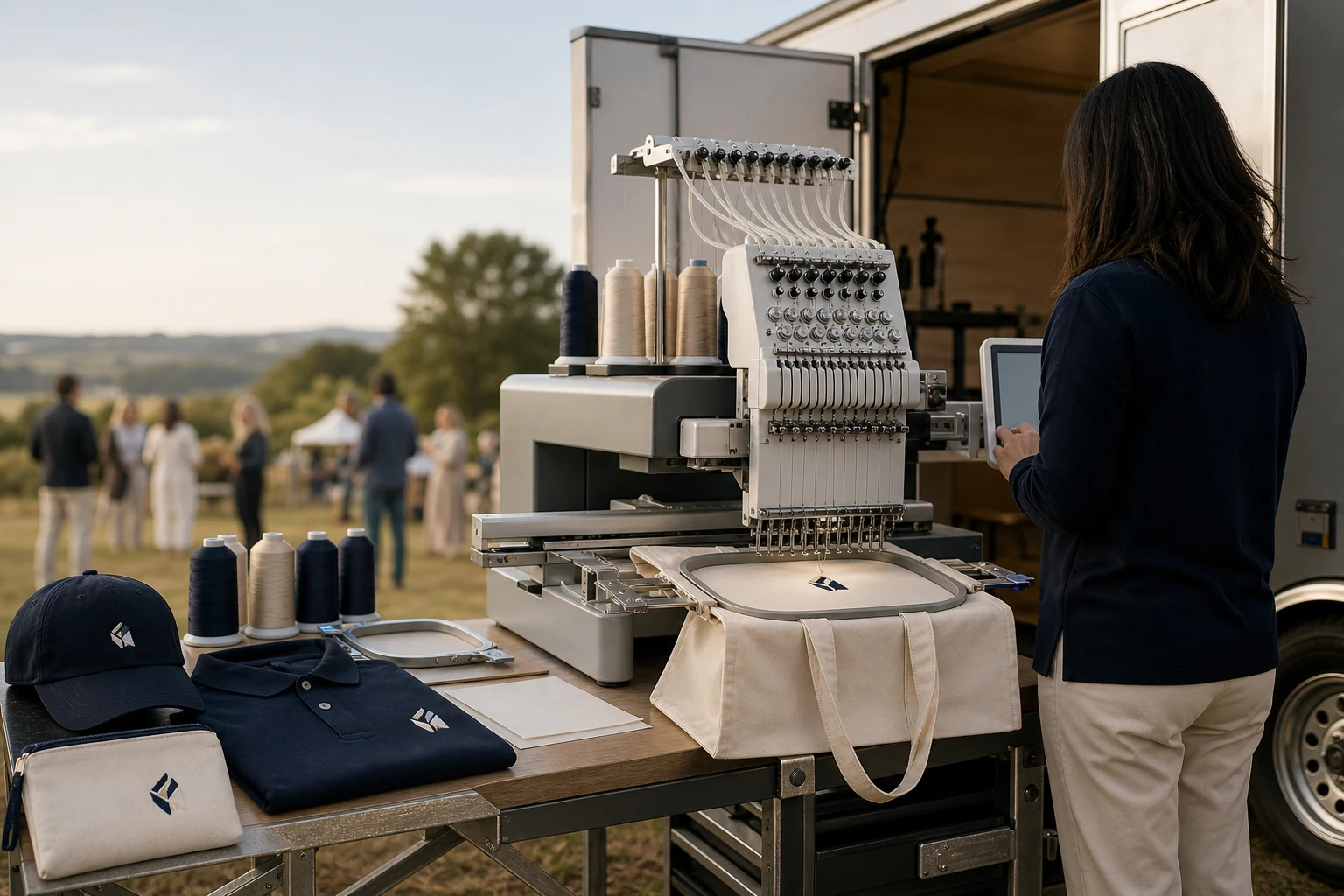
Cover image: AI-generated editorial concept; not a customer project or production proof.
Mobile embroidery services bring embroidery equipment and an operator to a venue so guests can personalize selected garments or accessories on location. They can suit corporate events, festivals, weddings, sports gatherings and retail pop-ups. Same-event collection depends on the approved design, available equipment and queue; it should be agreed before booking.
For buyers in the US, Canada and UK, the key questions are practical: does the provider travel to your venue, can it embroider your chosen items, and how many finished pieces can it realistically deliver during your event?
How mobile embroidery works
A mobile setup may be a temporary station inside a venue or a vehicle-based workspace. Ask which arrangement the provider uses and what space it needs. On-site embroidery does not always mean a van: for example, Initially London describes a pop-up service for events and retailers, with advance planning for the setup and suitable products.
The work usually starts before guests arrive:
Define the job. Confirm the venue, event hours, anticipated demand, products and personalization choices.
Prepare designs. Agree on artwork, lettering, thread colors, dimensions and placement.
Approve a sample. Request a physical sew-out on the intended item or a representative sample before committing to production.
Set up the station. Allow time for unloading, equipment checks, supplies and a clear guest collection area.
Record each order. Confirm spelling, item identification and the chosen design before stitching.
Finish and hand over. Inspect the embroidery, trim loose threads and match the item to its owner. Agree beforehand whether the organizer pays or guests purchase individually.
Benefits and suitable events
The main convenience is bringing personalization to the gathering. Guests can choose from an agreed menu and see the stitching process, while organizers can offer useful keepsakes. A station can also give people a shared activity while they wait, although engagement and sales results will vary.
Event or setting | A practical embroidery option |
|---|---|
Festivals and fairs | Short names or initials on a limited selection of souvenir bags or caps |
Corporate events and trade shows | An approved company motif, with optional individual personalization |
Weddings and celebrations | Initials on tested tote bags, napkins or handkerchiefs |
Sports events | Names or numbers on provider-approved apparel; supply authorized artwork for team designs |
Community events and fundraisers | A small menu of keepsakes with clearly stated purchase or donation arrangements |
Retail pop-ups | Personalization on selected products that have been tested in advance |
Keep guest choices manageable. A few approved fonts, placements and thread colors make ordering clearer and reduce the number of untested variations.
Which items and designs are suitable?
Clothing, bags, caps and small textile gifts are possible candidates, but a provider should approve the exact product and embroidery position. Send product photographs and, where possible, a sample. Ask whether seams, linings, pockets or access to the proposed stitching area create a problem.
Artwork needs preparation
A logo image and an embroidery machine file serve different purposes. Digitizing turns artwork into embroidery instructions; the resulting machine file contains the stitch information needed for production. Wilcom explains the distinction between editable design files and machine files.
Send the artwork, intended fabric, finished dimensions and placement to the person preparing the file. State measurements explicitly in inches or millimeters. Ask the event operator which machine format it requires and who is responsible for testing the file.
For this preparation stage, DigitEMB’s embroidery digitizing service is a relevant resource. Arrange the physical on-site equipment, staffing and event booking separately with the mobile provider.
Approve stitches as well as a preview
A screen preview helps confirm appearance, spelling and position. A sew-out lets you assess the actual stitching on fabric. For automatically digitized designs, Wilcom specifically advises checking fabric-related settings before production and explains that generated previews simulate stitches. See Wilcom’s auto-digitizing guidance.
For live work, consider offering names, initials and a small group of pre-approved motifs. Leave time before the event to resolve artwork changes and test the longest permitted names.
Equipment and materials
Ask the provider to describe its complete setup, including the embroidery machine, suitable frames, thread selection, stabilizers, spare consumables and finishing tools. The equipment brought to your venue determines which items and placements can be offered.
Hoops or frames secure the work, while stabilizer supports the fabric during stitching. These need to suit the material and project. Brother’s instructions explain how fabric and stabilizer are positioned in a frame, including alternatives for small pieces and fabrics that cannot be ironed. Read Brother’s hooping guidance.
Confirm the available thread colors against physical samples where color matching matters. Also ask whether the provider has the appropriate cap equipment if headwear is part of the booking.
Booking, venue setup and capacity
Give providers the same brief so you can compare proposals fairly. Include the full venue address, date, working hours, expected attendance, estimated item quantity and any access restrictions. Attendance alone does not tell a provider how many people will request embroidery.
Booking detail | What to confirm |
|---|---|
Service area | Travel availability, unloading access, parking and any travel charges |
Workspace | Required footprint, stable work surface and room for guests to order and collect |
Power | Equipment requirements and the venue contact responsible for confirming a suitable supply |
Outdoor plans | An agreed weather contingency and conditions in which work must move or stop |
Products | Who supplies blanks, which customer-owned items are accepted and what happens if an item is damaged |
Artwork | Design approval deadline, digitizing responsibility and sample approval |
Output | Planned quantity based on a timed sample, staffing and machine availability |
Queue | Order identification, estimated collection times and the final order cutoff |
Commercial terms | Included hours, setup, consumables, additional work, payment and cancellation arrangements |
For US, Canadian and UK bookings, ask for the quote currency to be explicit—USD, CAD or GBP—and for applicable taxes and travel costs to be shown clearly. Confirm local availability directly; online artwork preparation does not establish a provider’s physical travel coverage.
Estimate finished pieces, not just stitching speed
Machine speed is only one part of the schedule. Guest selection, order entry, hooping, thread changes, finishing and handover also take time. Melco’s business planning guide accounts for handling time when estimating embroidery production. See Melco’s embroidery business startup guide.
Ask the provider to time a complete sample cycle using your approved design and item. Use that result to plan capacity, then allow for interruptions and uneven arrivals. Treat any calculation as a planning estimate rather than a delivery guarantee.
Challenges and alternatives
Weather, venue access, equipment interruptions and sudden queues can affect an on-site booking. Agree on a fallback before the event, including what happens to unfinished orders and how guests receive updates.
For a large quantity of identical logos, ask about completing the repeated embroidery beforehand and adding only names or initials live. If the venue cannot accommodate the station, consider taking personalization orders at the event for later production, with collection or shipping terms stated upfront.
Customer-owned garments require particular care. Have the provider assess them before accepting payment, and make its acceptance and damage policies clear. An unusual or irreplaceable item deserves an individual discussion rather than an assumption that it can join the standard queue.
Promoting and improving a mobile embroidery service
For operators, useful marketing starts with accurate information: show your own sample work, explain the items you accept, state your travel area and describe the venue requirements. Build relationships with event organizers and retailers using a clear booking brief and realistic capacity estimates.
Packages can group defined hours, products and personalization choices so buyers can understand the scope. Use genuine customer feedback with permission, and obtain permission before sharing identifiable event photographs.
When considering new equipment or ordering software, test whether it improves the full workflow: accurate spelling, consistent samples, shorter handling time or clearer collection. Avoid basing plans on unsupported predictions about market growth.
To reduce unnecessary material use, start with a tested product range, track demand and record spoiled blanks and leftover supplies. Describe specific practices rather than making broad environmental claims without evidence.
Frequently asked questions
Can guests receive embroidery while they wait?
They may be able to, depending on the design and queue. Confirm expected collection times, capacity and the order cutoff with the provider before advertising the service.
Can I bring my own clothing or bags?
Only if the provider accepts them. Share the exact item and proposed placement in advance, and ask about testing and responsibility for damage.
Does every logo need digitizing?
A new logo generally needs an embroidery file prepared for stitching. If you already have one, let the operator check its format, size and suitability for the chosen product before deciding whether changes are needed.
How much does mobile embroidery cost?
Request a written quote for your event. Ask it to identify travel, staffing, equipment, blanks, artwork preparation, working hours and any charges for extra items or time. There is no single price that describes every booking.
Is mobile embroidery the same as online digitizing?
Mobile embroidery involves physical stitching at a location. Online digitizing prepares the digital embroidery file that an operator uses for production. Your project may need both services.
Practical details for Mobile Embroidery Services: How They Work and What to Plan
Use the article above as a starting point, then make the production brief specific to your own design. A stitch file is made for a finished size and material, so the artwork alone is only part of the instruction.
Work through these points in order and keep the answers with the artwork or production request. A short written brief makes it easier to compare a proof with the intended result, ask a useful follow-up question and avoid relying on assumptions made from a screen image alone.
The aim is not to add unnecessary steps. It is to identify the choices that change the final result before work begins. If a requirement is unknown, flag it for confirmation rather than guessing; that keeps the approval process focused on the design, material and use that apply to this particular project. Save the approved brief with the project files for future reorders or revisions.
Confirm the finished use
State the item, placement and finished width and height. A chest logo, cap front and jacket back do not use the same sewing area, even when they start from the same artwork.
Protect the smallest details
Review small lettering, narrow gaps, thin outlines and tiny colour changes at the final size. Simplifying a fragile detail before digitizing is often more reliable than trying to force it into a small sew-out.
Match the file to the machine
Tell the production team the embroidery machine or format required, along with the fabric or garment type. This lets them prepare the right export and make choices that suit the material rather than treating every job alike.
Quick questions to check before you proceed
What should I send with my artwork?
Send the clearest original available, the finished dimensions, placement, fabric or garment type and the required machine format if you know it.
Can the same file be used at every size?
Not always. Scaling changes the relationship between stitch length, detail and fabric, so a design may need review when the finished size or placement changes.
What should I check before production?
Confirm the spelling, colours, final size, placement and any details that must remain readable. A proof or sample is the best point to catch a change.