
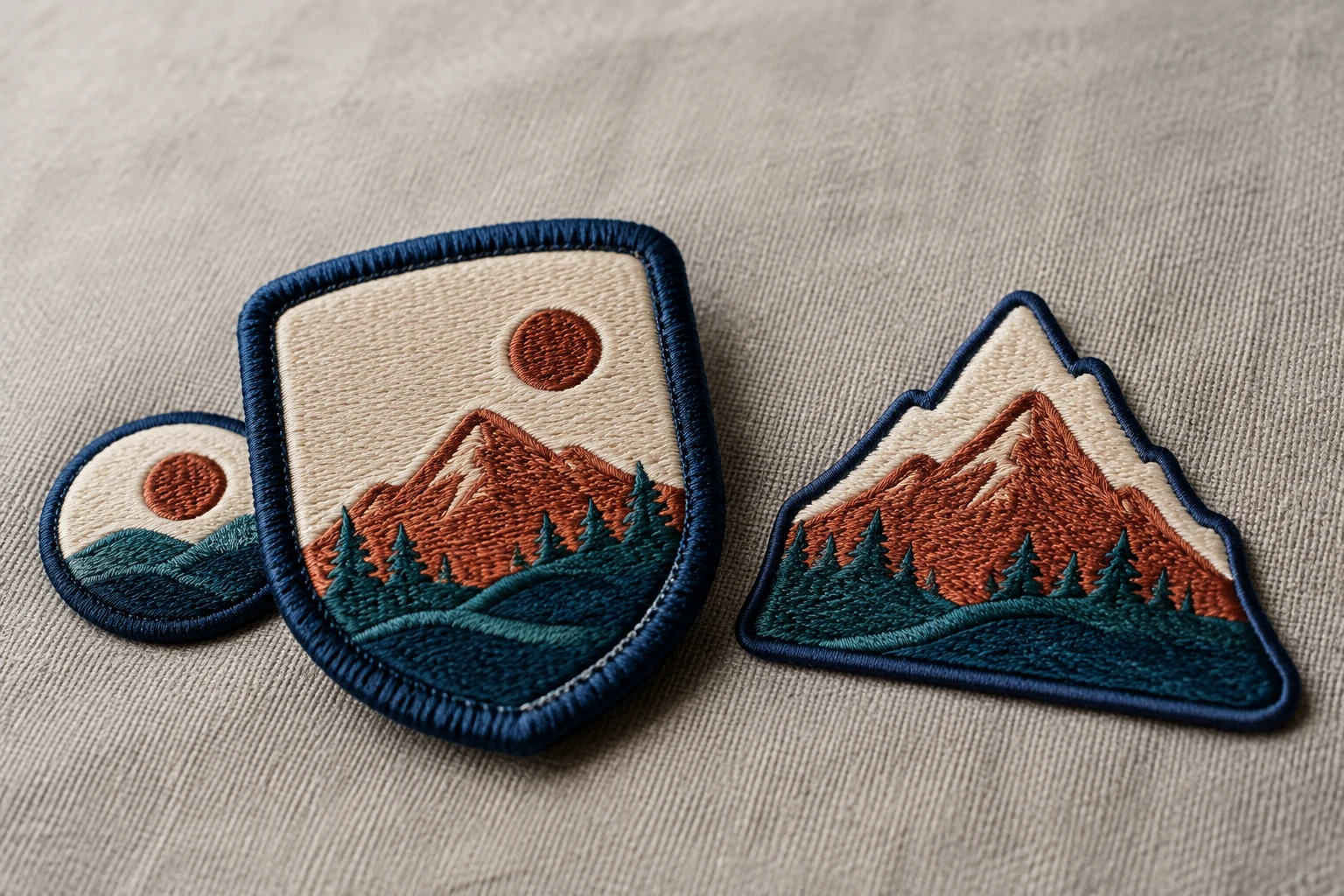
Cover image: AI-generated editorial concept; not a customer project or production proof.
Choose a merrowed border for a raised, traditional edge on a simple patch shape. Consider a hot-cut edge when the patch needs to follow a more intricate outline. These are common options, but they are not the only edge finishes available. Manufacturers also offer satin-stitched and other borders. World Emblem’s border guide illustrates several finishes.
What is a merrowed border?
A merrowed border uses overlock stitching wrapped around the patch edge, creating the familiar rounded, rope-like rim. It frames the design and covers the fabric perimeter. Merrow manufactures dedicated emblem-edging machines with several stitch widths and profiles, so there is no single universal border width. Merrow’s emblem-edging applications show those variations.
Circles, ovals, shields and rounded rectangles are useful starting shapes for this finish. However, saying that merrowing can only follow gentle curves is too absolute: suitability depends on the outline and the producer’s equipment and process. Penn Emblem specifically notes that intricate or irregular shapes may be unsuitable for merrowing on its woven emblems. Penn Emblem’s product specification explains this limitation.
For a badge with a simple outer frame, a merrowed border is a sensible first option. If the outline contains deep notches or narrow projections, ask the manufacturer to assess the actual artwork.
What is a hot-cut border?
Hot cutting uses a heated cutting tool to separate the patch and seal its edge. EverLighten describes heat cutting with heated scissors as one of its patch-finishing methods. The exact tool and material combination should be confirmed with the producer. EverLighten’s patch construction guide distinguishes heat-cut, merrowed and embroidered borders.
Hot cutting is commonly offered for more complex silhouettes, such as a letter, mascot or flame outline. It gives buyers an alternative to surrounding the artwork with a simple badge shape. That does not mean every tiny point or internal opening will reproduce successfully; request an assessment at the finished size. Patch Depot’s edge guide describes hot-cut edges as an option for more extreme shapes.
Hot cutting and satin stitching are different
Hot cutting describes how the edge is cut; satin stitching describes a sewn border. A hot-cut patch does not automatically have a satin border. If you want a visible thread outline, specify it separately and ask how the cut edge will sit beside it.
A satin border has a flatter appearance than the familiar raised merrowed rim. World Emblem’s border examples show this distinction.
Which border fits your design?
Your priority | Border to discuss with the manufacturer |
|---|---|
A raised, traditional badge rim | Merrowed border |
A circle, oval or rounded rectangle | Merrowed border as a starting option |
An outline following a mascot, letter or flame | Hot-cut edge, subject to artwork review |
A flatter visible thread outline | Satin stitching, with the cutting method specified separately |
Very small notches or sharp interior corners | A sample of the proposed finish at the final size |
Treat these as starting points for a production discussion. A border name alone does not establish the finished patch’s quality or suitability for your use.
What to confirm before ordering
For orders in the US, Canada or UK, provide the finished width and height with units clearly stated. For example, 3 inches equals 76.2 mm. Confirm whether those dimensions include the outer border.
Send the artwork and ask the producer to confirm:
The proposed border width and clearance from lettering or other important details.
Any corners, gaps or projections that need simplifying.
The cutting method, fabric compatibility and whether satin stitching is included.
The intended backing, attachment method and care instructions.
Request a close-up sample photograph showing the edge from the front and side. Check for consistent stitching, exposed fabric, rough cut areas and changes to the intended silhouette.
To discuss your shape and finish, visit DigitEMB’s custom patch service with your artwork, dimensions and preferred border.
Frequently asked questions
Is hot-cut the same as iron-on?
No. Hot-cut describes edge finishing; iron-on describes attachment through a heat-activated backing. Specify the edge and backing separately. EverLighten’s patch options list these as separate choices.
Can a simple round patch have a hot-cut edge?
A simple outline does not require merrowing. Ask for the finish that gives you the desired appearance, and confirm the producer’s material and construction options.
Is a merrowed border always more durable?
Do not assume that the border name guarantees longer life. Compare actual samples and ask about suitability for the intended garment, washing routine and wear conditions.
Practical details for Merrowed Border vs. Hot-Cut Border on Patches
A patch works best when its artwork, size, border and attachment method are chosen together. Use the guidance in this article to create a production brief that is clear enough for a proof review.
Work through these points in order and keep the answers with the artwork or production request. A short written brief makes it easier to compare a proof with the intended result, ask a useful follow-up question and avoid relying on assumptions made from a screen image alone.
The aim is not to add unnecessary steps. It is to identify the choices that change the final result before work begins. If a requirement is unknown, flag it for confirmation rather than guessing; that keeps the approval process focused on the design, material and use that apply to this particular project. Save the approved brief with the project files for future reorders or revisions.
Choose the patch type for the artwork
Consider whether embroidered, woven, chenille or PVC construction best suits the amount of detail, texture and finish you want. Fine lettering and small shapes should be assessed at the real patch size.
Set the size and edge treatment
Give the finished width and height, including any outline or border. A merrowed edge, hot-cut edge or shaped outline changes the usable design area and how the patch reads from a distance.
Select the backing for the use case
Iron-on, sew-on, hook-and-loop and other backings serve different garments and applications. Confirm the item surface and whether the patch must be removable before approving the proof.
Quick questions to check before you proceed
What should be on a patch order brief?
Include the artwork, finished size, quantity, patch type, border preference, backing choice and the product or garment where it will be used.
Why can small text change on a patch?
Patch construction has physical limits. At a small size, very thin lettering or tight spaces may need adjustment so the finished patch stays legible.
When should I approve the proof?
Approve only after checking spelling, dimensions, border, colours, backing and every detail that must be visible in the finished patch.