
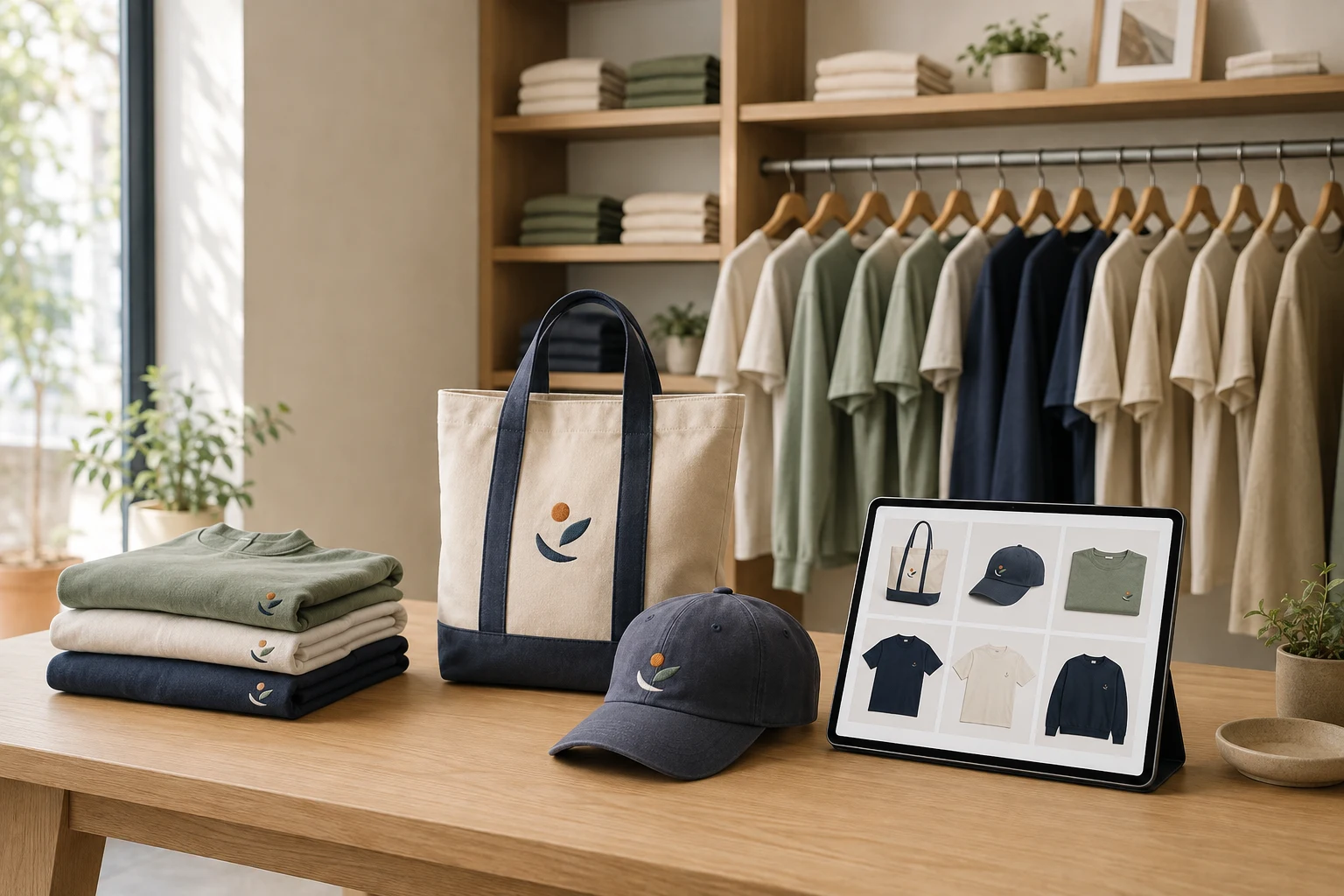
Cover image: AI-generated editorial concept; not a customer project or production proof.
Merchandising is the planning and presentation of products to help customers find, understand and buy them. It connects product selection, placement, pricing, availability and promotion across physical stores and online channels. Visual displays are one part of that work; a complete plan also considers what shoppers need and whether the business can fulfil their orders. Shopify’s merchandising guide describes its application in both retail and ecommerce.
For apparel and accessories businesses, a practical starting point is to choose a coherent range, show products accurately, make sizes and prices easy to compare, and keep promoted items available. These principles apply whether you sell through a shop, an online store or both.
What a merchandising plan should cover
Use a written plan to connect the customer experience with day-to-day operations. Give each activity an owner and a review date.
Planning area | Practical decision |
|---|---|
Product assortment | Choose the styles, sizes and colours that serve a defined audience. |
Presentation | Decide how displays and product pages explain the range. |
Inventory | Set stock review and replenishment routines for individual variants. |
Pricing and promotion | Define the offer, its duration and the margin needed to support it. |
Customer insight | Record sales patterns, shopper questions and reasons for returns. |
Channel coordination | Keep product details and availability consistent wherever customers shop. |
Start with a specific objective, such as helping shoppers locate matching accessories or improving discovery of an overlooked collection. Avoid treating every display change as a sales success before reviewing the results.
Make physical displays easy to shop
A useful display answers three questions quickly: what is this product, who is it for, and where can I find my option?
Group related items around a clear use, such as everyday workwear or travel essentials. Give the focal product enough space to be seen, then position complementary items nearby. Keep signs brief and ensure shoppers can reach products without disrupting the entire arrangement. Product grouping, shelf signage and demonstrations are established merchandising approaches described in Shopify’s definition guide.
For apparel, show one complete outfit while keeping the available sizes easy to locate. For accessories, make differences in dimensions, closures or materials visible. A display should support comparison as well as create an attractive first impression.
Plan maintenance alongside installation. Assign someone to refold garments, replace missing samples, check signs and remove promotions when they end. A strong opening display loses usefulness when its featured products are no longer available.
Merchandise apparel and accessories with useful detail
Build collections around a recognisable customer need. A tightly edited set of polos, caps and bags might suit a workwear collection; a fashion range may be better organised by silhouette, fabric or occasion.
Use consistent colours, photography and presentation to express brand identity, while keeping individual product differences clear. Show the full garment and close views of details that affect the buying decision, including decoration, fastenings and fabric texture.
For customers in the US, Canada and UK, identify the sizing system and provide measurements in inches and centimetres where useful. Distinguish garment measurements from body measurements. Label currencies clearly as USD, CAD or GBP, and explain shipping destinations, delivery estimates and return arrangements before purchase.
For decorated merchandise, approve a physical sample before using it as the reference for product photography. Ask the producer to confirm the decoration’s size, position and colour against the intended garment. Keep this approved reference available for repeat orders.
Connect inventory and promotions
Review demand at the variant level. A style may appear well stocked overall while the sizes customers request most often are unavailable.
Before featuring an item, check available stock, committed orders and the replenishment information supplied by the producer. Decide what shoppers should see if the featured option sells out: an alternative, a clear restock message or a removed promotion.
Set the purpose of a promotion before selecting its format. A coordinated bundle can introduce related products; a limited collection can organise a seasonal presentation. Check the offer against product costs and fulfilment expenses, and state exactly what is included.
Keep a promotion calendar that includes photography, sample approval, stock checks, launch and removal dates. Allow time to correct missing information before the campaign goes live.
Improve digital merchandising
Online merchandising should make the range easy to browse and individual products easy to evaluate.
Build informative product pages
Use descriptive product names, relevant categories and filters that match the range. For clothing, those might include size, colour, fit and material. Write descriptions that answer practical questions instead of repeating promotional language.
Provide an overall image, alternate views and detail photographs. Add concise alternative text that conveys the relevant information in informative images, following W3C’s guidance on informative images.
Video and 3D media can help explain movement or shape when those details matter. Support depends on the platform and theme; Shopify’s product media documentation covers images, video and 3D models. Evaluate whether extra media answers a real shopper question before investing in it.
Recommend relevant products
Separate alternatives from add-ons. A similar jacket offers another choice; a coordinating cap complements the original purchase.
Recommendation tools need configuration and review. For example, Shopify distinguishes related and complementary products and applies availability requirements to their display. Its recommendations also depend on supported theme sections. Check the official recommendation documentation before planning the experience.
Keep channels connected
Link social product features to the matching product or collection page. Ensure the photographed option, price and availability agree with the destination page.
If you offer collection from a physical location, explain which products qualify and how customers receive confirmation. Review the journey from discovery to purchase whenever you change a collection or promotion.
Choose professional merchandising support by scope
A merchandising provider may help with assortment planning, display design, product photography, online collections or reporting. Confirm the exact deliverables rather than assuming one supplier handles every part of the process.
Ask prospective providers for relevant examples, a proposed workflow and a clear account of who maintains the work after launch. Agree on asset ownership, revision limits, responsibilities and how results will be evaluated.
Artwork preparation is a separate production task within a wider merchandise programme. If your range includes embroidered products, DigitEMB’s embroidery digitizing services are relevant to preparing artwork as embroidery files. Specify the intended garment, decoration dimensions and the producer’s file requirements when discussing that work.
Measure results and evaluate new tools
Choose measures that match the original objective. Review product sales alongside availability, returns and the cost of the activity. For online discovery, examine whether shoppers reach the relevant product pages and proceed toward purchase.
Compare similar periods and record other changes, including advertising, discounts and stockouts. An increase during a campaign does not establish that the display alone caused it.
Automated recommendations, virtual previews and connected store experiences are worth testing when they solve an identifiable problem. Begin with a small trial and assess accuracy, maintenance effort and customer usefulness. Do not assume that adding technology will improve conversion or reduce returns.
For sustainability initiatives, consider reusable display components and accurate material information. Support any environmental statement with evidence specific to the product or practice being described.
Frequently asked questions
Is merchandising the same as marketing?
They overlap. Marketing includes activities that attract and communicate with an audience. Merchandising focuses on the products, offers and shopping experience customers encounter as they decide what to buy.
Can a small business manage merchandising itself?
Yes. Start with a manageable collection, clear product information and a routine for checking displays and stock. Bring in specialist help when a defined task exceeds your team’s skills or available time.
How often should displays and online collections change?
Review them regularly and update them when stock, customer needs or promotions change. A fixed refresh schedule can help operations, but useful, available products matter more than change for its own sake.
Does better merchandising guarantee higher sales?
No. Results also depend on demand, product quality, pricing, traffic and availability. Set a specific goal, test a manageable change and use the results to guide the next decision.
Practical details for Merchandising: Practical Strategies for Retail and Online Stores
The best next step is to translate the topic in this article into a short, specific brief. That gives everyone involved the same reference before a file, proof or finished product is prepared.
Work through these points in order and keep the answers with the artwork or production request. A short written brief makes it easier to compare a proof with the intended result, ask a useful follow-up question and avoid relying on assumptions made from a screen image alone.
The aim is not to add unnecessary steps. It is to identify the choices that change the final result before work begins. If a requirement is unknown, flag it for confirmation rather than guessing; that keeps the approval process focused on the design, material and use that apply to this particular project. Save the approved brief with the project files for future reorders or revisions.
State the intended outcome
Describe where and how the finished item will be used, who it is for and the result that matters most. This helps separate a useful requirement from a visual preference.
Collect the source material
Provide the clearest artwork, references and text available. Mark anything that cannot change, such as a logo, spelling, colour or placement requirement.
Review the final details
Before approving work, check the real size, material, format and any production constraints. Confirm the details that affect how the design will look in use, not only on a screen.
Quick questions to check before you proceed
What should I prepare first?
Start with the artwork, its intended use, finished size and any requirements that cannot change.
Why is a proof important?
A proof is the shared reference for checking details before production. It is the best time to correct a size, spelling, colour or placement issue.
What makes a useful request?
A clear request explains the goal, provides the best available source material and identifies the details that need approval.