
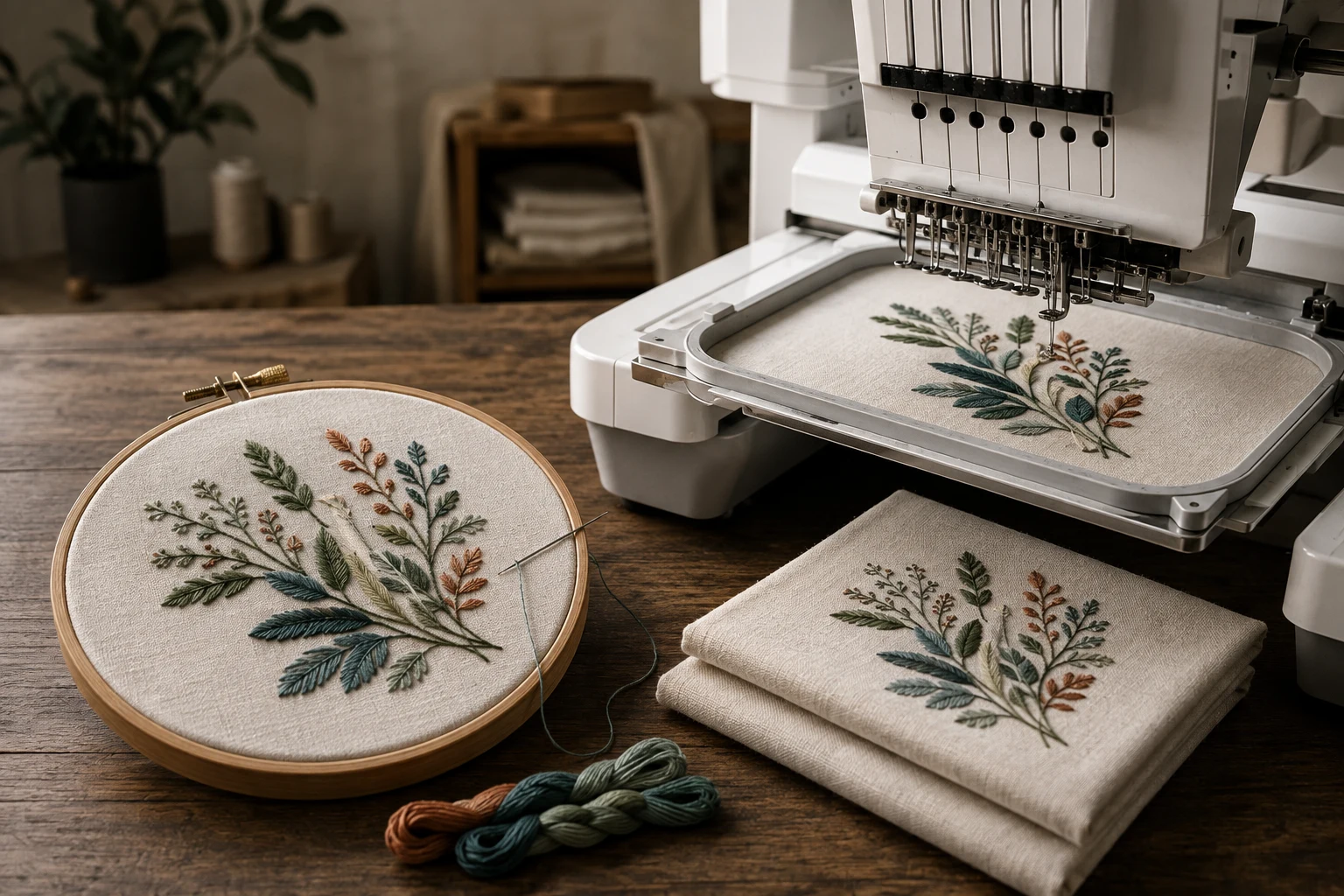
Cover image: AI-generated editorial concept; not a customer project or production proof.
Machine embroidery is usually the practical choice for repeating a design across garments; hand embroidery suits projects where individual stitchwork and artistic control are priorities. Neither method guarantees better quality. The right choice depends on the design, fabric, quantity, budget and finish you want.
For buyers commissioning uniforms, gifts or decorative textiles in the US, Canada and UK, the most useful comparison is between finished results and complete project quotes—not stitching speed alone.
What is hand embroidery?
Hand embroidery involves guiding a needle and thread through fabric by hand. The embroiderer controls each stitch and can adjust its direction, length and placement as the work develops.
Its creative range extends well beyond simple outlines. Techniques include crewelwork, blackwork, goldwork and silk shading, all taught by the Royal School of Needlework. Silk shading, for example, uses carefully placed stitches to create gradual color transitions and lifelike detail. See the school's silk shading overview.
Hand embroidery is worth considering for a personal keepsake, decorative panel or commission where the maker's interpretation is part of the appeal. Repeating a motif is possible, but each piece requires individual stitching time.
What is machine embroidery?
Machine embroidery uses a machine to form stitches. This comparison focuses on computerized embroidery, where the machine follows an embroidery design file. Free-motion machine embroidery, in which the operator guides the fabric, is another approach.
For custom computerized embroidery, digitizing turns artwork into stitch instructions. Software can help convert artwork and refine the resulting design; Hatch's description of auto-digitizing illustrates that distinction between an image and embroidery data.
The file must suit the machine and its embroidery area. Brother's format guidance identifies supported formats and design limits for the models it covers. Always check the specific machine's manual rather than assuming that every embroidery file works on every machine.
Machine and hand embroidery at a glance
Decision factor | How the methods compare |
|---|---|
Repeated designs | Computerized embroidery reuses stitch instructions; hand embroidery recreates the stitches for each piece. |
Appearance | Machine work supports consistent repeated motifs; hand work offers direct control over individual stitches. |
Production time | Machine work reduces manual stitching, but still needs preparation and finishing. Hand work requires time for each stitch. |
Cost | Machine quotes may include digitizing and setup. Hand embroidery quotes reflect the time and skill involved. |
Detail | Both can produce intricate work. Suitability depends on the technique, scale, materials and execution. |
Changes | Machine files can be edited before production. Hand patterns can also be revised before stitching. Finished work is harder to alter with either method. |
Skills required | Machine embroidery needs file preparation and machine operation skills. Hand embroidery needs stitch technique and control. |
Advantages of machine embroidery
Consistency across repeated garments
A saved embroidery file provides a repeatable stitch plan. That makes computerized embroidery a sensible starting point for matching staff shirts, teamwear or recurring merchandise orders.
Repeatability does not mean every finished garment will be identical without attention. Placement, fabric preparation and machine setup still matter. Approve a physical sample and establish a placement reference before a batch begins.
Less manual stitching for repeat work
Once a suitable design is prepared, the machine forms the stitches instead of an embroiderer placing each one by hand. This can make repeated orders more practical.
Allow time for digitizing, sample approval, hooping, thread changes and finishing. A machine's stitching speed is only one part of the schedule; ask for an estimate covering the complete order.
Reusable designs and planned revisions
A digital design can provide a useful starting point for future orders or variations. Keep the approved dimensions, thread references and file version with the production details.
Resizing is not always a simple enlargement. Hatch explains that scaling a stitches-only file changes the spacing between existing stitches without automatically adding or removing them. This can affect density and detail. Significant size changes should therefore be reviewed and tested. See Hatch's resizing guidance.
Potential savings across a batch
When the same prepared design is reused, its setup cost can be spread across several items. That is a reason to request a machine embroidery quote for repeat work, but it does not establish a universal price advantage.
For a single item, compare the complete quotes. A small hand-stitched detail and a large machine-embroidered design involve very different amounts of work.
Where hand embroidery may be the better fit
Choose hand embroidery when you want to commission individual stitchwork, explore a particular hand technique or make something yourself without investing in an embroidery machine.
It also allows the maker to respond directly to the developing piece. Discuss whether you want closely matched repeats or visible variations that reflect the hand process.
Do not assume that machine embroidery is inherently more delicate or that hand embroidery has fewer design possibilities. Review examples of the proposed technique at a comparable size, and ask how the maker would interpret your artwork.
Quality depends on preparation
Machine embroidery still needs an operator who understands the equipment and materials. Brother's PE-700II manual explains the importance of stabilizer and proper fabric framing, and includes troubleshooting for stitching problems. Automation does not eliminate faults.
Before approving either method, examine a representative sample for readable details, secure stitching, the intended colors and a finish appropriate to the item. For wearable pieces, also consider how the reverse feels against the skin. Request care instructions for the finished combination of fabric, thread and any embellishments.
A screen preview helps you discuss the design, but a physical sample lets you assess the actual texture and fabric response.
How to choose and brief your provider
Start with the purpose: matching uniforms point toward machine embroidery, while an individually stitched decorative commission may favor hand embroidery. Then give prospective providers the same information so their proposals are comparable:
Artwork and finished dimensions, clearly marked in inches or millimeters.
Garment or fabric type and the intended embroidery placement.
Quantity, including whether you expect repeat orders.
Desired colors, texture and any essential fine details.
Required completion date and whether you need a digital file or finished embroidered goods.
For US, Canadian and UK buyers comparing quotes, confirm the quoted currency and whether sampling, revisions and physical delivery are included. Distinguish file delivery from delivery of finished garments.
If you need a custom machine file, explore DigitEMB's embroidery digitizing service. Confirm the required machine format, finished size and fabric before requesting the work, and arrange a test sew-out before production.
Frequently asked questions
Is machine embroidery always cheaper than hand embroidery?
No. Quantity, design complexity, setup and finishing affect the total. Machine embroidery can be economical for repeated designs, while a simple hand-stitched detail may be suitable for a one-off project. Compare quotes for the same brief.
Can machine embroidery reproduce a hand-embroidered design?
It can interpret many motifs, but the result may have a different texture or stitch structure. Ask for a sample if preserving the original appearance matters.
Can either method be changed after stitching?
Some changes are possible, but removing stitches may leave marks or damage fabric. Approve size, colors and placement before work starts; editing a digital file does not change an already embroidered garment.
Which method should a beginner learn?
Hand embroidery offers a way to begin with basic tools and practice individual stitches. Machine embroidery suits someone interested in repeatable designs who is willing to learn machine setup, file compatibility and fabric preparation. Choose according to the projects you want to make.
Practical details for Machine Embroidery vs Hand Embroidery: Benefits and Key Differences
Use the article above as a starting point, then make the production brief specific to your own design. A stitch file is made for a finished size and material, so the artwork alone is only part of the instruction.
Work through these points in order and keep the answers with the artwork or production request. A short written brief makes it easier to compare a proof with the intended result, ask a useful follow-up question and avoid relying on assumptions made from a screen image alone.
The aim is not to add unnecessary steps. It is to identify the choices that change the final result before work begins. If a requirement is unknown, flag it for confirmation rather than guessing; that keeps the approval process focused on the design, material and use that apply to this particular project. Save the approved brief with the project files for future reorders or revisions.
Confirm the finished use
State the item, placement and finished width and height. A chest logo, cap front and jacket back do not use the same sewing area, even when they start from the same artwork.
Protect the smallest details
Review small lettering, narrow gaps, thin outlines and tiny colour changes at the final size. Simplifying a fragile detail before digitizing is often more reliable than trying to force it into a small sew-out.
Match the file to the machine
Tell the production team the embroidery machine or format required, along with the fabric or garment type. This lets them prepare the right export and make choices that suit the material rather than treating every job alike.
Quick questions to check before you proceed
What should I send with my artwork?
Send the clearest original available, the finished dimensions, placement, fabric or garment type and the required machine format if you know it.
Can the same file be used at every size?
Not always. Scaling changes the relationship between stitch length, detail and fabric, so a design may need review when the finished size or placement changes.
What should I check before production?
Confirm the spelling, colours, final size, placement and any details that must remain readable. A proof or sample is the best point to catch a change.