
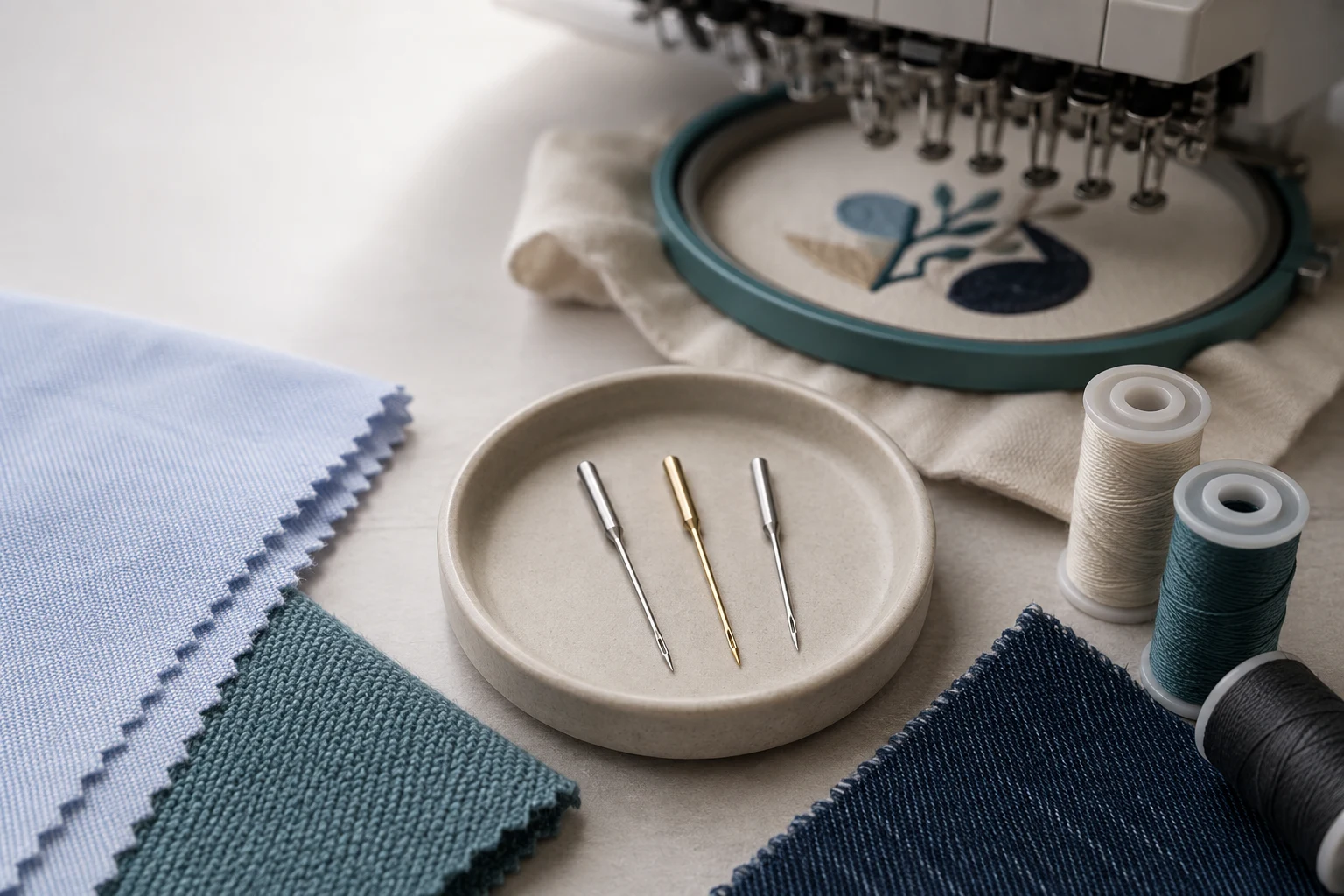
Cover image: AI-generated editorial concept; not a customer project or production proof.
Choose the needle system your machine requires first, then match the needle size to your thread and the point to your fabric. A 75/11 needle is a common starting point for 40-weight embroidery thread, provided your machine permits it. Confirm the combination with a sample before stitching the finished garment. Madeira’s needle guide identifies 75/11 as a standard size for this thread weight.
This guide covers home and commercial embroidery, from understanding the package to choosing needles for shirts, knits, heavier fabrics and specialty threads.
Check the needle system before buying
A size such as 75/11 does not establish compatibility. You also need the needle system specified in your machine manual.
Most home embroidery machines use flat-sided shanks, while many commercial machines use round shanks. There are exceptions: Madeira includes Brother PR multi-needle machines among those using flat-sided needles. Do not choose a shank solely by the number of needles on your machine. Madeira’s machine embroidery needle overview explains these distinctions.
For example, SCHMETZ identifies its household embroidery needle as system 130/705 H-E. That designation and the size serve different purposes: one identifies the needle system and type; the other identifies its thickness. Check the full specification against your manual before ordering. SCHMETZ embroidery needle specifications.
Whether buying in the US, Canada or the UK, keep the complete system designation and paired size in your shopping notes. A listing that says only “embroidery needle” is insufficient for checking fit.
Parts of a machine embroidery needle
Knowing the anatomy helps you understand why seemingly similar needles behave differently.
Needle part | What it does |
|---|---|
Shank | Fits into the machine’s needle holder. |
Shoulder | Connects the thicker shank to the blade. |
Shaft or blade | Forms the main working body; its diameter determines the metric size. |
Groove | Guides the thread toward the eye. |
Eye | Allows the upper thread to pass through the needle. |
Scarf | Provides clearance above the eye for the hook to catch the thread loop. |
Point and tip | Enter the material; their shape affects penetration. |
These functions are explained in SCHMETZ’s needle anatomy reference. The groove guides the upper thread; the scarf helps the hook reach its loop during stitch formation.
Embroidery needles versus general sewing needles
Embroidery needles are sewing machine needles designed with embroidery thread handling in mind. An enlarged eye and wider groove can reduce friction on thread during repeated stitching. SCHMETZ lists these features for its embroidery needles, including their use with rayon, polyester and specialty embroidery threads. SCHMETZ embroidery needle specifications.
A universal needle may work for some applications, but matching the size alone does not reproduce an embroidery needle’s geometry. Equally, the embroidery label does not guarantee that a needle suits every fabric. Consider the eye, point and system together.
Understanding embroidery needle sizes
In 75/11, 75 is the metric designation and 11 is the corresponding American size. The metric number describes blade diameter in hundredths of a millimeter: a size 75 blade is nominally 0.75 mm across. Higher numbers mean a thicker blade, rather than a sharper point. SCHMETZ needle guide.
Use the following as a starting reference, subject to your machine’s permitted range and the thread manufacturer’s recommendations.
Needle size | Selection guidance |
|---|---|
60/8–65/9 | Fine-thread options; check the specific thread’s recommended range. |
75/11 | Common starting size for standard 40-weight embroidery thread. |
80/12 | An option for certain thicker or specialty threads when specified by their manufacturer. |
90/14 | May suit heavier specialty threads; some Madeira 30-weight metallic threads specify this size. |
These examples follow Madeira’s needle and thread guidance. They are not fixed fabric rules: denim does not automatically require 90/14, and every lightweight fabric does not automatically require the smallest available needle.
Choose the point for the fabric
Ballpoint needles are commonly used for knits and some lightly woven fabrics. Their rounded point helps move between the fabric’s yarns. Sharper points are commonly used for tightly woven materials. Madeira distinguishes these applications in its needle selection overview.
For a polo shirt, begin with the recommended knit-compatible point. For a woven shirt, canvas bag or cap, consult the relevant fabric and machine guidance. Check the manufacturer’s point description because names and codes vary between product lines.
Highly elastic fabrics may require a different needle geometry. SCHMETZ identifies stretch needles as an option for fabrics containing elastane or spandex, and recommends testing to establish the best result. Use them for embroidery only when compatible with your machine. SCHMETZ needle FAQs.
Metallic and other specialty threads
Metallic thread can benefit from a needle designed to give it more clearance through the eye. SCHMETZ’s metallic needle has an elongated eye intended to reduce stress on the thread. Confirm the required system and size before substituting it for your usual embroidery needle. SCHMETZ metallic needle specifications.
Chrome and titanium-nitride coatings
Coating is another selection factor, alongside the needle’s system, size and point.
Chrome-coated needles: SCHMETZ describes chrome as its standard household needle coating. Choose the appropriate needle geometry within that product range. SCHMETZ coating guidance.
Titanium-nitride-coated needles: These have a hard, gold-colored wear-protection surface. SCHMETZ describes its Gold Embroidery needle as suitable for extensive embroidery and rigid, densely woven fabrics. This supports considering it for demanding work, but does not establish a universal lifespan multiplier or make it suitable for every machine. SCHMETZ Gold Embroidery specifications.
An enlarged eye is a design feature, not something supplied by the coating itself. Choose the correct geometry before comparing finishes.
Put your selection through a sample sew-out
Use this practical sequence before committing a garment or production run:
Record the machine requirement. Note the needle system, permitted sizes and installation instructions.
Check the thread recommendation. Use the exact thread product and weight when consulting a needle chart.
Match the point to the fabric. Consider stretch, weave and the layers being embroidered.
Prepare a representative sample. Use the intended fabric, backing, topping, thread and design.
Inspect the result. Look for thread damage, skipped stitches and visible fabric damage. Change one variable at a time and record the result.
Madeira’s needle selector follows the same core relationship: fabric informs point selection, while thread type and count inform needle diameter. It also recommends trying another size or point when the initial selection is unsuccessful.
If you are commissioning a stitch file, include the garment material, finished design dimensions, placement and intended thread in the brief for DigitEMB’s embroidery digitizing service. Keep the successful sample and needle details with your production notes for repeat work.
Replacement and basic troubleshooting
Replace a visibly bent or damaged needle before continuing. Worn needles can contribute to shredded thread, skipped stitches, fabric damage and unusual popping sounds. These symptoms are reasons to inspect the setup, rather than proof that the needle is the only cause. SCHMETZ needle guide.
For repeated breakage, stop and check installation and compatibility against the manual. Persistent needle contact or suspected timing trouble calls for machine service; repeatedly fitting a larger needle is not a reliable diagnosis. SCHMETZ notes that poor timing can cause needle breakage and may require a technician. SCHMETZ troubleshooting FAQs.
Frequently asked questions
Is 75/11 the best embroidery needle size?
It is a common starting point for 40-weight thread, not a universal choice. Your machine, thread product and sample result determine whether it is appropriate. Madeira needle guide.
Do caps always need titanium needles?
No. Select the required system and suitable point first. Madeira highlights sharp-point needles for tightly woven cap materials; its guidance does not make titanium coating a requirement for every cap. Madeira needle guide.
How often should I change an embroidery needle?
Follow your machine and needle supplier’s guidance and replace damaged needles immediately. Madeira gives about eight running hours as an average lifespan, which is a planning reference rather than a guaranteed service interval. Madeira needle guide.
Can two needles marked 80/12 be different?
Yes. They can share a blade size while having different systems, points, eyes or grooves. Read the full package specification rather than relying on the size alone. SCHMETZ needle guide.
Practical details for Machine Embroidery Needles: Sizes, Types and How to Choose
Use the article above as a starting point, then make the production brief specific to your own design. A stitch file is made for a finished size and material, so the artwork alone is only part of the instruction.
Work through these points in order and keep the answers with the artwork or production request. A short written brief makes it easier to compare a proof with the intended result, ask a useful follow-up question and avoid relying on assumptions made from a screen image alone.
The aim is not to add unnecessary steps. It is to identify the choices that change the final result before work begins. If a requirement is unknown, flag it for confirmation rather than guessing; that keeps the approval process focused on the design, material and use that apply to this particular project. Save the approved brief with the project files for future reorders or revisions.
Confirm the finished use
State the item, placement and finished width and height. A chest logo, cap front and jacket back do not use the same sewing area, even when they start from the same artwork.
Protect the smallest details
Review small lettering, narrow gaps, thin outlines and tiny colour changes at the final size. Simplifying a fragile detail before digitizing is often more reliable than trying to force it into a small sew-out.
Match the file to the machine
Tell the production team the embroidery machine or format required, along with the fabric or garment type. This lets them prepare the right export and make choices that suit the material rather than treating every job alike.
Quick questions to check before you proceed
What should I send with my artwork?
Send the clearest original available, the finished dimensions, placement, fabric or garment type and the required machine format if you know it.
Can the same file be used at every size?
Not always. Scaling changes the relationship between stitch length, detail and fabric, so a design may need review when the finished size or placement changes.
What should I check before production?
Confirm the spelling, colours, final size, placement and any details that must remain readable. A proof or sample is the best point to catch a change.