
Cover image: AI-generated editorial concept; not a customer project or production proof.
To create a luxurious home, choose pieces that suit your room, feel comfortable and show thoughtful workmanship. Start with a cohesive palette and one focal point, then add texture through cushions, throws, artwork and decorative objects. Assess materials, construction and care requirements before paying extra for a luxury or limited-edition label.
A beautiful interior can reflect your personality through a treasured textile, an unusual ceramic or a carefully chosen lamp. Embroidered cushions and wall hangings offer another way to introduce detail, while simpler furnishings give those pieces room to be appreciated.
Start with the room and how you use it
Decide what the space needs before choosing individual accessories. A living room used every evening calls for comfortable seating and manageable care. A quieter reading corner might accommodate a delicate decorative cushion or a textile displayed primarily for its appearance.
Choose a focal point: the sofa arrangement, a substantial artwork or a distinctive object on a console. Repeat one or two of its colors elsewhere, and leave some surfaces clear. This gives detailed pieces a place in the room without making every object compete for attention.
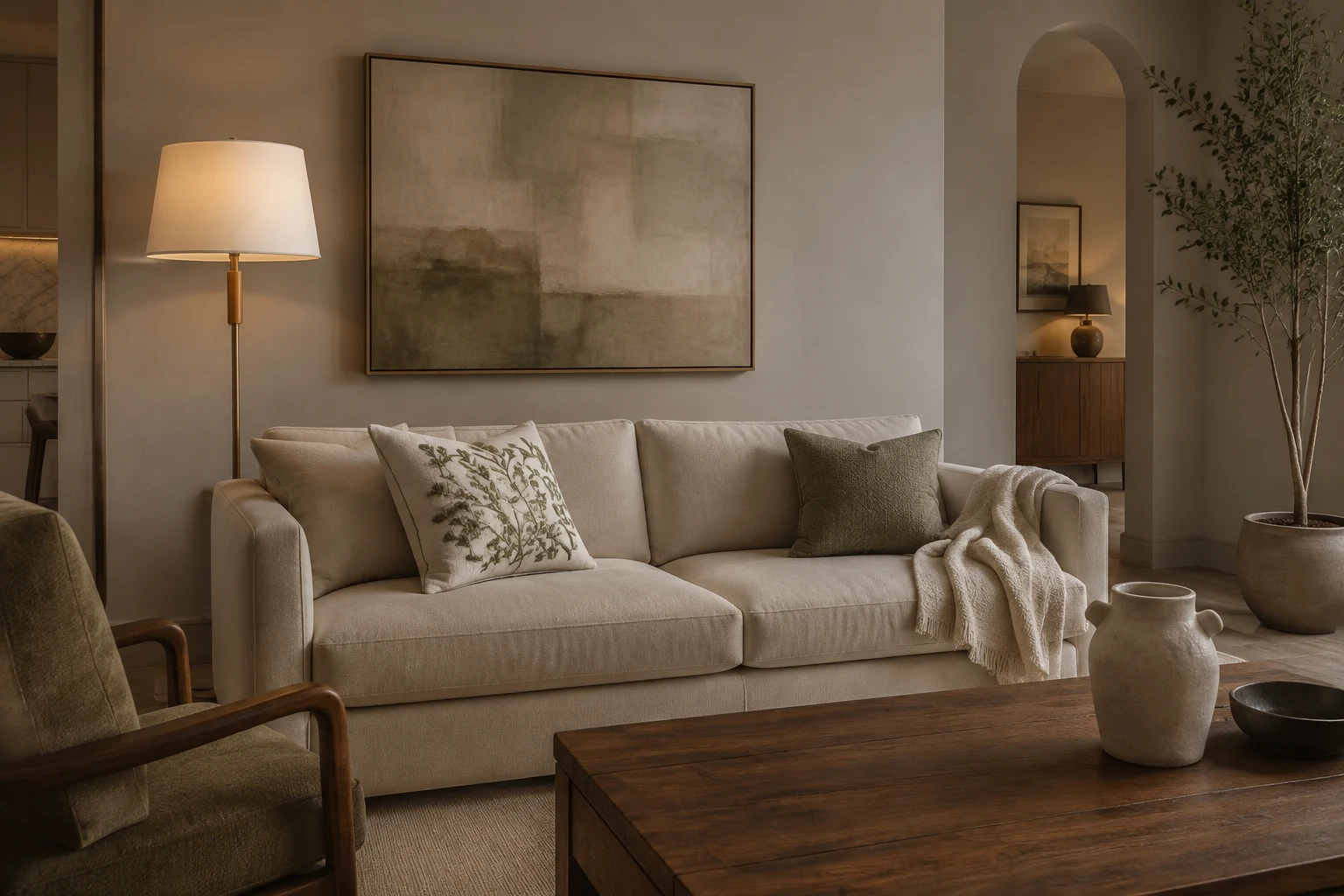
For example, an oatmeal sofa could carry a botanical embroidered cushion, a plain cushion in a matching green and a softly folded throw. A wood side table and a simple ceramic lamp complete the setting. Treat this as a styling possibility, adapting the colors and shapes to furnishings you already own.
Judge craftsmanship beyond the label
Look closely at the finished item. “Luxury,” “exclusive” and a high price do not establish how well something is made or how it will perform in your home.
For textiles, request photographs of the front, reverse, seams and closure. Inspect visible loose threads, uneven edges and areas where the decoration distorts the fabric. For furniture and accessories, ask about materials, surface finishes and care, and inspect details such as joins, edges and the underside when possible.
What to assess | What to ask or inspect |
|---|---|
Materials | Request the fabric composition or main construction materials, including the backing and filling where relevant. |
Workmanship | Examine seams, pattern alignment, closures, edges and the reverse of decorative work. |
Comfort | Handle a sample where possible and assess the areas that will touch your skin. |
Practical fit | Confirm dimensions, weight and any mounting or assembly requirements. |
Care | Obtain instructions for the complete item, including decoration and trims. |
Long-term use | Ask whether covers, inserts or other replaceable parts are available. |
Choose materials for the way you want the piece to look and feel. Silk, linen, cotton and velvet can all be appealing, but a material name alone is insufficient to judge the finished product. Request a swatch when texture or color is central to the purchase.
Understand what a limited edition offers
A limited edition can appeal because you like the designer’s work, the collection’s theme or its restricted availability. Ask the seller to explain what is limited: the number of finished pieces, a particular colorway or the period during which orders are accepted.
Useful questions include:
How many pieces are included in this edition?
Is the design offered in other sizes or colors?
Is the item numbered or accompanied by information identifying its maker and collection?
Is it ready to ship or made after ordering?
Keep any edition documentation with the receipt. Buy for the piece’s appearance, usefulness and personal meaning; do not assume restricted availability establishes superior quality or future resale value.
Custom and limited-edition also describe different arrangements. A personalized cushion might use a widely available motif, while a numbered collection may contain repeated versions of the same design. Ask what makes the specific item distinctive.
Choose embroidered pieces for texture and character
Embroidery adds visible stitch detail to cushions, throws and textile art. Consider how the motif reads both close up and from across the room. A highly intricate pattern may be enjoyable to examine, while a simpler design may have a stronger presence at a distance.
For a contemporary setting, try geometric or abstract motifs with restrained colors. Floral designs can work in traditional rooms or soften more minimal furniture. Choose patterns you enjoy living with rather than treating either approach as a fixed rule.
Ask whether a piece is hand embroidered, machine embroidered or combines techniques. Judge the finished result and the maker’s explanation instead of assuming one method always produces better workmanship.
If commissioning machine embroidery, confirm whether you are ordering a digital file or a finished household item. DigitEMB’s embroidery digitizing and vector services provide a starting point for an artwork-preparation enquiry. Describe your intended textile and confirm project suitability, deliverables and who will make the physical item before ordering.
Select cushions that balance decoration and comfort
Cushions are an approachable way to refresh an existing sofa, chair or bed. Measure the available space and check the finished cover dimensions. Confirm whether the purchase includes an insert and which insert size the maker recommends.
Inspect the closure and ask whether the cover can be removed. Check the reverse as carefully as the embroidered face, particularly if the cushion will be turned or handled frequently. Consider whether raised decoration or trims feel comfortable in the intended position.
Build the arrangement around one patterned cushion, then add simpler companions that repeat a color or texture. Varying shapes can add interest, but leave enough seating space for everyday use.
For online purchases, request a photograph of the full cushion alongside a close view of the embroidery. Detail photographs alone can make it difficult to judge the design’s scale.
Bring the whole room together
Coordinate color without matching everything
Take your palette from an existing rug, artwork or furnishing. Repeat selected colors across different materials: a thread color might reappear in a ceramic vessel or throw. Allow some variation so the room feels personal.
Review swatches in the actual room during daylight and under the lamps you use in the evening. Use physical samples to settle important color choices whenever possible.
Layer texture with restraint
Pair a detailed textile with quieter surfaces. An embroidered throw can sit alongside plain upholstery; a decorative bowl can stand on an otherwise uncluttered table. Balance soft furnishings with wood, glass or ceramic according to your taste.
Before buying another object, try rearranging what you own. Moving a lamp or giving a favorite piece more surrounding space may improve the room without an additional purchase.
Light textiles thoughtfully
Use comfortable room lighting to make texture visible, and avoid placing cherished textiles in strong sunlight or beneath intense display lighting. Light exposure can fade colors and weaken fibers; the Canadian Conservation Institute explains that the damage is cumulative and irreversible. Read its textile care guidance.
Buy with clear measurements and order details
For buyers in the US, Canada and UK, label measurements clearly in inches or centimeters. Check the listed dimensions rather than relying on descriptions such as “large” or “standard.” For example, 20 inches equals 50.8 centimeters, so a nominal 50-centimeter cover is not precisely the same measurement.
Before ordering, confirm:
Whether the listing covers a complete item, cover only, set or digital design.
The final dimensions, materials, colors and included components.
The total price and currency, with shipping and any additional charges identified.
The delivery destination, expected dispatch timing and delivery estimate.
The seller’s return arrangements and any terms specific to personalized pieces.
For a commission, retain the agreed description and approved design. Ask about a physical sample when the fabric, stitch appearance or color is important to the decision.
Plan care before choosing a delicate piece
For newly manufactured cushions and throws, obtain the maker’s care instructions for the complete product. Do not infer that a decorated cover is washable simply because its base fabric is described as cotton or linen. Ask separately about the insert.
Historic or fragile textiles need a different approach from everyday furnishings. The Canadian Conservation Institute recommends consulting a qualified textile conservator about wet cleaning special textiles and describes supportive storage using suitable materials. Its guidance is particularly relevant to inherited or collected pieces. See basic textile care.
Match the item’s care needs to your routine. A piece you can comfortably use and maintain is more likely to remain a satisfying part of your home.
Frequently asked questions
Does luxury décor have to be limited edition?
No. Assess design, workmanship, comfort and suitability for your room. Limited availability is one consideration, not proof of quality.
How can I make an existing room feel more refined?
Choose a clear focal point, reduce crowded surfaces and coordinate a few colors. Add one distinctive textile or object, then review the arrangement before buying more.
Are embroidered cushions suitable for everyday use?
Assess the specific cushion’s comfort, construction and care instructions. Check raised decoration, trims, removable covers and the supplied or recommended insert before choosing it for frequently used seating.
Can I combine modern furniture with traditional embroidery?
Yes. Try repeating a color from the embroidery in another part of the room and keeping nearby accessories simple. Judge the combination in your own space.
Does an embroidery digitizing order include a finished cushion?
Confirm the deliverables explicitly. Digitizing concerns the machine embroidery file; the fabric, stitching, sewing and insert need to be included in a separate or clearly defined finished-product arrangement.
Practical details for Luxury Home Decor: Choosing Quality Pieces and Styling Them Well
Use the article above as a starting point, then make the production brief specific to your own design. A stitch file is made for a finished size and material, so the artwork alone is only part of the instruction.
Work through these points in order and keep the answers with the artwork or production request. A short written brief makes it easier to compare a proof with the intended result, ask a useful follow-up question and avoid relying on assumptions made from a screen image alone.
The aim is not to add unnecessary steps. It is to identify the choices that change the final result before work begins. If a requirement is unknown, flag it for confirmation rather than guessing; that keeps the approval process focused on the design, material and use that apply to this particular project. Save the approved brief with the project files for future reorders or revisions.
Confirm the finished use
State the item, placement and finished width and height. A chest logo, cap front and jacket back do not use the same sewing area, even when they start from the same artwork.
Protect the smallest details
Review small lettering, narrow gaps, thin outlines and tiny colour changes at the final size. Simplifying a fragile detail before digitizing is often more reliable than trying to force it into a small sew-out.
Match the file to the machine
Tell the production team the embroidery machine or format required, along with the fabric or garment type. This lets them prepare the right export and make choices that suit the material rather than treating every job alike.
Quick questions to check before you proceed
What should I send with my artwork?
Send the clearest original available, the finished dimensions, placement, fabric or garment type and the required machine format if you know it.
Can the same file be used at every size?
Not always. Scaling changes the relationship between stitch length, detail and fabric, so a design may need review when the finished size or placement changes.
What should I check before production?
Confirm the spelling, colours, final size, placement and any details that must remain readable. A proof or sample is the best point to catch a change.