
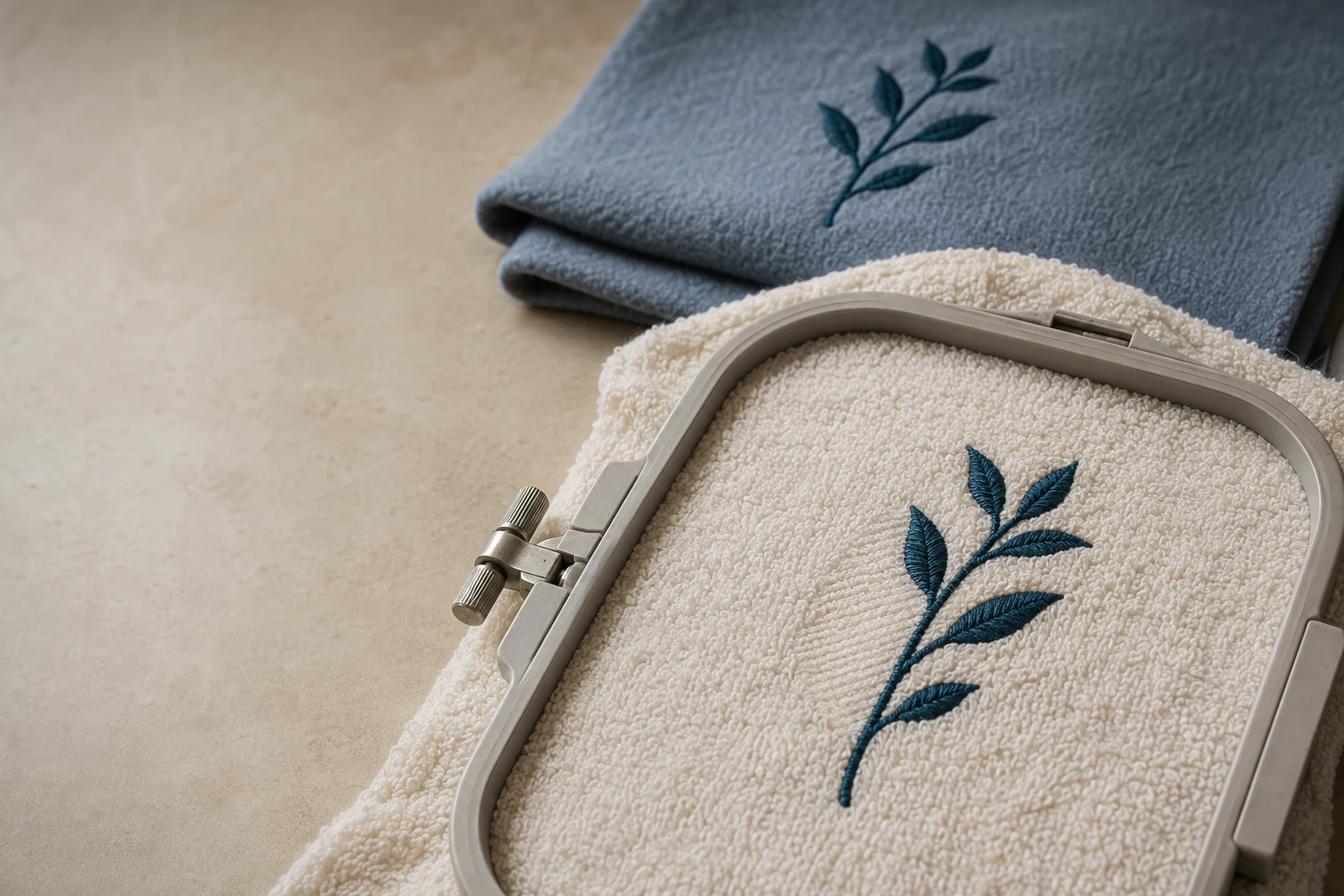
Cover image: AI-generated editorial concept; not a customer project or production proof.
A knockdown stitch is a light foundation of stitching that holds down fabric pile before the main embroidery is sewn. It helps lettering and outlines remain visible on terry cloth, fleece and other textured fabrics. The foundation usually extends slightly beyond the design to keep surrounding fibers from hiding its edges. Embrilliance’s knockdown guide explains this use as a global underlay.
How does a knockdown stitch work?
Raised loops and loose fibers can obscure embroidery, especially thin details. Knockdown stitching compresses that surface beneath and around the design, giving the decorative stitches a clearer background.
It is generally a light fill, rather than a solid satin-like block of densely packed stitches. Hatch calls its corresponding feature Laydown Stitch and allows adjustments to spacing, layers, angle, length and offset. Hatch’s laydown explanation describes how the light fill flattens nap.
The foundation can follow the design’s outline or form a deliberate background shape, such as an oval or rectangle. Choose thread close to the fabric color for a quieter appearance, or treat the visible foundation as part of the artwork.
When should you use it?
Consider knockdown stitching when towel loops or fleece pile obscure lettering, narrow lines or design edges. It is especially relevant to monograms on towels and names on plush items. Embrilliance identifies thin elements on looped and fuzzy fabrics as a useful application. Knockdown applications
Treat the actual fabric and design as the deciding factors. A smooth fabric has little pile to flatten, and a dense design may already cover much of the surface. Test whether the additional foundation improves the result before including it in production.
Knockdown vs. underlay, topping and backing
Knockdown is a form of foundation stitching, so its purpose overlaps with underlay. The useful distinction is its coverage: it controls pile across an area, while ordinary design underlay supports individual embroidered objects.
Foundation or material | Role in the embroidery |
|---|---|
Knockdown stitching | Holds pile down beneath and slightly outside the design; remains in the finished embroidery. |
Design underlay | Supports satin or fill objects and helps stabilize the embroidery; can also help keep cover stitches above soft fabric. |
Topping | Material placed over textured fabric to hold embroidery above the nap during stitching. |
Backing stabilizer | Material beneath the fabric that provides support during embroidery. |
These functions are described in BERNINA’s embroidery glossary and Embrilliance’s knockdown guidance. Adding knockdown does not automatically remove the need for the design’s underlay or suitable backing.
How to add and sew knockdown stitches
Set the final design size first. Record the fabric, placement and finished dimensions so the foundation can be evaluated with the intended artwork.
Create the foundation. Use a knockdown or laydown feature, or digitize a light fill shape beneath the design. Hatch’s tool can work with the entire design or selected objects.
Review the coverage. Adjust the offset and inspect spaces between letters and other openings. Decide which areas should remain textured and which should be flattened.
Check the sewing sequence. The knockdown must sew before the decorative elements it supports. Preview the sequence before exporting the machine file.
Prepare the fabric and sew a sample. Use the intended backing, thread and any topping, then inspect the result before repeating it on finished goods.
Hatch documents the generation, preview and editing controls in its Laydown Stitch walkthrough. Embrilliance also describes creating knockdown by expanding an outline and applying a light fill in its automatic outlining documentation.
Choosing settings and reviewing the sample
Start with the software’s knockdown defaults rather than treating a single density or stitch length as suitable for every fabric. Embrilliance’s manual recommends test sewing to decide whether spacing, stitch length, coverage or bidirectional stitching needs adjustment. Embrilliance platform manual, “Add Knockdown Stitching”
Use these questions to guide that test:
Are loops still covering the edges? Review the foundation’s coverage before changing several settings at once.
Is the background too conspicuous? Compare its shape and thread color with the intended finish.
Does the area feel too stiff? Review the combined foundation and decorative stitching.
Is lettering still difficult to read? Reconsider its size and shape as well as pile control.
For washable items, assess a sample after finishing and laundering according to the fabric and thread care instructions. Keep the successful settings with the production details.
What to tell your digitizer
When requesting DigitEMB embroidery digitizing, include the artwork, fabric description or close-up photo, placement, finished dimensions and required machine format. State whether a visible knockdown border is acceptable and provide a sample photo if pile is hiding the embroidery.
For orders in the US, Canada or UK, label dimensions explicitly in inches or millimeters. Ask whether the file already includes knockdown before adding another foundation, and confirm the result with a sew-out on the intended material.
FAQs
Is knockdown the same as laydown stitch?
The terms describe the same general nap-flattening purpose here. Software tools and their available controls differ; Hatch uses the name Laydown Stitch. Hatch’s feature guide
Can knockdown replace water-soluble topping?
It can make topping unnecessary for some designs, but test your combination before omitting it. Knockdown remains as stitching, while topping is a separate surface material. See Embrilliance’s guidance and BERNINA’s topping definition.
Should the knockdown be completely hidden?
Not necessarily. Its coverage commonly extends beyond the embroidery, so a narrow flattened border may remain visible. Approve that appearance as part of the sample rather than assuming the main design will conceal it.
Practical details for What Is a Knockdown Stitch? How to Use It in Machine Embroidery
Use the article above as a starting point, then make the production brief specific to your own design. A stitch file is made for a finished size and material, so the artwork alone is only part of the instruction.
Work through these points in order and keep the answers with the artwork or production request. A short written brief makes it easier to compare a proof with the intended result, ask a useful follow-up question and avoid relying on assumptions made from a screen image alone.
The aim is not to add unnecessary steps. It is to identify the choices that change the final result before work begins. If a requirement is unknown, flag it for confirmation rather than guessing; that keeps the approval process focused on the design, material and use that apply to this particular project. Save the approved brief with the project files for future reorders or revisions.
Confirm the finished use
State the item, placement and finished width and height. A chest logo, cap front and jacket back do not use the same sewing area, even when they start from the same artwork.
Protect the smallest details
Review small lettering, narrow gaps, thin outlines and tiny colour changes at the final size. Simplifying a fragile detail before digitizing is often more reliable than trying to force it into a small sew-out.
Match the file to the machine
Tell the production team the embroidery machine or format required, along with the fabric or garment type. This lets them prepare the right export and make choices that suit the material rather than treating every job alike.
Quick questions to check before you proceed
What should I send with my artwork?
Send the clearest original available, the finished dimensions, placement, fabric or garment type and the required machine format if you know it.
Can the same file be used at every size?
Not always. Scaling changes the relationship between stitch length, detail and fabric, so a design may need review when the finished size or placement changes.
What should I check before production?
Confirm the spelling, colours, final size, placement and any details that must remain readable. A proof or sample is the best point to catch a change.