
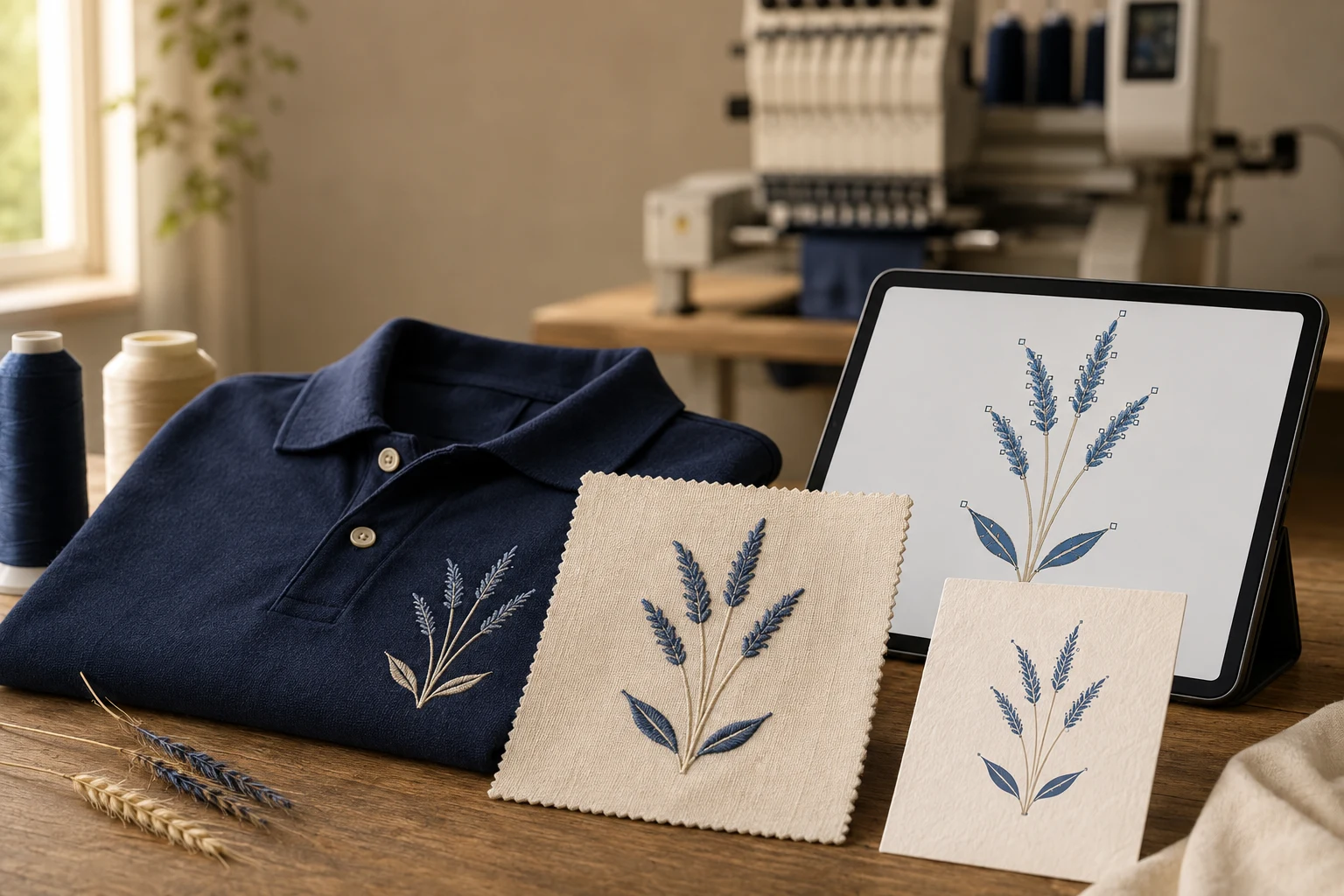
Cover image: AI-generated editorial concept; not a customer project or production proof.
For Kentucky buyers, choose an embroidery digitizing or vector art service by matching its deliverables to your production needs, reviewing relevant samples and agreeing on testing, revisions and deadlines. Request a machine stitch file for embroidery, editable vector artwork for scalable graphics, or both when your project includes apparel and printed materials.
Whether you are ordering staff polos in Louisville, school apparel in Bowling Green or event merchandise in Lexington, start with the finished product and the shop that will produce it. A clear brief makes provider comparisons more useful than an unsupported “top” ranking.
Embroidery digitizing and vector art serve different purposes
Embroidery digitizing prepares artwork for stitching. Vector conversion creates editable shapes for graphic applications. One logo can require both services, but the deliverables are different.
Your project | What to request |
|---|---|
Embroidered polos, jackets or caps | A digitized design exported to the machine format your embroiderer requests |
Logos for signs, printed materials or promotional graphics | Editable vector artwork in the format your producer accepts |
A logo used across embroidery and print | Separate embroidery and vector deliverables based on the same approved artwork |
Finished decorated garments | A production quote that explicitly includes garments and embroidery |
Vector graphics use mathematically defined shapes and remain sharp when resized. They are useful for logos that must appear at several sizes, while raster images use pixels. Adobe explains the distinction between raster and vector images.
An embroidery machine needs compatible stitch data. Hatch’s documentation distinguishes exporting a design to machine formats such as DST and JEF from retaining the working design. Ask your production shop for its exact requirements before commissioning the file. See Hatch’s machine export guidance.
Choosing a service for a Kentucky project
Establish who handles each part of the job
Ask whether the quote covers artwork preparation, digitizing, vector conversion, physical embroidery or a combination. If you need finished uniforms, identify who supplies the blanks, approves placement, runs the sample and delivers the garments.
For an in-person service, confirm the actual location and whether appointments, garment drop-off and pickup are available. For a remote provider, confirm how files and revision feedback will reach your Kentucky embroiderer. A digital service listing alone does not establish a local office or production facility.
Compare relevant work and clear explanations
Request samples similar to your intended size, fabric and application. For a cap order, ask about cap work; for small lettering on polos, ask to see lettering at a comparable finished size. Distinguish photographs of sewn samples from software previews.
For vector work, ask to review curves, spacing, lettering and shape proportions against the supplied original. Confirm whether the service is reconstructing existing artwork, simplifying it for production or creating a new design. Those are different scopes of work.
Useful experience shows in the provider’s questions and proposed adjustments. Ask what details may need changing and require approval before lettering, proportions or important brand elements are altered.
Compare complete quotes
Send each provider the same brief. Ask for the total scope, included formats, revision allowance, charges for additional sizes and any separate production costs. Confirm whether editable working files are included or only final exports.
For deadlines, separate the first proof, revised file, sample approval and finished-garment delivery. Leave room for testing before an event or uniform rollout. Obtain a project-specific schedule instead of relying on a general turnaround claim.
If a buyer or production partner is in Canada or the UK, state dimensions in millimeters and inches and confirm the invoice currency. For example, a 3-inch design is 76.2 mm wide. Specify the time zone for approvals and distinguish digital file delivery from shipping physical goods.
How to assess embroidery quality
Match the design to the fabric
Fabric selection affects digitizing decisions. Underlay, stitch density and pull compensation need to work together for the intended material; a single setting is not a universal quality standard. Hatch’s fabric features adjust these settings according to fabric selection. See Hatch’s description of fabric settings.
Tell the digitizer the garment style, fabric composition, placement and finished dimensions. Include the blank’s product reference if available. Ask whether a change from a polo to a jacket or cap requires a separate version rather than assuming the original file will suit every item.
Approve a physical sample
Have the production shop sew a sample using the intended materials and setup before approving the full order. Inspect lettering, outlines, gaps, overall shape and how the surrounding fabric lies. Record any problems with clear photographs and the sample’s dimensions.
Pull compensation addresses the way stitches can pull shapes inward, and a test sew-out can reveal where adjustments are needed. Hatch explains pull compensation and test stitching.
Agree in advance on who reviews a failed sample and how revisions are handled. Provide the digitizer with the production details as well as the photographs so the discussion can address both the file and the sewing setup.
Confirm compatibility before production
Give the provider the machine model, accepted file format and usable embroidery area supplied by your embroiderer. Ask the shop to confirm that the delivered file opens correctly and fits the intended placement before running garments.
Keep the approved version clearly named with its size and application. If the project changes, request a reviewed version instead of treating an old export as suitable for every new use.
What quality vector artwork should provide
Vector artwork supports consistent logo shapes across signs, print and promotional materials. Its editable geometry also makes changes to colors, proportions and layout practical. However, scalable artwork still needs to meet the requirements of the chosen production process.
Ask your printer or fabricator which file format it accepts and whether it needs specific color information, outlined lettering or other preparation. Review the actual artwork, including any embedded images; a filename extension alone should not be your acceptance test.
Check that the reconstruction preserves intentional details. If the source is blurry, supply another reference for uncertain letters or symbols instead of asking the artist to guess. Request approval of any simplification.
When the same design will also be embroidered, supply the approved vector artwork as a reference and commission the stitch file separately. Agree on any differences between the print and embroidery versions so the finished products remain recognizable as the same identity.
Prepare a useful order brief
Information to supply | Detail to include |
|---|---|
Original artwork | The clearest available file, plus references for unclear details |
Intended products | Polos, caps, jackets, signs or other specific applications |
Finished size | Width and height with units for each version |
Fabric and placement | Blank reference, material and embroidery location |
Production requirements | Machine model and format, or the printer’s vector specifications |
Colors and lettering | Approved color references, exact spelling and permitted changes |
Deliverables | Required exports, editable files and preview documents |
Approval and timing | Decision-maker, sample responsibility and dated milestones |
For service information, review DigitEMB’s embroidery digitizing and raster-to-vector conversion pages. Use your brief to request confirmation of the deliverables, revision terms and schedule for your project.
If environmental considerations affect your order, direct material questions to the garment supplier and decorator. Ask for evidence about the specific blanks, threads and production practices involved rather than assuming a digital artwork service establishes the environmental performance of the finished product.
Frequently asked questions
Do I need a Kentucky-based digitizer?
Choose according to your workflow. Confirm a physical location when you need in-person consultation or garment pickup. For digital files, prioritize clear communication with the shop that will perform the embroidery.
Can a vector logo be sent straight to an embroidery machine?
A vector logo is artwork, not the final machine stitch file. Have it digitized and exported in the format your embroiderer requests, then approve a sewn sample.
Do I need both digitizing and vector conversion?
You may need both if the same artwork will be embroidered and used in print or signage. If you already have suitable vector artwork, ask whether any cleanup is necessary before paying for a separate conversion.
How long should I allow?
Request a schedule for your actual artwork and deliverables. Include time for proof review, test sewing, revisions and physical production where applicable. There is no verified statewide turnaround that applies to every Kentucky order.
What should I do if the sample looks wrong?
Send the provider photographs, finished dimensions, garment details and a description of the problem. Ask the digitizer and embroiderer to review it together, then test the revised setup or file before approving the remaining garments.
Practical details for Embroidery Digitizing and Vector Art in Kentucky: A Buyer’s Guide
Use the article above as a starting point, then make the production brief specific to your own design. A stitch file is made for a finished size and material, so the artwork alone is only part of the instruction.
Work through these points in order and keep the answers with the artwork or production request. A short written brief makes it easier to compare a proof with the intended result, ask a useful follow-up question and avoid relying on assumptions made from a screen image alone.
The aim is not to add unnecessary steps. It is to identify the choices that change the final result before work begins. If a requirement is unknown, flag it for confirmation rather than guessing; that keeps the approval process focused on the design, material and use that apply to this particular project. Save the approved brief with the project files for future reorders or revisions.
Confirm the finished use
State the item, placement and finished width and height. A chest logo, cap front and jacket back do not use the same sewing area, even when they start from the same artwork.
Protect the smallest details
Review small lettering, narrow gaps, thin outlines and tiny colour changes at the final size. Simplifying a fragile detail before digitizing is often more reliable than trying to force it into a small sew-out.
Match the file to the machine
Tell the production team the embroidery machine or format required, along with the fabric or garment type. This lets them prepare the right export and make choices that suit the material rather than treating every job alike.
Quick questions to check before you proceed
What should I send with my artwork?
Send the clearest original available, the finished dimensions, placement, fabric or garment type and the required machine format if you know it.
Can the same file be used at every size?
Not always. Scaling changes the relationship between stitch length, detail and fabric, so a design may need review when the finished size or placement changes.
What should I check before production?
Confirm the spelling, colours, final size, placement and any details that must remain readable. A proof or sample is the best point to catch a change.