
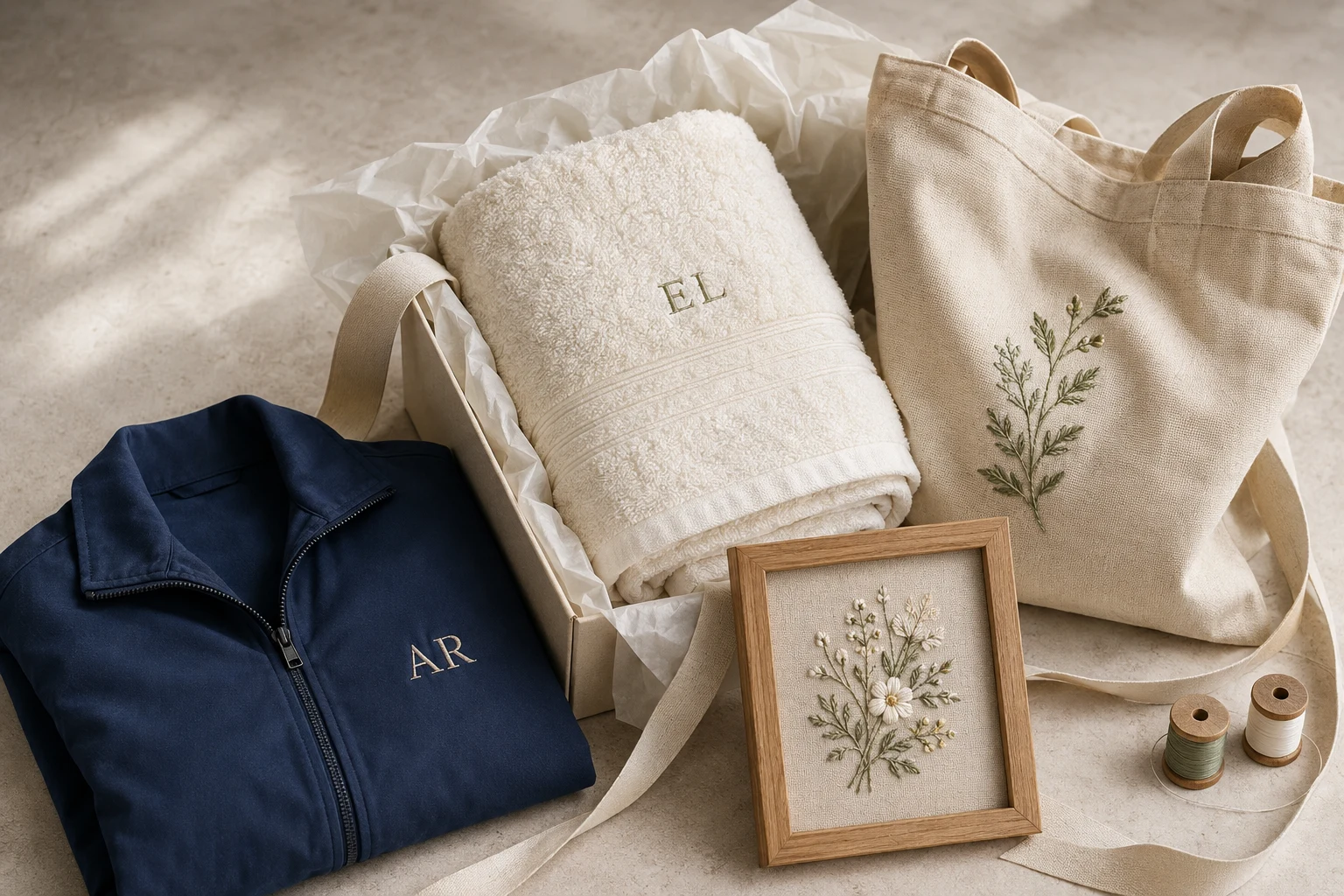
Cover image: AI-generated editorial concept; not a customer project or production proof.
Personalized embroidery gifts work best when the item suits the recipient and the design adds a meaningful detail: initials on wedding towels, a favorite motif on a tote, or a name on a jacket. Choose the gift first, agree on the wording and placement, then review the design before stitching begins.
For buyers in the US, Canada and the UK, the key ordering question is what the service includes: a finished embroidered item, embroidery on an item you supply, or a digital design file for a separate embroiderer.
Gift ideas for different recipients and occasions
Start with something the recipient will enjoy using or displaying. A thoughtful design can be small and understated; it does not need to cover the whole item.
Gift idea | Personalization to consider |
|---|---|
Wedding or anniversary towels | Initials, names or a shared date, with placement shown on a proof |
Housewarming linens | A discreet monogram or botanical motif on napkins or a table runner |
Birthday tote or pouch | A name, hobby motif or short personal phrase |
Apparel such as T-shirts and jackets | Initials, a meaningful symbol or a small commemorative design |
Sports team hats or bags | A team motif with individual names or numbers checked against a roster |
Framed textile keepsake | A hand-stitched message, family motif or celebration date |
Employee or client gifts | Useful bags or apparel with restrained branding and optional recipient initials |
For group gifts, confirm whether changing each name affects the quote or approval process. For apparel, check the supplier’s measurements rather than relying only on a familiar size label.
Hand embroidery or machine embroidery?
Hand embroidery involves a person forming stitches with a needle and thread. It can suit an individual keepsake when the recipient values the maker’s work. Ask to see examples that match the style you want, whether that is cross-stitch lettering, chain-stitch outlines or satin-stitched details.
Machine embroidery follows prepared stitch data. Digitizing converts artwork into embroidery objects and then into instructions for the machine; an ordinary picture file is not itself a finished embroidery file. BERNINA’s embroidery glossary explains these distinctions.
For several matching gifts, discuss machine embroidery with the supplier. For a personal textile artwork, discuss hand stitching. Neither method alone establishes quality, and the word “handcrafted” does not tell you exactly how an item was made. Ask who creates the design and how it will be stitched.
Match the design to the fabric
Fabric, thread and supporting materials affect the finished result. Ask the embroiderer to assess the actual item before you settle on the size and detail of the design.
Towels need particular attention because of their raised loops. Brother recommends water-soluble stabilizer on top of thick terry towels to help control the pile during embroidery. Its guidance also identifies suitable stabilizer, hooping, needles and thread as factors in embroidery quality. Brother’s guidance on better embroidery results.
For fine fabrics, keep the design discussion focused on whether the material can support the proposed stitching. BERNINA’s bernette manual recommends simpler, lower-stitch-count motifs for fine fabric and testing with the same fabric and stabilizer intended for the project. Bernette 340 embroidery manual.
Request a thread color reference if the shade matters. Also ask how the reverse will look and feel, especially on an unlined bag, towel or garment worn against the skin.
How to order a personalized embroidery gift
Define the finished item. Specify the product, quantity, material, color and sizes. State whether you or the supplier will provide the blank items.
Supply the personalization exactly. Type names, initials, punctuation and dates as they should appear. Spell out the month to avoid US/Canada/UK date-format ambiguity.
Agree on dimensions and placement. Give the embroidery width and height in clearly labeled inches or millimeters. Request a placement preview on the intended item.
Review the proof. Check spelling, initial order, colors and position. For corporate or team gifts, have one person approve the complete recipient list.
Discuss a stitched sample. A digital mock-up helps assess layout; a physical sample lets you inspect the thread, fabric and finish. Confirm whether sampling is included or charged separately.
Confirm the complete quote and schedule. Ask about the item, design preparation, stitching, personalization changes, packaging and shipping. Establish when production starts after approval and distinguish dispatch from expected arrival.
For cross-border orders, confirm the billing currency, destination coverage and whether the quoted total includes applicable taxes and import charges. Give the supplier your required arrival date before approving production.
If you already have an embroiderer and need artwork prepared for machine stitching, explore DigitEMB’s embroidery digitizing service. Specify the item, fabric, finished design dimensions and the file format requested by your embroiderer. Confirm finished-gift production separately from digital file preparation.
Check quality, care and material claims
Before accepting the finished work, compare it with the approved wording and placement. Look for readable lettering, unwanted fabric puckering, loose threads and a tidy reverse. For multiple gifts, check each personalized item against the order list.
Request care instructions for the completed embroidered item, including any limits on washing, drying or ironing. Pass those instructions to the recipient.
For a more considered purchase, choose an item the recipient will keep using. If a supplier describes a gift as recycled or environmentally friendly, ask which component the claim covers and what evidence supports it. Personalization alone does not establish an environmental benefit.
Frequently asked questions
Are personalized embroidered gifts always handmade?
No. They may be stitched by hand or machine. Ask the seller to describe the process if hand stitching is important to your choice.
Can I supply my own towel, jacket or bag?
Ask before buying or sending it. The embroiderer needs to assess the material, construction and access to the intended stitching area. Confirm their policy for customer-supplied items.
Does a digitizing order include the finished gift?
A digitizing order supplies embroidery design data. Confirm separately who supplies the item, runs the embroidery and ships the finished gift.
What should I check on a monogram proof?
Check the exact initials, their order, relative size and placement. For a couple’s gift, confirm their preferred names and arrangement instead of assuming a monogram convention.
Practical details for Personalized Embroidery Gifts: Ideas, Materials and Ordering Tips
Use the article above as a starting point, then make the production brief specific to your own design. A stitch file is made for a finished size and material, so the artwork alone is only part of the instruction.
Work through these points in order and keep the answers with the artwork or production request. A short written brief makes it easier to compare a proof with the intended result, ask a useful follow-up question and avoid relying on assumptions made from a screen image alone.
The aim is not to add unnecessary steps. It is to identify the choices that change the final result before work begins. If a requirement is unknown, flag it for confirmation rather than guessing; that keeps the approval process focused on the design, material and use that apply to this particular project. Save the approved brief with the project files for future reorders or revisions.
Confirm the finished use
State the item, placement and finished width and height. A chest logo, cap front and jacket back do not use the same sewing area, even when they start from the same artwork.
Protect the smallest details
Review small lettering, narrow gaps, thin outlines and tiny colour changes at the final size. Simplifying a fragile detail before digitizing is often more reliable than trying to force it into a small sew-out.
Match the file to the machine
Tell the production team the embroidery machine or format required, along with the fabric or garment type. This lets them prepare the right export and make choices that suit the material rather than treating every job alike.
Quick questions to check before you proceed
What should I send with my artwork?
Send the clearest original available, the finished dimensions, placement, fabric or garment type and the required machine format if you know it.
Can the same file be used at every size?
Not always. Scaling changes the relationship between stitch length, detail and fabric, so a design may need review when the finished size or placement changes.
What should I check before production?
Confirm the spelling, colours, final size, placement and any details that must remain readable. A proof or sample is the best point to catch a change.