
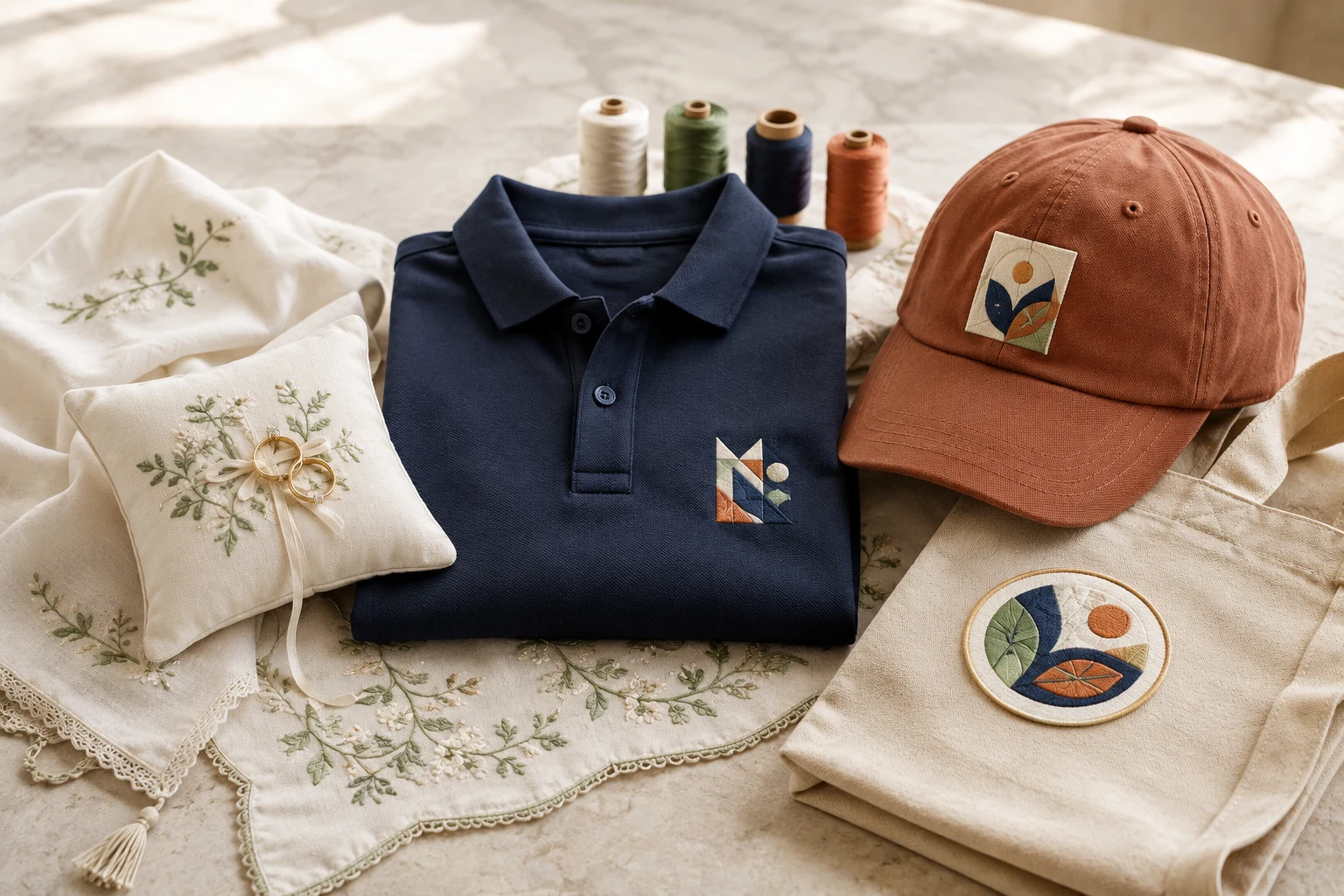
Cover image: AI-generated editorial concept; not a customer project or production proof.
Event-based embroidery adds names, dates, logos or themed motifs to clothing, accessories and decorations for a particular occasion. For weddings, consider personal keepsakes; for corporate events, coordinated staff apparel; and for festivals, merchandise and crew identification. Start with the item and its purpose, then confirm the design, approve a stitched sample and plan production around the date you need the goods in hand.
Wedding embroidery: personal details and keepsakes
Choose a small set of related details that reflects the couple’s style. A floral motif might appear on a ring pillow and table linen, while initials can connect pocket squares, handkerchiefs and bridal party gifts without making every item identical.
Wedding item | Embroidery idea and planning consideration |
|---|---|
Bridal attire | Add a discreet date, initials or floral detail; ask a bridal specialist to assess the garment before any stitching. |
Groomswear | Personalize a pocket square or an accessible jacket lining, subject to the tailor’s approval. |
Bridal party gifts | Coordinate robes, garment bags or totes, with each recipient’s name checked individually. |
Ceremony accessories | Use a shared motif on a ring pillow or keepsake handkerchief. |
Table decorations | Repeat a restrained design on napkins or a runner, with placement approved against the table setting. |
For a valuable or irreplaceable garment, request a trial on matching spare fabric before authorizing work. Ask who will handle any lining access or alterations. If the garment cannot be sampled adequately, consider embroidering a separate keepsake instead.
Confirm the exact initials, their order, spelling and date format. Writing the month as a word can avoid confusion between US and UK date conventions, especially when buyers, suppliers and guests are in different countries.
Corporate event embroidery: apparel with a clear purpose
At conferences, exhibitions and company retreats, embroidered polos, shirts, jackets and caps can give staff a consistent appearance. Tote bags and selected accessories can carry the same visual identity as attendee or client gifts.
Decide whether the item should work beyond the event. An evergreen company logo may suit reusable staff clothing, while an event name or year may be better placed on a separate commemorative item.
Before requesting a sample, agree on:
Which items identify staff, speakers or volunteers.
The approved logo version and thread color references.
Placement and finished dimensions for each item.
Whether individual names or role labels are needed.
The quantity and garment size breakdown.
Ask to see the logo at its intended physical size. If the sample’s tagline is difficult to read, approve a simpler version rather than insisting on every element of the original artwork. Review the actual thread against the garment under useful lighting, as a screen preview alone is a poor basis for color approval.
Festival embroidery: merchandise, costumes and decorations
Festival projects can combine expressive designs with practical uses. Consider caps and bags for merchandise, coordinated clothing for crew members, and embroidered accents for costumes. Banners, flags and tablecloths can also be explored with a decorator who can assess the proposed dimensions and construction.
Use one recognizable motif across the collection, then adapt its size and detail for each product. A souvenir design can include the event year; reusable crew clothing may be more useful without it. For cultural celebrations, have the organizer review symbols, language and imagery before production.
On-site personalization is a separate operational service. If you want guests to add names during the event, confirm that the provider offers it and agree on a limited design menu, available garments, venue requirements, queue management and a daily order limit. Ask what happens to orders that cannot be completed before closing.
These are planning options, not confirmation that a digitizing provider supplies mobile machines, venue staff or finished event merchandise.
Match the design to the fabric
The same artwork needs to be assessed for each intended item. Tell the decorator whether it will be stitched on a woven napkin, a stretchy polo, a cap or a delicate accessory, and supply the actual product details before the design is finalized.
Backing supports the fabric during embroidery. Madeira identifies cut-away backing as suitable for unstable materials such as knits, fleece and stretchy fabrics, while tear-away backing is generally suited to stable fabrics. The appropriate choice still depends on the material and design. Madeira’s embroidery backing guide.
For buyers, the useful question is: “Can you sample this design on the product we intend to order?” Ask to inspect both sides for appearance and comfort, including any backing that will remain.
Special finishes such as raised embroidery should be discussed as optional treatments for a suitable design and item. Approve a physical example before extending them across an event collection.
From artwork to approved production
1. Prepare one complete brief
Include the event purpose, artwork, exact wording, product specifications, quantities, garment sizes, embroidery placement and finished design dimensions. Specify measurements in inches or millimeters, or both, so suppliers in the US, Canada and UK work from the same brief.
Provide a single checked list for personalized names. Identify one person who can approve changes, and keep the approved version clearly distinguished from earlier artwork.
2. Confirm digitizing and production responsibilities
Digitizing creates embroidery objects and stitches from artwork. It involves choices about stitch treatment and sequence; even automated conversion can require adjustment. Wilcom’s documentation describes generating embroidery from imported artwork and optimizing the resulting stitch sequence. Wilcom’s guide to auto-digitizing designs.
Confirm whether your order covers a digital embroidery file, finished embroidered goods, or both. Your production shop should specify the file format it needs. DigitEMB’s embroidery digitizing services provide a relevant starting point for preparing artwork for machine embroidery; separately confirm who supplies and stitches the event items.
3. Approve a stitched sample
Use the sample to assess spelling, placement, scale, thread colors, legibility and fabric appearance. Where practical, request the same blank, backing and thread intended for production. Agree on any changes before authorizing the full quantity.
A digital preview is useful for layout approval, but it does not show how the actual fabric behaves during stitching.
4. Schedule backward from the in-hand date
Set an in-hand date before the event, allowing time to inspect and distribute the goods. Ask the supplier to account for blank availability, digitizing, sampling, revisions, stitching, packing and shipping.
For orders moving between the US, Canada and UK, confirm the delivery destination, shipping arrangements and who handles import charges. Put the quoted currency and delivery assumptions in writing. A digital file completion date is separate from the arrival date for physical merchandise.
5. Inspect delivery and retain the approved details
Check quantities, garment sizes, personalized wording and visible embroidery against the approved sample. Report discrepancies promptly under the supplier’s agreed process.
Keep the approved artwork, thread references, dimensions and product details for reorders. Ask for care instructions appropriate to the finished item and clarify whether repairs or replacement orders are available.
Choose a supplier and plan for reuse
Request examples comparable to your project: delicate keepsakes for a wedding, coordinated apparel for a conference, or a mixed merchandise range for a festival. Ask who handles sampling, revisions and production problems, and compare quotes using the same quantities and specifications.
Discuss artwork preparation, samples, personalization, garment supply, stitching and shipping as separate quote components where applicable. This makes different offers easier to compare without relying on a headline price.
To support reuse, choose items recipients are likely to keep, confirm quantities carefully and consider whether permanent event dates are necessary. If a supplier describes materials as recycled or otherwise environmentally preferable, request product-specific evidence. Embroidery alone does not establish an item’s environmental performance.
Frequently asked questions
Can one design be used for wedding accessories, shirts and caps?
One visual theme can connect them, but ask the decorator to assess each item separately. Confirm size, placement and a suitable sample for every materially different product.
How early should I order event embroidery?
There is no universal lead time. Start once the event date and product choices are known, then obtain a schedule that includes sampling, revisions, production, shipping and inspection before the event.
Does a digitizing order include finished clothing?
Confirm the order scope. A digitizing order may supply only the embroidery file; garment sourcing, stitching and delivery of physical goods must be explicitly included or arranged separately.
Can guests personalize items at the event?
Potentially, if a provider confirms on-site service and venue suitability. Agree in advance on the available options, capacity, collection process and treatment of unfinished orders.
Practical details for Event-Based Embroidery Solutions for Weddings, Corporate Events and Festivals
Use the article above as a starting point, then make the production brief specific to your own design. A stitch file is made for a finished size and material, so the artwork alone is only part of the instruction.
Work through these points in order and keep the answers with the artwork or production request. A short written brief makes it easier to compare a proof with the intended result, ask a useful follow-up question and avoid relying on assumptions made from a screen image alone.
The aim is not to add unnecessary steps. It is to identify the choices that change the final result before work begins. If a requirement is unknown, flag it for confirmation rather than guessing; that keeps the approval process focused on the design, material and use that apply to this particular project. Save the approved brief with the project files for future reorders or revisions.
Confirm the finished use
State the item, placement and finished width and height. A chest logo, cap front and jacket back do not use the same sewing area, even when they start from the same artwork.
Protect the smallest details
Review small lettering, narrow gaps, thin outlines and tiny colour changes at the final size. Simplifying a fragile detail before digitizing is often more reliable than trying to force it into a small sew-out.
Match the file to the machine
Tell the production team the embroidery machine or format required, along with the fabric or garment type. This lets them prepare the right export and make choices that suit the material rather than treating every job alike.
Quick questions to check before you proceed
What should I send with my artwork?
Send the clearest original available, the finished dimensions, placement, fabric or garment type and the required machine format if you know it.
Can the same file be used at every size?
Not always. Scaling changes the relationship between stitch length, detail and fabric, so a design may need review when the finished size or placement changes.
What should I check before production?
Confirm the spelling, colours, final size, placement and any details that must remain readable. A proof or sample is the best point to catch a change.