
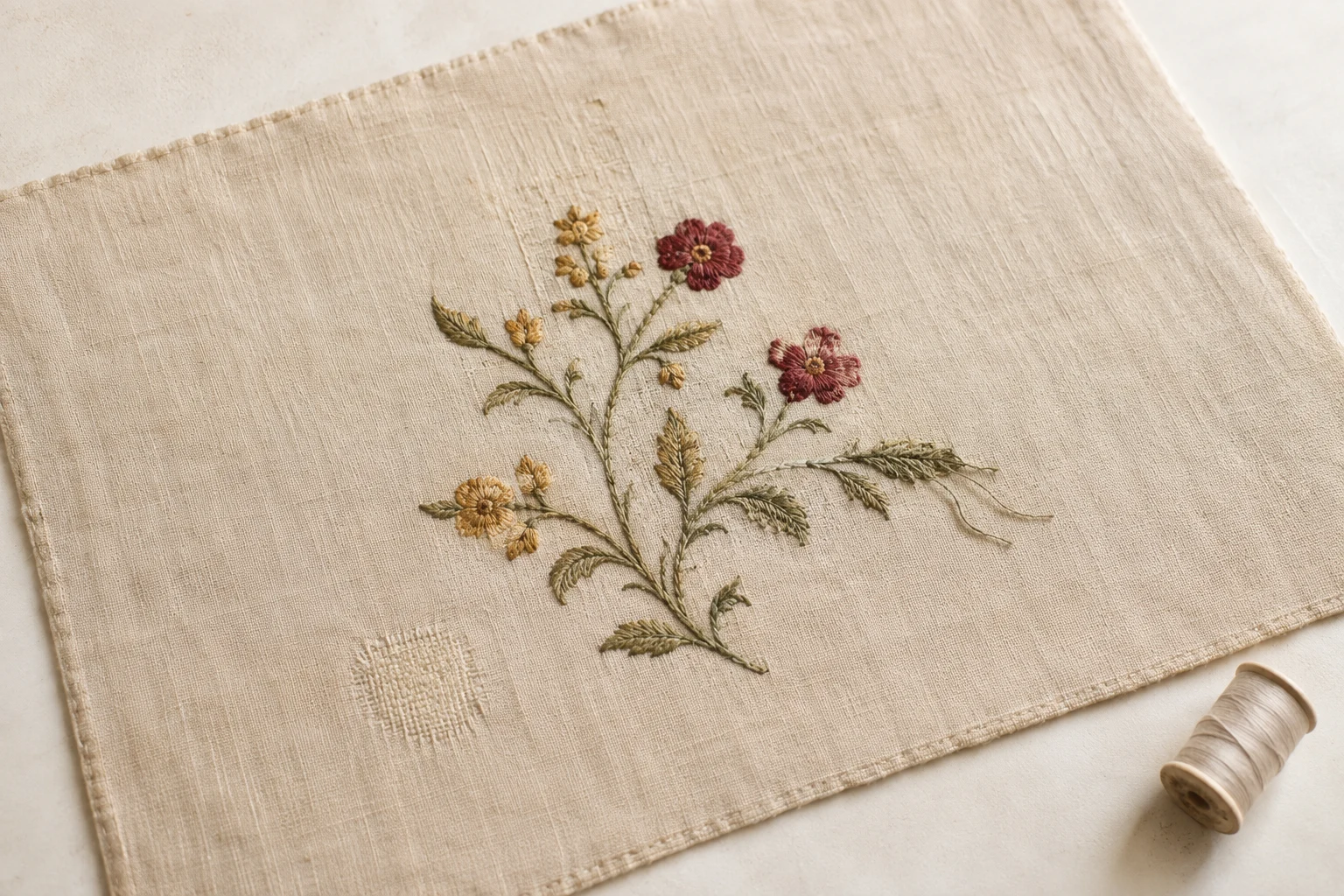
Cover image: AI-generated editorial concept; not a customer project or production proof.
Embroidery repair may secure loose stitches, support damaged fabric or restore missing detail, depending on the item’s condition. Start by deciding whether you want to wear it, display it or preserve its original materials. For fragile or historically significant embroidery, seek a textile conservator’s assessment before cleaning or stitching.
A family sampler, embroidered jacket and antique wall hanging can all deserve attention, but they need different treatment goals. This guide helps owners prepare an assessment, commission appropriate work and care for the result.
Decide what you want to preserve
Before requesting a repair, write down what matters most: the original stitching, a recognizable design, continued use, or the history attached to the piece. Include any cultural significance and changes you would find unacceptable.
Use these descriptions when discussing the work:
Your goal | What to discuss |
|---|---|
Wear a modern garment again | Practical repair, comfort, appearance and future washing. |
Improve the appearance of a decorative piece | Which missing details could be reconstructed and how visible additions may be. |
Preserve a fragile heirloom | Stabilization, retention of original material and supported storage or display. |
Keep using a design while protecting the original | A separate reproduction on new fabric. |
Ask the provider to explain exactly what they mean by “repair,” “restoration” or “conservation” in their proposal. Agree on the treatment itself rather than relying on the service name.
Record the condition before requesting work
Photograph the whole item and any damaged areas. Include the reverse only if it can be accessed without strain. Record dimensions in inches or millimeters, approximate age, known materials, previous repairs and any cleaning already attempted.
Describe what you see without trying to diagnose it: a loose thread, missing stitches, a split beside the embroidery, discoloration or fabric that sheds fragments. Photographs and treatment records are also part of the Canadian Conservation Institute’s guidance on documenting textile cleaning. CCI textile washing and documentation guidance.
Give the specialist enough context to judge the whole object. A close-up of a broken flower motif alone does not show the surrounding fabric or the weight of the garment.
Understand the likely treatment options
Loose stitching and weakened fabric
Ask whether the existing stitches can be secured, whether missing embroidery should be replaced, and whether the underlying fabric needs support first. Recreating a motif and stabilizing its foundation are separate decisions.
Conservation stitching can attach weak or torn areas to support fabric. CCI describes self-couching for this purpose and advises using few, relaxed stitches to avoid tension that can break old threads. Materials should be selected for compatibility, including weight and color. These are specialist treatment considerations, not a universal home repair recipe. CCI stitches used in textile conservation.
Ask to see comparable work, including the reverse where available. Discuss whether a discreet repair, visible mending or preservation of an incomplete area best fits your goal. Do not make an invisible finish a condition before the item has been examined.
Fading and missing colors
Light damage can fade dyes irreversibly. Cleaning should not be presented as a way to recover color lost through fading. CCI textile and costume care guidance.
If replacement stitching is proposed, ask whether the color will match the current appearance or an earlier reference. Those choices can produce different results. Request an explanation before approving dyeing, tinting or replacement of surviving embroidery; a brighter appearance alone does not establish a better preservation outcome.
Stains and cleaning
Do not wash an heirloom simply to make it presentable for assessment. CCI advises against washing fragile, fragmenting textiles and identifies mixed constructions, such as wool embroidery on linen, as unsuitable for its washing procedure. Some stains and finishes also carry historical information. CCI washing guidance.
Ask what testing would precede cleaning, what improvement is realistic and whether leaving a stain is preferable. Colorfastness testing itself may affect the tested area, and even tested dyes can move unexpectedly during washing. Leave testing of valuable embroidery to the specialist. CCI colorfastness testing guidance.
Choose a provider and compare written proposals
For an everyday garment, ask a repairer about experience with its fabric and embroidery. For an antique, culturally significant piece or deteriorating heirloom, request textile conservation experience relevant to the object.
Send the same brief to each provider so that you can compare the proposed work:
Proposal detail | What to confirm |
|---|---|
Assessment | Whether photographs are sufficient initially and whether examination has a fee. |
Treatment goal | Wearability, appearance, stabilization or reproduction. |
Original material | What will remain, what may be removed and what will be added. |
Cleaning | Proposed tests, limitations and whether cleaning is optional. |
Appearance | Expected differences in thread, texture and visible repairs. |
Cost | Assessment, treatment, documentation, mounting and transport listed separately. |
Timing | Examination date, treatment estimate and approval points. |
Handover | Treatment photographs, care advice and restrictions on future use. |
For buyers in the US, Canada and UK, confirm the quote currency and where the physical work will happen. Before mailing an item, obtain packing and delivery instructions and clarify responsibility for return transport. Discuss cross-border arrangements directly when relevant.
Authorize a defined scope. Ask the provider to contact you if examination reveals damage that changes the proposed work or cost. A useful result may be a stable, well-supported textile with some age and wear still visible.
Where digital reconstruction fits
Keep photographs and any surviving artwork with the object’s history. If you want a new embroidered version of a motif, discuss that as a separate reproduction project. Specify which surviving details should be followed and which missing areas would require interpretation.
DigitEMB’s embroidery digitizing service is a relevant starting point for discussing artwork and machine embroidery files for a new piece. Supply the reference, intended dimensions and new fabric. This service page does not establish that DigitEMB repairs or conserves physical heirlooms.
Do not treat a digital preview as evidence that the original textile can tolerate stitching, or that a replacement will match its aged thread exactly. Keep approval of a reproduction separate from approval of treatment to the original.
Plan care before the item comes home
Ask whether the completed piece can be worn or washed, how it should be supported and which changes should prompt another assessment. Retain the treatment description with dated photographs and the item’s history.
For preserved textiles, reduce exposure to light and protect against dust. CCI recommends acid-free tissue and suitable boxes for small flat textiles such as samplers, and padding unavoidable folds to reduce hard creases. Ask the conservator which arrangement suits your particular item. CCI storage and display guidance.
Repair can help you retain something meaningful and, where appropriate, continue using it. Its success depends on the agreed goal and ongoing care; it does not guarantee a particular lifespan or increase in resale value.
Frequently asked questions
Can every embroidered item be restored?
No single treatment suits every condition. Ask whether the feasible outcome is repair, stabilization, supported display or a separate reproduction. Have the object assessed before committing to a cosmetic result.
Should I trim loose threads before sending photographs?
Leave them in place for assessment. Show their location in photographs and ask the repairer how to protect the item during handling and transport.
Will restoration make the piece look new?
That should be discussed before treatment. Matching additions, retaining faded thread and preserving visible age can be different goals. Request a realistic description of the expected result.
How much does embroidery restoration cost?
Request an item-specific written estimate after the provider has enough information to assess it. Compare the treatment scope, documentation, mounting and transport as well as the total. A fixed price without a defined scope is difficult to evaluate.
Practical details for Embroidery Repair and Restoration: A Guide to Saving Treasured Textiles
Use the article above as a starting point, then make the production brief specific to your own design. A stitch file is made for a finished size and material, so the artwork alone is only part of the instruction.
Work through these points in order and keep the answers with the artwork or production request. A short written brief makes it easier to compare a proof with the intended result, ask a useful follow-up question and avoid relying on assumptions made from a screen image alone.
The aim is not to add unnecessary steps. It is to identify the choices that change the final result before work begins. If a requirement is unknown, flag it for confirmation rather than guessing; that keeps the approval process focused on the design, material and use that apply to this particular project. Save the approved brief with the project files for future reorders or revisions.
Confirm the finished use
State the item, placement and finished width and height. A chest logo, cap front and jacket back do not use the same sewing area, even when they start from the same artwork.
Protect the smallest details
Review small lettering, narrow gaps, thin outlines and tiny colour changes at the final size. Simplifying a fragile detail before digitizing is often more reliable than trying to force it into a small sew-out.
Match the file to the machine
Tell the production team the embroidery machine or format required, along with the fabric or garment type. This lets them prepare the right export and make choices that suit the material rather than treating every job alike.
Quick questions to check before you proceed
What should I send with my artwork?
Send the clearest original available, the finished dimensions, placement, fabric or garment type and the required machine format if you know it.
Can the same file be used at every size?
Not always. Scaling changes the relationship between stitch length, detail and fabric, so a design may need review when the finished size or placement changes.
What should I check before production?
Confirm the spelling, colours, final size, placement and any details that must remain readable. A proof or sample is the best point to catch a change.