
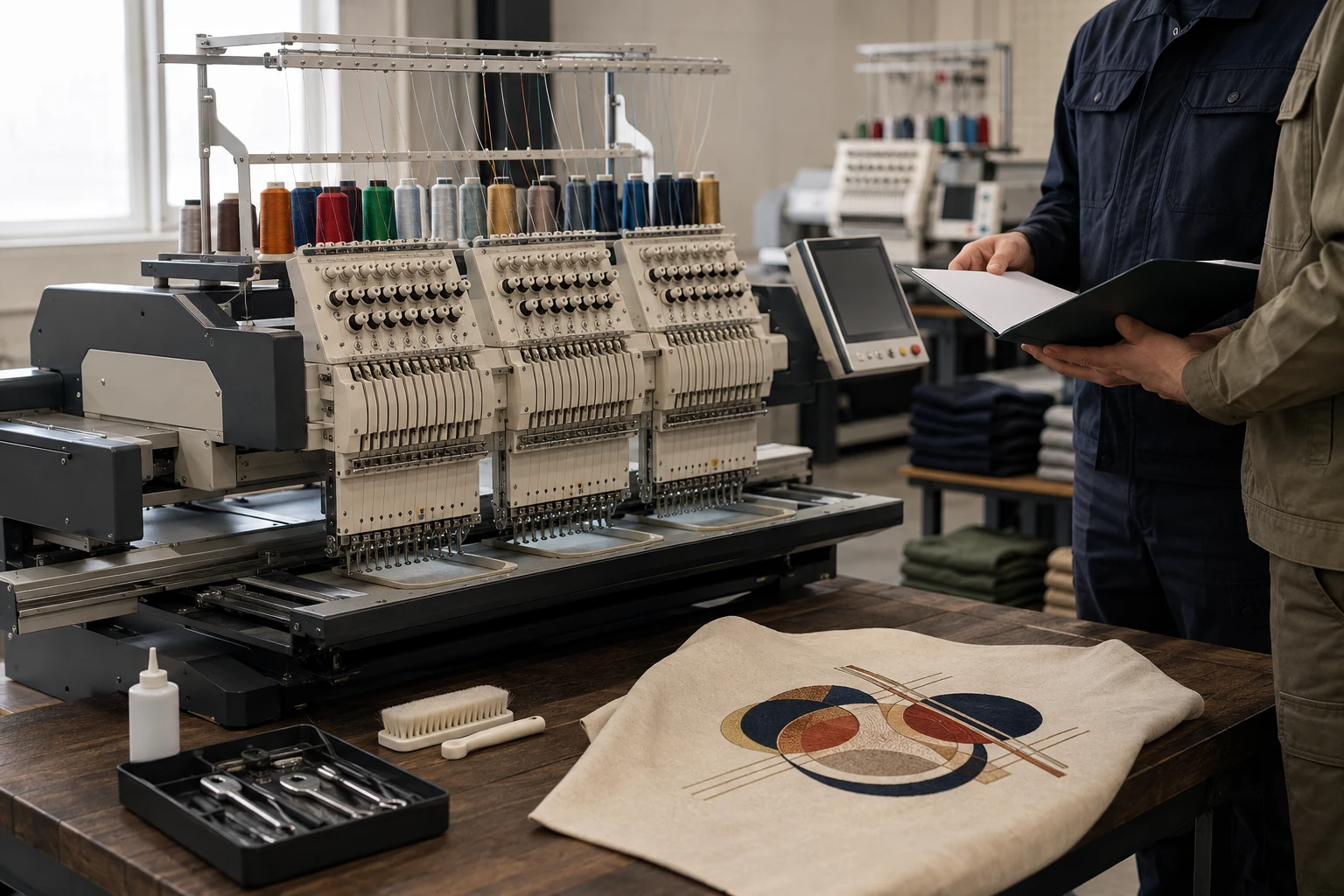
Cover image: AI-generated editorial concept; not a customer project or production proof.
An embroidery machine maintenance subscription can be worthwhile when its scheduled servicing, repair support and total cost match your equipment and production needs. Before signing, confirm which machines, visits, parts, labor and travel charges are covered. A recurring payment alone does not guarantee fewer breakdowns or faster repairs.
For commercial embroidery businesses in the US, Canada and UK, the decision starts with three things: the manufacturer’s maintenance requirements, the practical availability of a technician, and the cost of losing production time.
What maintenance and repair plans cover
Preventive maintenance and breakdown repairs serve different purposes. A provider may combine them, but you should ask for separate descriptions of each service.
Arrangement | What to establish before buying |
|---|---|
Scheduled maintenance | Which inspections, cleaning tasks, lubrication and adjustments are included, and how visits are scheduled. |
Breakdown repair coverage | Whether diagnosis, labor and replacement parts are included, capped or charged separately. |
Remote support | Who provides help, when it is available and when an onsite visit becomes necessary. |
Combined maintenance and repair plan | Whether one agreement covers both services without gaps or duplicate charges. |
Pay-as-you-go servicing | The booking process, callout charges and availability when you need assistance. |
Treat these as comparison categories. The written quote determines what a particular provider supplies.
Why routine maintenance still matters
A service agreement should support the machine’s prescribed care. For example, Melco’s AMAYA documentation bases lubrication intervals on accumulated stitches and specifies different lubricants for different components. It also warns that excessive lubrication can cause damage. These instructions are specific to AMAYA equipment; they are not a universal schedule for embroidery machines. Melco AMAYA lubrication guidance.
This matters when comparing plans advertised as annual or quarterly servicing. Ask how those visits fit your actual machine usage and which tasks remain the operator’s responsibility between appointments.
The useful goals of a maintenance program are to manage wear, identify developing problems and preserve reliable production. Avoid treating longer machine life, perfect stitch quality or uninterrupted operation as guaranteed outcomes.
Agree on operator and technician responsibilities
Ask the provider to identify the correct manual for every covered model and explain which tasks your staff should perform. Record completed care, usage readings where available, recurring symptoms and previous repairs in a shared service log.
Do not use a generic oiling routine across a mixed fleet. Follow each model’s instructions for lubricant, quantity, location and maintenance safety. Ask a technician to resolve unclear instructions before staff attempt unfamiliar adjustments.
How to judge whether a plan is affordable
Compare the full annual cost with separately booked servicing for the same scope. Include recurring fees, compulsory inspections, excluded parts, additional labor, travel and any shipping charges.
Use your own service history to estimate likely needs. A lightly used machine with accessible local support may suit separately booked visits. A shop relying on one machine for daily orders may place more value on a defined support process. Neither situation proves that a subscription will save money.
For a practical comparison, request written costs for three situations:
A year containing only scheduled maintenance.
A year containing maintenance plus one repair involving an excluded part.
A breakdown requiring an onsite visit outside the provider’s usual service area.
Also consider the work you would need to reschedule or outsource while equipment is unavailable. Keep that production exposure separate from the provider’s fee so the comparison remains clear.
What to check in a service quote
Item to confirm | Question to ask |
|---|---|
Equipment eligibility | Does coverage name every model, serial number, head configuration and relevant attachment? |
Initial condition | Is an inspection required, and are existing faults excluded? |
Visit schedule | Are visits based on time, usage or both, and who books them? |
Technician experience | What experience does the assigned technician have with this model? |
Parts and consumables | Which items are included, excluded or subject to a spending limit? |
Labor and travel | Are diagnosis, repeat visits, mileage and accommodation included? |
Response commitment | Does the stated time mean a reply, remote diagnosis or arrival onsite? |
Repair completion | What happens when the required part is unavailable? |
Support hours | Which hours, time zone and holidays apply? |
Agreement changes | What are the renewal, cancellation and machine-transfer terms? |
If a provider claims manufacturer authorization or certification, ask for evidence that applies to the person or business servicing your equipment. Manufacturer support channels can help you locate appropriate assistance: Melco’s support page, for example, provides routes to manuals, parts and local technicians.
Service access in the US, Canada and UK
Confirm coverage for the machine’s physical address before comparing headline fees. Ask whether the technician travels to your premises or whether the machine must go to a workshop.
For US buyers, clarify travel zones and support hours across time zones. Canadian buyers should establish whether parts and service are supplied domestically or require cross-border arrangements. UK buyers should confirm onsite coverage for their postcode and whether the quoted total includes VAT. For any international arrangement, ask who handles shipping, import charges and returns.
Request quotes in a clearly stated currency—USD, CAD or GBP—and compare equivalent coverage. A manufacturer’s international website does not by itself establish local subscription availability. Melco’s UK-facing service page directs users to distributor and technical-support resources; confirm the actual service agreement with the relevant provider.
Combining maintenance with a repair plan
Combining scheduled care and repair support can make service administration easier when responsibilities are clear. Ask for one documented route from fault reporting to diagnosis, approval of extra charges, repair and return to production.
Before purchasing additional coverage, check the warranty documents and any existing dealer agreement for services you already have. Ask how the proposed plan works alongside those arrangements.
Keep a breakdown record containing the machine identification, error message, affected head or needle, recent service history and photographs where useful. Have the technician document work completed and any follow-up required. Plan a test sew-out before committing the machine to the next customer order.
Keep machine service and design support clearly scoped
Specify whether the service provider includes production troubleshooting or only equipment work. For artwork preparation and stitch-file work, DigitEMB’s embroidery digitizing service is a relevant separate resource. That service link should not be interpreted as an offer of machinery maintenance or repair coverage.
FAQs
Does a subscription replace routine operator maintenance?
No. Ask which tasks remain with your staff, then follow the manual for each covered model. Scheduled technician visits must fit around those requirements.
Are parts and emergency repairs always included?
Do not assume they are. Request an itemized list of included parts, exclusions, labor limits and charges for urgent or out-of-hours work.
How often should an embroidery machine receive maintenance?
Use the model’s manufacturer guidance and discuss your workload with the service provider. Requirements may depend on accumulated usage as well as calendar time, so one annual interval will not describe every maintenance task.
Is priority response the same as a guaranteed repair time?
No. Ask whether priority refers to answering your request, starting diagnosis or sending a technician. Repair completion also needs a separate explanation, including what happens when parts are unavailable.
What should I send when requesting a quote?
Provide your location, machine models and serial numbers, approximate usage, service history, known faults and preferred service windows. Request both maintenance-only and combined coverage so you can compare their practical value.
Practical details for Embroidery Machine Maintenance Plans: Coverage, Costs and Choosing Care
Use the article above as a starting point, then make the production brief specific to your own design. A stitch file is made for a finished size and material, so the artwork alone is only part of the instruction.
Work through these points in order and keep the answers with the artwork or production request. A short written brief makes it easier to compare a proof with the intended result, ask a useful follow-up question and avoid relying on assumptions made from a screen image alone.
The aim is not to add unnecessary steps. It is to identify the choices that change the final result before work begins. If a requirement is unknown, flag it for confirmation rather than guessing; that keeps the approval process focused on the design, material and use that apply to this particular project. Save the approved brief with the project files for future reorders or revisions.
Confirm the finished use
State the item, placement and finished width and height. A chest logo, cap front and jacket back do not use the same sewing area, even when they start from the same artwork.
Protect the smallest details
Review small lettering, narrow gaps, thin outlines and tiny colour changes at the final size. Simplifying a fragile detail before digitizing is often more reliable than trying to force it into a small sew-out.
Match the file to the machine
Tell the production team the embroidery machine or format required, along with the fabric or garment type. This lets them prepare the right export and make choices that suit the material rather than treating every job alike.
Quick questions to check before you proceed
What should I send with my artwork?
Send the clearest original available, the finished dimensions, placement, fabric or garment type and the required machine format if you know it.
Can the same file be used at every size?
Not always. Scaling changes the relationship between stitch length, detail and fabric, so a design may need review when the finished size or placement changes.
What should I check before production?
Confirm the spelling, colours, final size, placement and any details that must remain readable. A proof or sample is the best point to catch a change.