
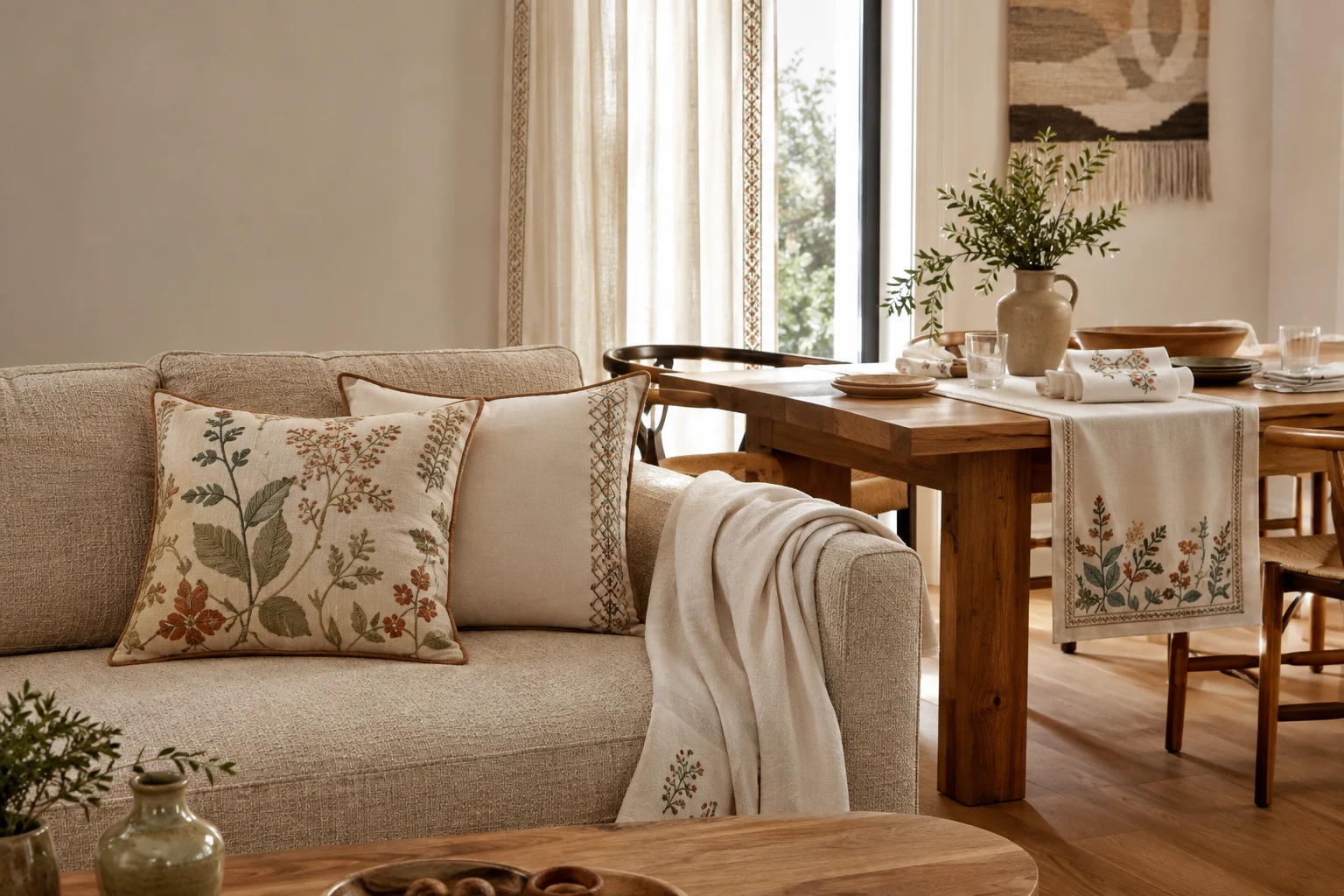
Cover image: AI-generated editorial concept; not a customer project or production proof.
Embroidery adds stitched patterns, texture and personal details to home textiles, including cushions, curtains, table linens, wall hangings and throws. Start with an item you use or see often, choose a motif that suits the room, and plan the fabric, placement and care requirements before stitching or ordering.
A removable cushion cover or a small set of napkins makes a manageable first project. Larger pieces, such as curtains and blankets, need more attention to how the embroidery looks when the fabric hangs, folds or rests against the body.
Ways to use embroidery throughout your home
Decorative cushions and pillows
Use a botanical motif, geometric border or family monogram to give a sofa or bedroom a personal detail. A single embroidered cushion can act as a focal point among plain textiles; several coordinated covers can repeat a room’s accent colors.
Plan the placement with the cushion insert inside the cover. A design that looks centered on a flat panel may appear different once the cushion is filled. Before ordering embroidery on an existing cover, ask whether its opening allows access to the intended stitching area.
Seasonal covers offer another option: leaf motifs for autumn, restrained winter designs or brighter florals for spring. Keep the cover dimensions consistent so you can reuse the same inserts.
Curtains and drapes
Consider embroidery along a leading edge, near the hem or on a separate tieback. These placements let you repeat a motif without covering the whole panel. For paired curtains, specify whether the designs should mirror one another.
View a sample hanging vertically before committing to a large design. Include the lining, seams and finished folds in your placement plan. Embroidery decorates a tieback or tab; the sewn construction provides its function.
Table covers, runners and napkins
Small corner motifs and monograms work well as design options for napkins. On a runner or tablecloth, place decoration where it remains visible around dishes and centerpieces. A restrained border can coordinate a dining setting without requiring every piece to match exactly.
Check the design with the napkin folded or the tablecloth hanging over the table edge. For frequently washed linens, agree on the intended cleaning method before choosing thread and decorative materials.
Wall hangings and framed embroidery
An embroidered panel can stand alone or join photographs and prints in a gallery wall. Abstract shapes, botanical studies and personally meaningful motifs offer starting points. Where a design draws on family or cultural traditions, preserve the meaning of the original work and credit the maker when known.
Choose the finished display size before designing. Leave space around the stitching for the planned frame or hanging method, and ask the framer how the textile will be supported.
Throws and blankets
A corner motif, name or commemorative date can personalize a throw for a housewarming, wedding or anniversary. Check how the design appears when the blanket is folded over a chair as well as when it is spread out.
For a blanket used against the skin, request a sample you can feel on both sides. The appearance of the front is only one part of the decision; the finished reverse also matters.
Coordinate designs without making everything identical
Choose one connection across the room: a recurring color, a shared botanical theme or a similar line style. You might pair a floral cushion with a geometric runner in the same palette, then leave the curtains plain.
Use a paper template at the proposed embroidery size to judge the placement from normal viewing distance. Compare thread samples with upholstery, paint and other textiles in the room’s own lighting.
Personalization can also carry sentimental value. A meaningful date or motif may make a useful household object feel special, but custom embroidery alone does not establish superior workmanship or guarantee that an item will become an heirloom.
Choose materials for the item’s everyday use
Fabric, backing, thread and stitch coverage need to work together. Madeira explains that backing helps control fabric movement and puckering, and that no single stabilizer suits every fabric and embroidery project. Ask for a setup appropriate to your chosen textile rather than specifying one backing for every item. Madeira’s embroidery FAQ
Material or feature | What to discuss before stitching |
|---|---|
Woven cotton, linen or blends | Fabric weight, weave, intended washing method and a sample on the actual material. |
Lightweight curtain fabric | Whether the backing will show and how the finished embroidery affects the hanging panel. |
Stretchy or knitted blankets | Support during stitching and the feel of the backing that remains afterward. |
Textured or piled fabric | Whether the proposed design remains clear on the surface in a physical sample. |
Frequently washed linens | Compatible care instructions for the fabric, thread, backing and any appliqué fabric. |
Rayon/viscose and polyester are both embroidery thread options. Choose by the desired appearance, feel and maintenance requirements of the finished item, rather than assuming one fiber is best for all home décor. Madeira identifies these as key factors in thread selection. Madeira’s thread selection guidance
Match the technique to the design
Direct embroidery places stitches on the base fabric. It can provide outlines, lettering and filled motifs. For cushions and linens, ask to see the proposed coverage in a sample so you can judge both its appearance and its feel.
Appliqué combines added fabric shapes with stitching that secures and finishes them. It offers a way to introduce contrasting fabric into a bold motif. BERNINA’s documentation describes placement, tack-down and cover stitching within the appliqué process. BERNINA’s appliqué stitch guide
3D puff embroidery uses foam to produce raised embroidery. It is a specialty option to discuss when a pronounced raised effect is part of the design; request a sample and care instructions before choosing it for household textiles. Madeira’s 3D foam tutorial
Hand stitching is another route for an individual decorative piece. If you enjoy making your own décor, a small shared project with friends or family can be a practical way to explore motifs and colors before taking on a larger item.
From an idea to a finished embroidered item
Define the project. Record the item, quantity, fabric, design size and exact placement. Include a photo of the room or textile if it helps explain your palette.
Prepare a placement mockup. Mark the design’s width, height and distance from a named edge. Confirm spelling, dates and monogram order.
Clarify the production route. For machine embroidery, the artwork needs a stitch file compatible with the production setup. DigitEMB’s embroidery digitizing service is relevant to this file preparation stage. Confirm separately who supplies and stitches the physical textiles.
Request a physical sample. Use the intended fabric and production materials where possible. A digital preview helps assess layout, while a stitched sample lets you inspect the fabric and finished texture.
Approve the finished specification. Check color, placement, lettering, puckering, the reverse and the feel of the item. For washable décor, ask for a sample evaluated after the agreed cleaning method before approving a larger set.
Keep the approved sample and written specification together so later pieces can be compared with the same reference.
Choose a provider and compare quotes
Ask to see relevant examples on similar household textiles. Experience with small shirt logos does not, by itself, establish that a provider can access and stitch your finished curtain panel or cushion cover.
For buyers in the US, Canada and UK, label measurements clearly in inches or millimeters. Specify whether dimensions describe the embroidery, the flat fabric panel or the finished item. For example, “motif width: 4 inches (101.6 mm)” removes a common ambiguity.
Request an itemized quote covering digitizing, sample stitching, textiles, embroidery and any sewing or finishing. State the currency when comparing suppliers. If physical goods will cross a border, ask what shipping and import-related costs are included; distinguish that arrangement from digital file delivery.
Confirm revision terms and the proposed schedule in writing. A lower quote may include fewer services, so compare the scope before drawing conclusions about quality.
Care for embroidered home textiles
Obtain care instructions for the complete finished item. A thread’s washing tolerance does not automatically apply to its base fabric, lining, trim or appliqué. Madeira’s care guidance advises referring to sewn-in care labels on finished textiles. Madeira’s thread and care FAQ
Keep those instructions with seasonal covers and table linens. If the materials or care requirements are unknown, ask the maker or a suitable textile-cleaning specialist before washing a valued piece.
Frequently asked questions
What is a practical first home décor embroidery project?
A removable cushion cover or a small napkin set gives you a limited area to plan and an easy way to assess the finished design. Start with one sample before ordering matching pieces.
Can existing curtains or cushions be embroidered?
Possibly. The provider needs to assess fabric suitability, seams, lining, openings and access to the proposed placement. Send photographs and measurements before arranging the work.
Does ordering digitizing include the embroidered item?
Do not assume it does. Confirm whether the order covers a digital stitch file, sample stitching, finished textiles or a combination of these services.
Can embroidered home décor be machine washed?
Some pieces can, but the answer depends on the complete item. Follow its care instructions and confirm the intended cleaning method before commissioning washable décor.
Practical details for Embroidery for Home Décor: Ideas, Materials and Custom Ordering
Use the article above as a starting point, then make the production brief specific to your own design. A stitch file is made for a finished size and material, so the artwork alone is only part of the instruction.
Work through these points in order and keep the answers with the artwork or production request. A short written brief makes it easier to compare a proof with the intended result, ask a useful follow-up question and avoid relying on assumptions made from a screen image alone.
The aim is not to add unnecessary steps. It is to identify the choices that change the final result before work begins. If a requirement is unknown, flag it for confirmation rather than guessing; that keeps the approval process focused on the design, material and use that apply to this particular project. Save the approved brief with the project files for future reorders or revisions.
Confirm the finished use
State the item, placement and finished width and height. A chest logo, cap front and jacket back do not use the same sewing area, even when they start from the same artwork.
Protect the smallest details
Review small lettering, narrow gaps, thin outlines and tiny colour changes at the final size. Simplifying a fragile detail before digitizing is often more reliable than trying to force it into a small sew-out.
Match the file to the machine
Tell the production team the embroidery machine or format required, along with the fabric or garment type. This lets them prepare the right export and make choices that suit the material rather than treating every job alike.
Quick questions to check before you proceed
What should I send with my artwork?
Send the clearest original available, the finished dimensions, placement, fabric or garment type and the required machine format if you know it.
Can the same file be used at every size?
Not always. Scaling changes the relationship between stitch length, detail and fabric, so a design may need review when the finished size or placement changes.
What should I check before production?
Confirm the spelling, colours, final size, placement and any details that must remain readable. A proof or sample is the best point to catch a change.