
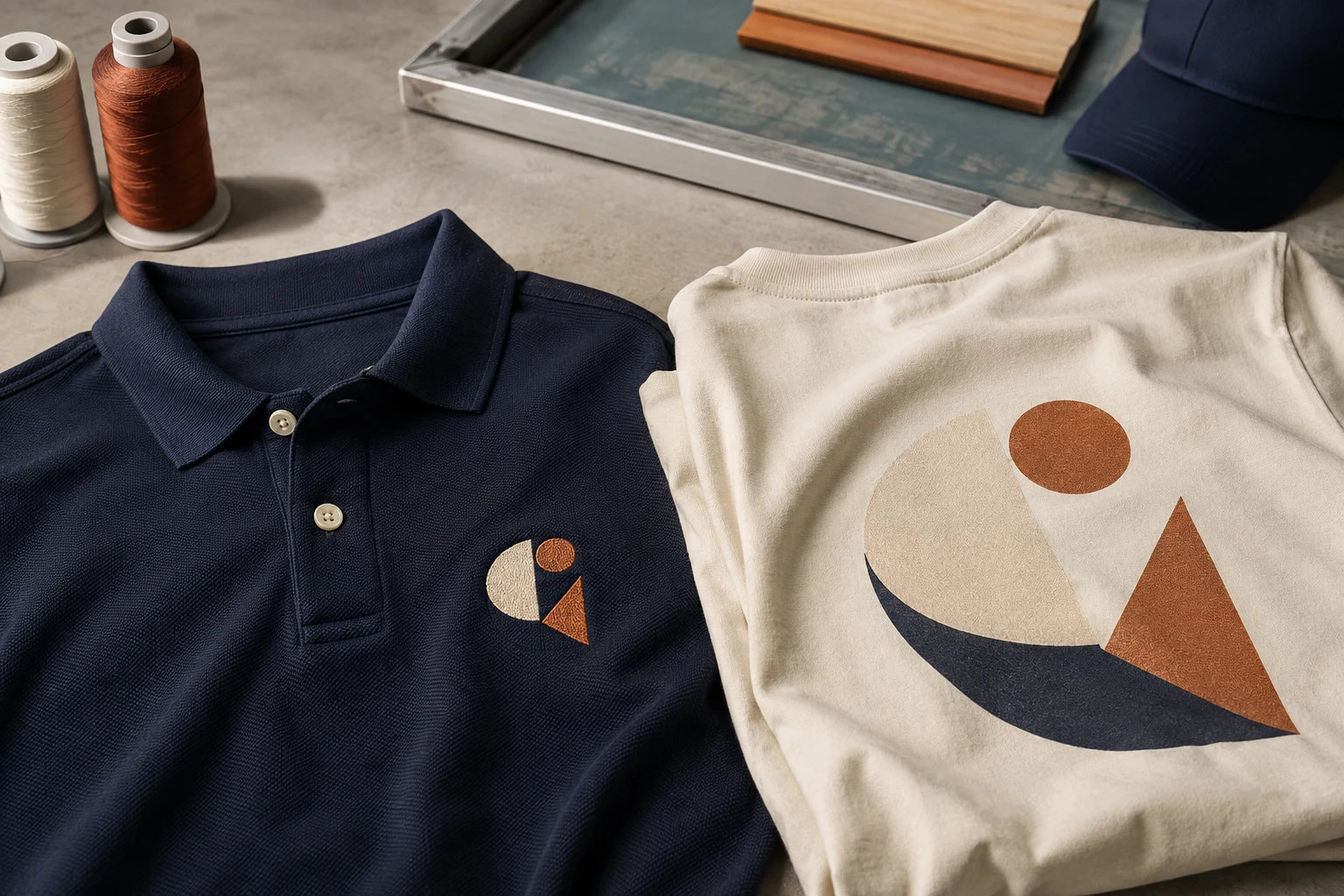
Cover image: AI-generated editorial concept; not a customer project or production proof.
Choose embroidery for compact logos with a raised thread finish on polos, caps and jackets. Choose screen printing for larger graphics and repeated designs on T-shirts and sweatshirts. Neither method is always cheaper, faster or more durable: the right choice depends on your artwork, garment, quantity and care requirements.
One distinction matters before comparing quotes: embroidery digitizing prepares the stitch file; embroidery produces the decoration. A digitizing quote alone is therefore not comparable to a quote for finished screen-printed garments.
How the two methods work
Embroidery digitizing turns artwork into embroidery objects and stitch instructions. The digitizer plans how the design will be sewn, including stitch types, direction and sequence. An embroidery machine then uses the resulting machine file to stitch thread into the garment. Digitizing is a production preparation step, not simply saving a picture with a different extension. Wilcom’s digitizing documentation explains this process.
Screen printing pushes ink through a mesh stencil onto the garment. Conventional multicolor work uses separate screens for the ink colors, aligned so the layers form the finished image. The ink must then be cured according to its manufacturer’s requirements. See ScreenPrinting.com’s process guide.
Which method fits your project?
Use these as starting points to discuss with your decorator, then confirm the choice with a sample.
Your priority | Method to consider |
|---|---|
A compact logo with visible texture | Embroidery, especially when the thread finish is part of the intended look. |
A large front or back graphic | Screen printing; compare its feel and coverage on the chosen garment. |
Polos, caps, fleece or jackets | Embroidery is worth sampling, with preparation suited to the fabric and placement. |
A repeated design on event T-shirts | Screen printing is worth quoting, particularly for artwork with few ink colors. |
Small lettering or intricate artwork | Request an actual-size proof and sample; embroidery has physical stitch limits. |
A deadline or strict budget | Compare complete quotes and confirmed schedules for the same specification. |
Appearance, detail and customization
Embroidery creates texture, with thread direction and sheen contributing to the appearance. That makes it useful when you want a logo to feel substantial on uniforms, accessories or promotional garments. Screen printing offers a flatter graphic treatment, although the feel varies with ink and coverage.
Embroidery does not automatically reproduce finer detail than printing. Small letters, narrow gaps and sharp corners can become crowded when translated into stitches. Wilcom explains that lettering quality depends on stitch density, fabric strength, machine capabilities and the font’s recommended size range. Wilcom’s embroidery lettering guidance.
For an embroidered logo, consider simplifying tiny taglines or fine outlines. Ask to see the smallest lettering sewn at the intended size rather than judging an enlarged screen preview.
Screen printing can reproduce fine detail and tonal effects through suitable artwork preparation, mesh selection and halftones—patterns of dots that suggest shading. A gradient is therefore a production decision, not an effect to assume will print unchanged. ScreenPrinting.com’s screen preparation guide.
Fabric and garment suitability
Start with the exact garment, including its fabric composition, weight, stretch and decoration location. A result approved on one shirt should not automatically be accepted for a different blank.
For embroidery, ask the decorator to assess whether the fabric can support the design and what backing it needs. Large, dense areas deserve particular attention on lightweight garments. Check the sample for puckering, stiffness and comfort against the skin.
Polyester is not automatically unsuitable for screen printing. Its dyes can migrate into the ink when heated, so the printer needs an appropriate ink system and testing procedure. Low-cure inks may help, but some garments require low-bleed or dye-blocking layers. ScreenPrinting.com explains polyester dye migration.
For caps, coated outerwear and constructed bags, confirm access to the intended decoration area before approving artwork.
Cost: compare the complete order
There is no universal quantity at which one method becomes cheaper. Ask both suppliers to quote the same garment, design size, placement and order quantity.
Embroidery pricing can reflect digitizing, stitch count and production work. Enlarging a design can change its stitch count and estimated production cost, as illustrated by Wilcom’s embroidery estimating documentation.
Screen printing requires screen preparation and press setup. Because that setup supports repeated impressions, larger runs of the same design can spread its cost across more garments. Additional ink colors and placements add production steps. This is a practical implication of the screen-printing workflow, not a fixed price rule.
Request separate figures for artwork preparation, decoration, garments, samples and shipping. For US, Canadian and UK buyers, confirm whether the quote is in USD, CAD or GBP and whether applicable taxes and cross-border charges are included. Also distinguish digital file delivery from delivery of finished clothing.
Production time and repeat orders
Neither process is inherently faster for every job. Embroidery requires file preparation and sewing time; lettering trims and other machine operations also affect production. Screen printing requires screen preparation, registration, printing and curing. Equipment capacity and the supplier’s workload affect both methods.
Ask for a schedule covering artwork approval, sampling, production and shipping. Give an actual required arrival date rather than simply requesting a “rush” order.
For reorders, confirm what the supplier retains and whether a changed size, fabric or placement requires new preparation. Keeping the same logo does not necessarily mean the previous production setup remains suitable.
Durability and care
Avoid treating either method as indestructible. For embroidery, thread selection matters: Madeira advises against using rayon where harsh laundering, abrasion or prolonged outdoor exposure are expected. Discuss the intended washing routine before choosing thread. Madeira’s rayon thread guidance.
For screen printing, proper curing is essential. An under-cured print can appear acceptable initially and then crack or wash out; production samples should be tested. ScreenPrinting.com’s curing guidance.
Request care instructions for the finished garment, accounting for both its fabric and decoration. For frequently washed uniforms, approve a sample after washing under the intended conditions.
What to send before requesting a quote
Give your decorator enough information to assess the whole job:
Original artwork and required colors.
Finished design dimensions in inches or millimeters.
Garment model, fabric composition, color and placement.
Quantity, size breakdown and any individual names or variations.
Intended washing conditions and required arrival date.
If you choose embroidery and need artwork prepared for your machine or decorator, review DigitEMB’s embroidery digitizing service. Confirm the required machine format and arrange a test sew-out on the intended fabric before production.
Frequently asked questions
Is embroidery digitizing the same as embroidery?
No. Digitizing creates the embroidery design file. Embroidery is the separate process of sewing that design onto the item. Confirm which work your quote includes.
Is screen printing always cheaper for bulk orders?
No. Repeating one design can make setup economical, but colors, placements, garments and finishing requirements affect the total. Compare complete quotes rather than relying on an order-size rule.
Which is better for small text?
Screen printing is often worth considering when tiny lettering is essential. Embroidery lettering must work within physical stitch and font limits. Request a sample at final size before deciding.
Can I use both on one garment?
Yes, subject to the decorator’s approval of the garment and placements. For example, you could request a compact embroidered chest logo and a larger screen-printed back graphic. Ask for a combined sample and quote.
Practical details for Embroidery Digitizing vs. Screen Printing: Which Should You Choose?
Use the article above as a starting point, then make the production brief specific to your own design. A stitch file is made for a finished size and material, so the artwork alone is only part of the instruction.
Work through these points in order and keep the answers with the artwork or production request. A short written brief makes it easier to compare a proof with the intended result, ask a useful follow-up question and avoid relying on assumptions made from a screen image alone.
The aim is not to add unnecessary steps. It is to identify the choices that change the final result before work begins. If a requirement is unknown, flag it for confirmation rather than guessing; that keeps the approval process focused on the design, material and use that apply to this particular project. Save the approved brief with the project files for future reorders or revisions.
Confirm the finished use
State the item, placement and finished width and height. A chest logo, cap front and jacket back do not use the same sewing area, even when they start from the same artwork.
Protect the smallest details
Review small lettering, narrow gaps, thin outlines and tiny colour changes at the final size. Simplifying a fragile detail before digitizing is often more reliable than trying to force it into a small sew-out.
Match the file to the machine
Tell the production team the embroidery machine or format required, along with the fabric or garment type. This lets them prepare the right export and make choices that suit the material rather than treating every job alike.
Quick questions to check before you proceed
What should I send with my artwork?
Send the clearest original available, the finished dimensions, placement, fabric or garment type and the required machine format if you know it.
Can the same file be used at every size?
Not always. Scaling changes the relationship between stitch length, detail and fabric, so a design may need review when the finished size or placement changes.
What should I check before production?
Confirm the spelling, colours, final size, placement and any details that must remain readable. A proof or sample is the best point to catch a change.