
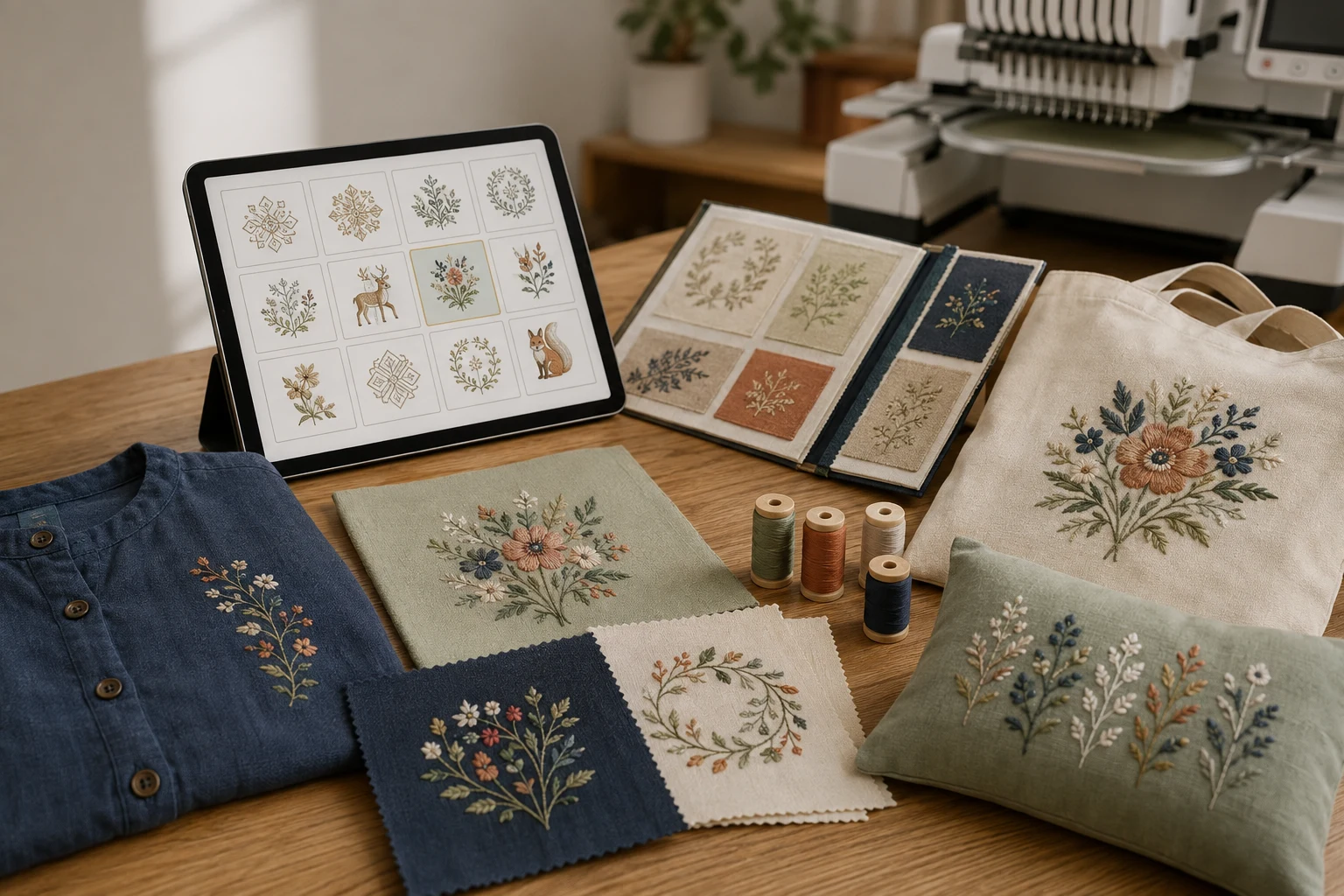
Cover image: AI-generated editorial concept; not a customer project or production proof.
An embroidery design portfolio subscription gives you access to a collection of downloadable designs under a recurring plan. It can suit hobbyists, freelancers and small businesses that regularly need different motifs for clothing, gifts and home décor. Its value depends on how many suitable designs you actually use, whether they work with your equipment, and what the license permits.
“Unlimited access” needs careful reading: download access, permission to sell embroidered items and rights after cancellation are separate questions. Choose a plan around your projects and production needs, rather than the size of its advertised library.
How embroidery design subscriptions work
You select a plan, browse its included collection and download designs for your projects. Before joining, establish whether the package contains machine embroidery files, hand embroidery patterns or other creative assets. A broad craft membership may include several categories with different requirements and usage terms.
For example, Creative Fabrica’s embroidery collection includes designs across themes such as animals, flowers, holidays and home projects. Use a provider’s actual listings to assess the selection; a total catalog count says little about how many designs fit your work.
A practical buying sequence is to:
Identify upcoming projects and the motifs, sizes and techniques they need.
Check whether those designs are included in the proposed plan.
Review file compatibility and the applicable license.
Try an available sample before making a longer commitment.
Record the renewal date, cancellation procedure and any restrictions after the plan ends.
Check whether new releases, older collections and repeat downloads are included. Do not assume that every membership covers the entire catalog or that future additions follow a guaranteed schedule.
Where a subscription can be useful
A varied library can reduce the time spent sourcing individual patterns. Floral, geometric, animal and seasonal designs can support different product lines without requiring a new illustration for every item.
For a hobbyist, the benefit may be freedom to experiment with gifts and home textiles. For a freelancer, a small selection of suitable options can make project discussions more concrete. A business can use coordinated motifs to plan a collection of tote bags, garments or home accessories.
These benefits depend on selection and testing. Access alone does not establish stitch quality, profitability or faster delivery. A catalog design also should not be presented as exclusive to your business unless the provider expressly grants that exclusivity.
For client presentations, check whether the license permits use of preview images. Photographing your own permitted sample sew-outs gives clients a clearer idea of the finished texture and scale.
What to compare before subscribing
Buying consideration | What to establish |
|---|---|
Library relevance | Enough suitable designs for your actual products, styles and customers |
Access model | Included collections, download limits, new releases and repeat-download access |
Design information | Finished dimensions, available sizes, stitch counts and instructions |
Machine compatibility | Supported file format, embroidery area and transfer method for your exact model |
Usage rights | Permission for personal projects, sales, modifications and any outside production |
Support | How to report a missing file, unclear instructions or a stitching problem |
Renewal and cancellation | Billing interval, renewal amount, cancellation steps and rights after ending the plan |
For buyers in the US, Canada and the UK, compare the checkout total in the currency you will pay. Check whether applicable taxes are included and whether your payment method adds a currency-conversion charge. An advertised monthly equivalent may be billed as a full annual payment.
Evaluate seasonal coverage against your own customer calendar. A collection relevant to one market may not provide the occasions, wording or timing needed in another.
Check machine compatibility and sample quality
Start with the manual for your exact embroidery machine. A familiar file extension is only one part of compatibility; also compare the design’s finished dimensions with your usable embroidery area and check the supported transfer method.
As a model-specific example, Brother lists PES, PHC and DST files for its PR680W/PR680WC. Brother also explains that DST files do not contain specific thread-color information, so the displayed colors need checking. These details should not be generalized to every machine. See Brother’s embroidery data precautions.
Before purchasing, look for a color sequence, project instructions and photographs of actual stitching. Ask whether the supplied size suits your intended placement instead of assuming that substantial resizing will work. Brother’s documentation also warns that overly fine stitch density or overlapping stitches can cause thread or needle breakage. Brother’s guidance on imported embroidery data.
Make a sample on material representative of the intended product, using the planned thread, stabilizer and hooping setup. Inspect the result for readable detail, clean outlines and fabric distortion before committing customer garments. Keep a photograph and production notes with the file so repeat jobs have a useful reference.
Understand commercial use and cancellation
Read the terms for the embroidery category itself. Permission to sell stitched items does not automatically include permission to share files, sell modified downloads or upload them to a production platform.
For a concrete example, Creative Fabrica’s Needlework terms permit selling physical stitched products but prohibit redistribution of the digital files and use of Needlework designs for print on demand. They also prohibit stitching new physical products with those designs after the subscription ends, while allowing the sale of stock stitched during the active subscription. These are that provider’s terms, not a rule for every subscription. Creative Fabrica’s subscription license, Needlework Products Usage.
Before relying on a plan for commercial work, clarify:
Whether your intended products and sales channels are permitted.
Whether an outside embroiderer may receive or use the file.
Whether modifications and customer previews are allowed.
Whether you may produce repeat orders after cancellation.
Keep the relevant license, receipt, download date and design identifier together. If a provision is unclear, obtain a written answer before building a product line around it.
Decide whether the subscription offers value
Estimate how many distinct designs you expect to use during the billing period. Divide the subscription charge by that number to estimate the access cost per used design. Count designs selected for real projects, rather than every file you might download.
Then account for sampling materials, machine time, editing and any extra purchases. A large library can still be poor value if the useful designs need extensive changes or lack suitable sizes.
Your likely workload | Option to consider |
|---|---|
Frequent projects across several themes | A subscription with a relevant collection and suitable rights |
A few specific projects each year | Individual designs or a focused bundle |
A particular logo or original customer artwork | Custom embroidery digitizing |
A short seasonal collection | A shorter plan, after checking renewal and post-cancellation production rights |
A subscription supplies existing designs. When a job requires a specific logo, placement or adaptation to a garment, review DigitEMB’s embroidery digitizing service. Provide the artwork, intended dimensions, fabric, placement and machine format so the requirements are clear.
Build a usable design portfolio
Organize downloads by project type and retain the original files separately from edited versions. Save the instructions and license alongside each design, then add sample photographs and notes after testing.
For a customer-facing portfolio, curate a manageable selection that reflects the products you can make reliably. Include the available size, fabric example and personalization options you have actually tested. Review the collection periodically and remove designs whose permissions or production suitability are uncertain.
This approach preserves the main benefit of a subscription: a convenient source of creative options that supports practical project planning.
FAQs
Does unlimited access mean I own the designs?
Do not assume so. Check the license for the rights granted, any restrictions and what remains permitted after cancellation. Download access does not itself establish ownership or exclusivity.
Can I use subscription designs on products I sell?
Only when the applicable license permits your intended use. Check embroidery-specific terms and any restrictions on outside production, file sharing or sales platforms.
Will every design work with my embroidery machine?
Check each download against your exact machine’s supported format and embroidery area. Review the instructions and make a representative sample before production.
Is a subscription better than buying individual designs?
It can be useful when you regularly use a varied selection. Individual purchases may make more sense for occasional projects or a small number of specific motifs. Compare actual use, testing effort and license terms before deciding.
Practical details for Embroidery Design Portfolio Subscriptions: Access, Value and Buyer Essentials
Use the article above as a starting point, then make the production brief specific to your own design. A stitch file is made for a finished size and material, so the artwork alone is only part of the instruction.
Work through these points in order and keep the answers with the artwork or production request. A short written brief makes it easier to compare a proof with the intended result, ask a useful follow-up question and avoid relying on assumptions made from a screen image alone.
The aim is not to add unnecessary steps. It is to identify the choices that change the final result before work begins. If a requirement is unknown, flag it for confirmation rather than guessing; that keeps the approval process focused on the design, material and use that apply to this particular project. Save the approved brief with the project files for future reorders or revisions.
Confirm the finished use
State the item, placement and finished width and height. A chest logo, cap front and jacket back do not use the same sewing area, even when they start from the same artwork.
Protect the smallest details
Review small lettering, narrow gaps, thin outlines and tiny colour changes at the final size. Simplifying a fragile detail before digitizing is often more reliable than trying to force it into a small sew-out.
Match the file to the machine
Tell the production team the embroidery machine or format required, along with the fabric or garment type. This lets them prepare the right export and make choices that suit the material rather than treating every job alike.
Quick questions to check before you proceed
What should I send with my artwork?
Send the clearest original available, the finished dimensions, placement, fabric or garment type and the required machine format if you know it.
Can the same file be used at every size?
Not always. Scaling changes the relationship between stitch length, detail and fabric, so a design may need review when the finished size or placement changes.
What should I check before production?
Confirm the spelling, colours, final size, placement and any details that must remain readable. A proof or sample is the best point to catch a change.