
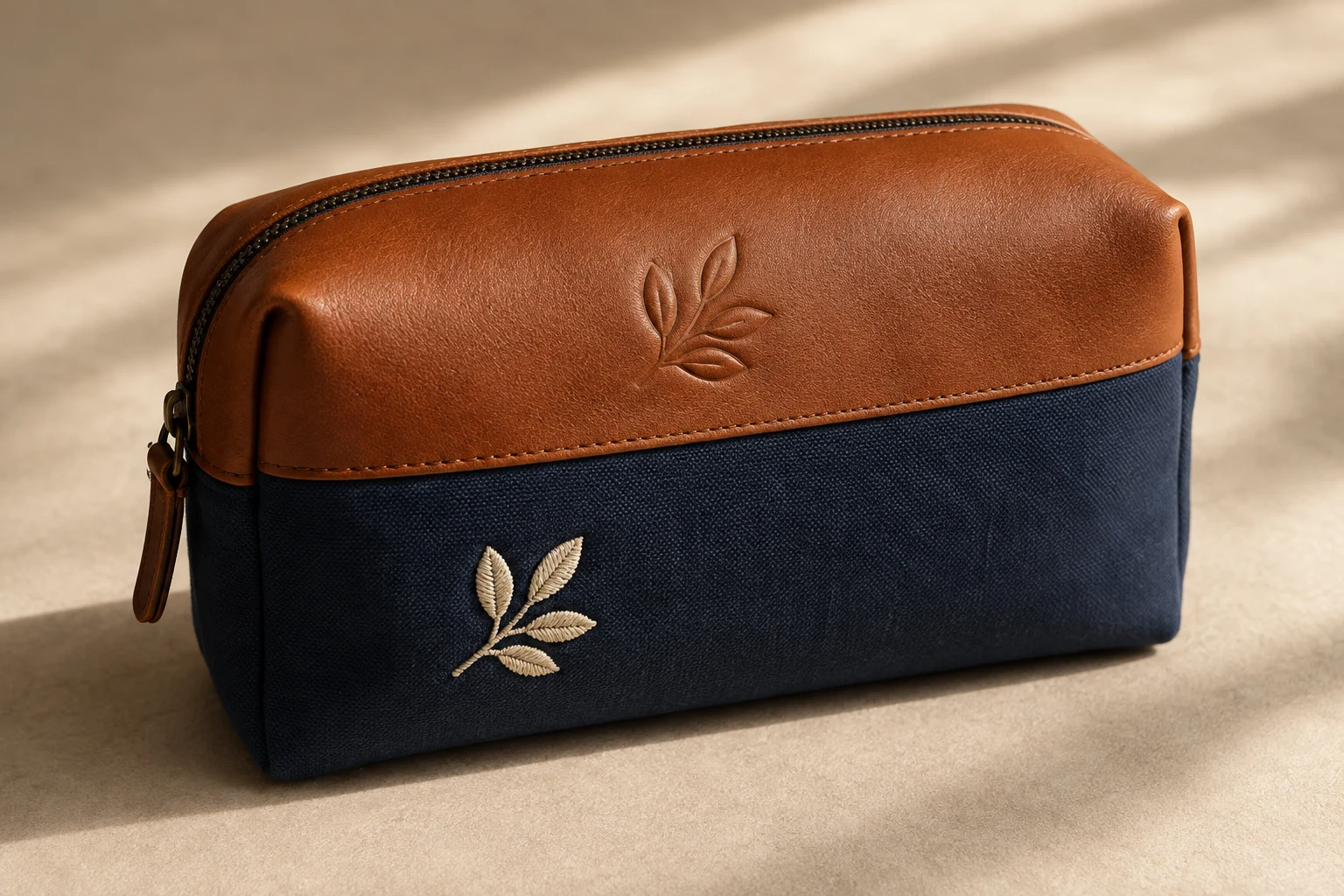
Cover image: AI-generated editorial concept; not a customer project or production proof.
Embossing shapes a material to create raised relief; embroidery creates a design with stitched thread. Choose embossing when you want the material itself to carry the design, and embroidery when you want thread texture and color on a suitable garment or accessory. A recessed impression is more precisely called debossing. Manufacturers distinguish raised embossing from recessed debossing in their tooling descriptions. Dowle Manufacturing’s process explanation
For uniforms, caps, jackets, bags and patches, the right choice depends on the actual material, finished artwork size, desired appearance and care requirements. Neither method is automatically more durable or economical for every project.
What is embossing?
Embossing forms a raised design in the surface using tooling and pressure; some processes also use heat. Debossing presses the design below the surrounding surface. Suppliers sometimes use “embossing” broadly for both, so specify whether you want the mark raised or recessed and provide a visual reference. Krintech’s leather decoration guide
A blind finish uses the material’s own appearance without added foil. Foil decoration can introduce color or a metallic accent, so it is inaccurate to describe all embossed or debossed work as colorless. Dowle describes foil debossing as a recessed logo with colored foil bonded to the surface. Foil debossing explained
Leather accessories, notebook covers and suitable packaging are useful applications to discuss with a specialist. Paper, leather and textile projects require their own material and process assessment; a successful sample on one surface does not establish suitability for another. Bookbinders also use raised embossing and recessed debossing as finishing techniques. Masters Bookbinding’s finishing methods
Ask the decorator to assess the exact material, coating, thickness and access to the decoration area. Describe whether the item is already assembled or will be decorated before assembly.
What is embroidery, and where does digitizing fit?
Embroidery decorates a surface with thread. Machine embroidery follows a digital stitch file, while digitizing is the preparation of that stitch plan. It is a separate stage from physically sewing the design.
The working design can contain editable embroidery objects. Exporting creates the needle positions and supported commands used by the machine. An ordinary image file alone does not contain those instructions. Hatch’s explanation of design and machine files
Embroidery offers visible thread texture and a choice of thread colors. It can also be subtle when the thread is close to the fabric color. For a logo on a polo, jacket, cap or bag, evaluate the design at its intended size before committing to production.
Small lettering needs particular care. Embroidery fonts have recommended size ranges, and small lowercase characters can become difficult to stitch even when their capitals remain workable. Simplifying a tagline or increasing the finished size may be necessary. Hatch’s embroidery font guidance
Embossed vs embroidered: practical differences

Decision factor | How the methods compare |
|---|---|
Surface effect | Embossing raises the material; debossing recesses it. Embroidery adds a stitched surface. |
Color and contrast | Blind embossing relies on relief and the material’s appearance. Foil can add color; embroidery uses thread colors. |
Material choice | Embossing needs a material and process capable of retaining the intended relief. Embroidery needs a suitable sewing and support setup. |
Artwork preparation | Embossing may require custom tooling. Machine embroidery requires a stitch plan prepared for the application. |
Detail | Review fine lines, small text and open spaces in a physical sample. Neither method reproduces every screen detail at every size. |
Production comparison | Compare setup, samples, quantity and finished application costs using the same brief. |
Use the table to narrow your options, then compare samples on the intended material. A photograph helps show the design, but it cannot fully communicate surface feel or flexibility.
Is embossed embroidery the same as 3D puff?
The term embossed embroidery can describe different stitched effects. Confirm the construction instead of assuming it always means foam.
3D puff embroidery uses foam beneath stitching to add height. Madeira describes foam positioned between fabric and satin stitches, and specifies stable fabrics for its product. Its guidance also calls for designs prepared specifically for foam embroidery. An ordinary flat embroidery file should therefore be reviewed before adding foam. Madeira’s foam overview and 3D design requirements
Embossed effects on towels or fleece can instead use stitching to flatten selected areas of the pile, leaving other areas standing higher. This creates a contrast between compressed and uncompressed fabric. Urban Threads demonstrates this approach on towels, robes and fleece. Urban Threads’ embossed embroidery tutorial
Both are embroidery techniques. Neither is the same manufacturing process as pressing relief into leather or paper. When ordering, describe the effect you want and ask whether the proposal uses foam, pile compression or another construction.
Choosing for garments, accessories and patches
For a uniform logo that needs visible thread color, start by discussing embroidery on the actual garment. For a leather accessory with a quiet surface mark, discuss blind embossing or debossing. For pronounced raised stitching on a stable cap or bag fabric, ask whether the artwork is suitable for puff embroidery.
Treat these as starting points for a sample, rather than automatic material approvals. Placement, seams and the construction of the finished item also belong in the brief.
A patch adds another decision: the decoration is produced as a separate piece and then attached. An embroidered patch and a decorated leather patch can serve a similar visual role while having different textures and care needs. Confirm the edge finish and attachment method alongside the face design. DigitEMB’s custom patches page provides a starting point for discussing the available constructions.
If you want one design across several products, review each application separately. A leather bag label and a stitched shirt logo may need different interpretations of the same artwork to remain recognizable.
Durability and maintenance
There is no useful universal rule that embroidery always outlasts embossing. Compare the complete decorated item under its expected use: washing, rubbing, bending, exposure and handling.
For embroidery, obtain care instructions compatible with the garment and thread. Madeira’s care guidance explicitly considers both when discussing laundering. Do not transfer a thread’s washing capability to an entire garment without checking its other components. Madeira’s embroidered garment care guidance
For embossed or debossed accessories, ask for care guidance for the specific material and finish. For puff embroidery and attached patches, include the foam or attachment construction in that discussion.
Before a larger order, agree on a practical sample evaluation:
Inspect relief, thread coverage, lettering and placement at the finished size.
Handle and flex the sample as the item will be used.
Where washing is intended, assess a sample after the agreed care cycle.
Check patch edges and attachment, as well as the visible design.
A sample evaluation supports your purchasing decision; it does not establish a lifetime guarantee.
Cost and production considerations
Avoid assuming that embroidery always has lower setup costs or that embossing becomes cheaper at a particular quantity. Request comparable quotes for the actual design and product.
For embossing or debossing, ask whether custom dies are needed and whether tooling, sampling and repeat-order setup are charged separately. Stock lettering may be an option for some initials or names, while custom artwork can require bespoke tooling. Krintech’s tooling and artwork information
For embroidery, ask whether the quote covers digitizing only, physical stitching, finished patches or a combination. Confirm sample and revision arrangements. The price of a stitch file is not the price of a decorated garment.
For buyers in the US, Canada and UK, specify dimensions with units, quote currency, quantities per design and delivery destination. Ask the supplier to separate preparation, production and shipping estimates, and confirm any applicable taxes or import charges in the quote.
What to send before ordering
Prepare a brief with:
Your clearest original artwork and exact wording.
Finished width and height in inches or millimeters.
The item, material, surface finish and decoration location.
The desired effect: raised material, recessed material, flat stitching or puff stitching.
Color references, quantity and intended care conditions.
Delivery destination and required date.
Ask the supplier to identify any artwork changes before making tooling or preparing the final stitch file. Approve the appearance at actual size and agree who will produce and review the physical sample.
For machine embroidery preparation, use DigitEMB’s embroidery digitizing service page to discuss the artwork, material, dimensions and required machine format.
Frequently asked questions
Is embossing always raised?
In precise process terminology, embossing is raised and debossing is recessed. Because suppliers may use “embossing” as a broader label, specify the surface effect explicitly.
Can embroidery look subtle?
Yes. Thread close to the fabric color can provide a restrained effect while retaining stitched texture. Review a sample because sheen and lighting affect how visible it appears.
Can the same artwork be used for both methods?
The same original artwork can be the starting point, but each method needs its own production preparation. Review the size, smallest details and any proposed simplification separately.
Does an embossed logo need an embroidery file?
Pressed embossing uses tooling rather than embroidery machine instructions. A stitched embossed effect, including foam or pile-based embroidery, does require an appropriate embroidery design.
Which should I choose for a frequently washed item?
Choose a construction whose care instructions suit the complete item, then evaluate a sample under the intended washing conditions. The technique name alone does not establish wash performance.
Practical details for Embossed vs Embroidered: Choosing the Right Technique for Your Design
Use the article above as a starting point, then make the production brief specific to your own design. A stitch file is made for a finished size and material, so the artwork alone is only part of the instruction.
Work through these points in order and keep the answers with the artwork or production request. A short written brief makes it easier to compare a proof with the intended result, ask a useful follow-up question and avoid relying on assumptions made from a screen image alone.
The aim is not to add unnecessary steps. It is to identify the choices that change the final result before work begins. If a requirement is unknown, flag it for confirmation rather than guessing; that keeps the approval process focused on the design, material and use that apply to this particular project. Save the approved brief with the project files for future reorders or revisions.
Confirm the finished use
State the item, placement and finished width and height. A chest logo, cap front and jacket back do not use the same sewing area, even when they start from the same artwork.
Protect the smallest details
Review small lettering, narrow gaps, thin outlines and tiny colour changes at the final size. Simplifying a fragile detail before digitizing is often more reliable than trying to force it into a small sew-out.
Match the file to the machine
Tell the production team the embroidery machine or format required, along with the fabric or garment type. This lets them prepare the right export and make choices that suit the material rather than treating every job alike.
Quick questions to check before you proceed
What should I send with my artwork?
Send the clearest original available, the finished dimensions, placement, fabric or garment type and the required machine format if you know it.
Can the same file be used at every size?
Not always. Scaling changes the relationship between stitch length, detail and fabric, so a design may need review when the finished size or placement changes.
What should I check before production?
Confirm the spelling, colours, final size, placement and any details that must remain readable. A proof or sample is the best point to catch a change.