
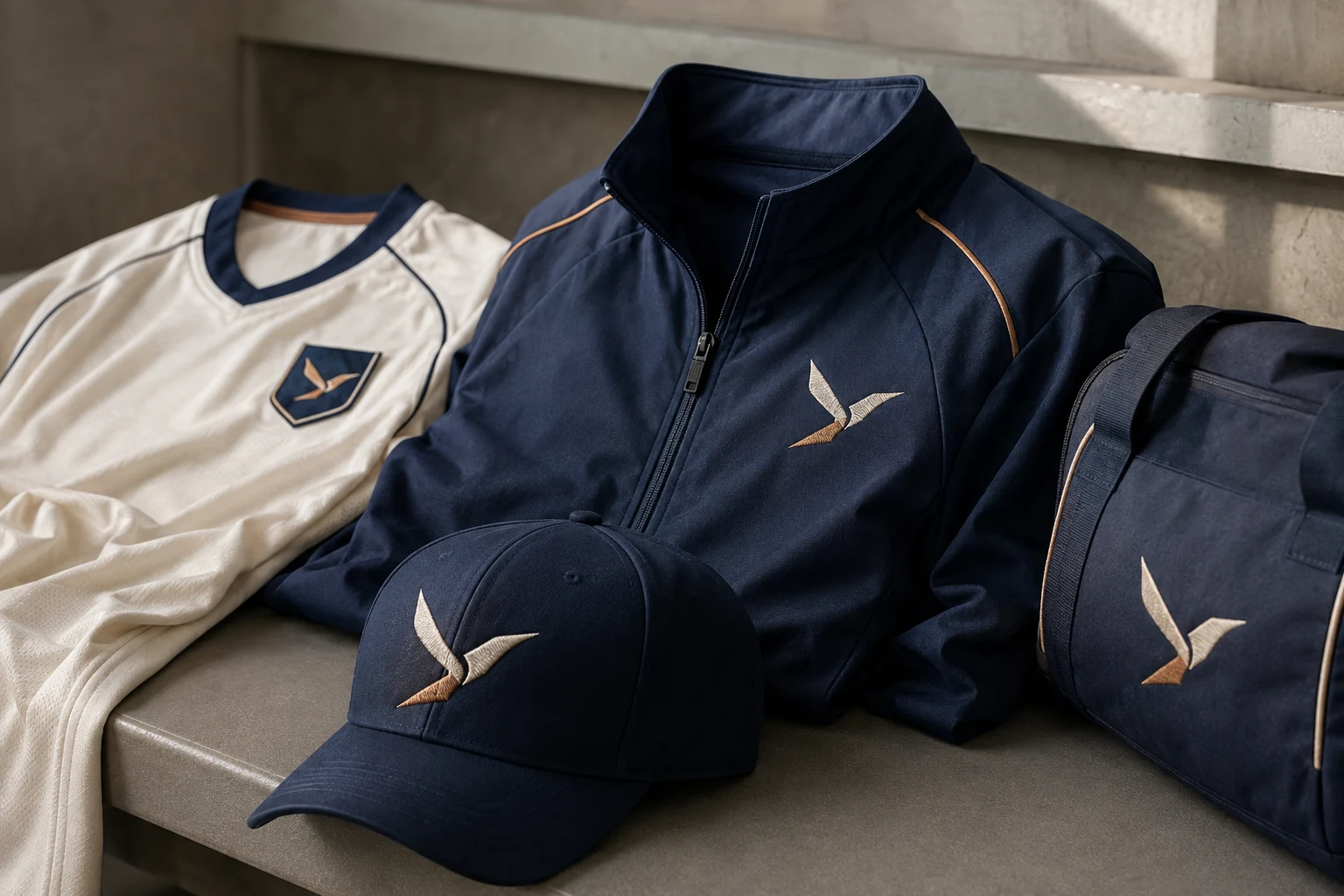
Cover image: AI-generated editorial concept; not a customer project or production proof.
Customized embroidery gives sports teams a consistent identity across uniforms, caps, warm-up clothing and equipment bags. Start with the exact garment and its intended use, choose a suitable decoration method, then approve the artwork and a physical sample before the full order. Playing kit also needs to meet the applicable competition requirements.
For clubs, schools and community teams in the United States, Canada and the United Kingdom, the goal is coordinated gear that players, coaches and supporters can comfortably use. One crest can connect the collection, while its size, stitching and attachment vary by item.
Where team embroidery works
Matching crests and colors help identify players and staff, while names and numbers make personal gear easier to distinguish. Supporter merchandise extends that shared identity beyond match day. These are practical benefits; embroidery alone does not establish better sporting performance or attract sponsorship.
Team item | What to plan |
|---|---|
Playing jerseys | Crest, names and numbers; permitted layout; flexibility and comfort against the skin. |
Caps and hats | Logo size and position on the actual cap style; a separate sample for any raised treatment. |
Warm-up jackets and hoodies | Team crest and optional player identification; lining, seams and pocket access. |
Coaches’ and staff polos | Consistent chest branding and clearly approved role or name lettering. |
Equipment bags | Logo and personal identification on a panel the decorator can access. |
Towels | Readability on the actual towel texture and a suitable finished reverse side. |
Supporter clothing | A coordinated version of the team identity, with its own garment and size options. |
Embroidery applies to textile items. A bottle itself needs another decoration method; an embroidered fabric sleeve would be a separate accessory.
Choose the crest treatment for each item
Direct flat embroidery
Direct embroidery stitches the design into the garment. It is an option to discuss for chest crests, names, caps and bags, with the design prepared for the intended material and finished size.
Ask the decorator to assess stitch coverage and the supporting stabilizer, especially on light or stretchy jerseys. Madeira explains that cut-away stabilizers support unstable fabrics and that performance versions aim to provide stability with less bulk. This makes the fabric and backing part of the design decision. Madeira’s stabilizer guidance.
Raised embroidery and appliqué
3D puff embroidery uses foam to produce a raised effect. Consider it for a bold cap emblem after reviewing a sample. It requires a purpose-built stitch treatment: Wilcom identifies changes such as wider satin columns and additional compensation for puff work. Wilcom’s embroidery style guidance.
Appliqué attaches shaped fabric pieces with stitching. It is another treatment to discuss for larger team lettering or emblems. The stitch file must account for placing and securing the fabric, as shown in Wilcom’s appliqué documentation. Approve the finished edges, flexibility and appearance on the intended garment.
Separately made patches
A patch is produced separately and attached to the item. It can carry a consistent crest across a collection, but each garment still needs an appropriate size and attachment method.
An embroidered patch provides visible stitch texture. For a crest with essential small lettering, ask whether a woven version would reproduce the detail more clearly. STAHLS describes its woven patches as using interlaced construction for intricate designs and small text; this is a manufacturer example, not a guarantee for every crest. STAHLS woven patch details.
Keep the comparison focused on your team’s actual artwork. A detailed crest that works on a jacket may need an approved simplified version for a small youth shirt.
Check competition requirements before fixing the layout
Record the sport, competition, age group and season. Obtain the relevant uniform requirements before approving team crests, sponsor logos, player numbers or commemorative badges.
For association football, called soccer in much of the US and Canada, IFAB Law 4 covers equipment safety and permitted slogans, statements and images. Competition rules may further restrict their size, number and position. Use this as a football-specific reference and check the rules for your own sport and competition. IFAB Law 4.
Where placement is unclear, send the organizer a mockup before production. Keep proposed decoration clear of required identifiers and obtain the team’s approval for sponsor artwork.
Prepare one identity with clear garment specifications
Start with the clearest available logo artwork, approved team colors and a checked roster. Identify tiny mottos, dates, thin outlines and other details that need review at the finished size. Approve any simplification with the club before digitizing.
For each item, supply:
Garment manufacturer, style code, fabric composition, color and care label.
Finished design width and height, including any patch border.
Placement measured from named garment reference points.
Approved wording, player names, numbers and artwork version.
Decoration method and the quantity for that version.
Use a master measurement unit and checked conversions when working across countries. For example, 3 inches equals 76.2 mm; that is a conversion example, not a recommended crest size.
Place a full-size paper outline on the smallest and largest garments. Define the wearer’s left or right and show the measurement points in a photograph. Check home, away and goalkeeper shirts separately, along with caps, jackets and bags. A paper layout helps settle position and scale; it cannot establish stitch quality or attachment performance.
Match materials and attachment to the garment
Ask the decorator to propose thread, backing and a sewing setup for the actual item. Review thread colors against each garment color and obtain care instructions for the selected materials. Avoid treating all polyester jerseys, cotton polos or blended hoodies as interchangeable.
For patches, specify the exact attachment system. A sew-on trial should include inspection of the surrounding fabric and the inside surface. For heat-applied patches, obtain the supplier’s instructions for the patch, garment and equipment combination.
There is no universal iron-on setting for sports-team patches. STAHLS publishes different embroidered-patch instructions for different press arrangements, illustrating why settings must remain specific to the product and equipment. STAHLS embroidered patch application instructions.
Heat can also cause polyester dyes to migrate into some applied decorations. Test dyed or sublimated kit with the intended application process rather than assuming compatibility from the fiber name. Follow the product instructions instead of independently changing the temperature. STAHLS heat-printing guidance.
Approve artwork and physical results separately
Digitizing prepares the machine stitch file from the artwork. A digital proof helps confirm wording, dimensions, layout and color references; a physical sew-out or applied sample shows how the decoration behaves on fabric.
Ask which sample options are available, their cost and their effect on the schedule. A stock sample demonstrates a general finish, while a sample of your crest on your garment addresses the actual order.
Use a clear approval sequence:
Approve the artwork. Check the crest, spelling, numbers, dimensions and revision number.
Review the decorated sample. Inspect readable lettering, coverage, outlines, placement and the reverse side.
Check fit and movement. Have a wearer reach, raise their arms and move as they would during use. Look for rubbing, pulling or awkward folds.
Agree a care trial. Use instructions compatible with both garment and decoration, including any required waiting period before washing.
Inspect and record the result. Note puckering, loose stitches, lifting patch edges, color change or fabric damage, along with the care conditions and cycles completed.
Resolve conflicting care instructions before production. A short trial can expose problems, but it does not prove season-long durability. During production and on receipt, compare items with the approved sample and check personalized pieces against the roster.
Order by item and compare complete quotes
Build the order from garments rather than player count alone. A hypothetical squad of 18 players receiving two shirts each needs 36 shirt decorations if each shirt takes one crest. Count staff clothing, bags, caps and agreed spares separately.
Keep different crest sizes, garment styles and artwork versions on separate order lines. Name one team approver and save the final roster, sample approval and placement record for replacements or late registrations.
When comparing providers, ask for relevant examples and a clear explanation of what the quote includes: artwork preparation, digitizing, garments, decoration, personalization, samples and shipping. Confirm who supplies the blanks and who performs the embroidery or patch attachment.
For US, Canadian and UK orders, provide the destination country, postal or ZIP code and required in-hand date. Ask the supplier to identify the quote currency, delivery charges and responsibility for destination-related charges. Confirm the time allowed for approvals, sampling, production and transit, plus the terms for repeat orders.
If you need a stitch file, send the artwork, garment details and finished dimensions through DigitEMB’s embroidery digitizing service. For separately produced badges, use the custom patches service to ask about construction, backing and sample options for your specific items. Confirm the scope of either enquiry before ordering.
Extend the collection to supporters and sponsors
Keep supporter caps, hoodies and bags visually connected to the playing kit through the approved crest and palette. Use photographs of the finished merchandise so buyers can judge the actual decoration, and provide sizing and care information with the order.
Teams can introduce the collection through club social accounts, an online shop, tournaments or community events. Obtain permission before using player photographs or supporter testimonials. A preorder can help establish demand before deciding quantities.
For sponsor participation or local retail collaborations, agree the artwork, permitted placement and responsibilities in advance. Treat merchandise sales and sponsor interest as outcomes to measure, without promising that embroidery will generate funding.
Frequently asked questions
Can lightweight sports jerseys be embroidered?
They may be suitable, but the decision depends on the actual fabric, design and supporting materials. Ask for a sample on the intended jersey and check its appearance, movement and comfort before approving the team order.
Should every item use the same crest size?
Use a consistent identity, but approve size and placement for each item. A cap, youth shirt, adult jacket and bag may need different versions to remain readable and fit properly.
Can a patch be ironed onto a polyester jersey?
Only when the exact patch and garment are compatible with the specified application process. Obtain written instructions and test the combination before decorating the order.
Is embroidery always more durable than printing?
No universal comparison covers every garment and decoration system. Compare samples and care requirements for the options being quoted, and assess how they suit the team’s use.
Does ordering a digitized logo include finished uniforms?
A digitized logo is a machine stitch file. Confirm separately whether the order includes garments, embroidery production, patches or attachment; those are distinct parts of the project.
Practical details for Customized Embroidery for Sports Teams: Uniforms, Caps and Gear
Use the article above as a starting point, then make the production brief specific to your own design. A stitch file is made for a finished size and material, so the artwork alone is only part of the instruction.
Work through these points in order and keep the answers with the artwork or production request. A short written brief makes it easier to compare a proof with the intended result, ask a useful follow-up question and avoid relying on assumptions made from a screen image alone.
The aim is not to add unnecessary steps. It is to identify the choices that change the final result before work begins. If a requirement is unknown, flag it for confirmation rather than guessing; that keeps the approval process focused on the design, material and use that apply to this particular project. Save the approved brief with the project files for future reorders or revisions.
Confirm the finished use
State the item, placement and finished width and height. A chest logo, cap front and jacket back do not use the same sewing area, even when they start from the same artwork.
Protect the smallest details
Review small lettering, narrow gaps, thin outlines and tiny colour changes at the final size. Simplifying a fragile detail before digitizing is often more reliable than trying to force it into a small sew-out.
Match the file to the machine
Tell the production team the embroidery machine or format required, along with the fabric or garment type. This lets them prepare the right export and make choices that suit the material rather than treating every job alike.
Quick questions to check before you proceed
What should I send with my artwork?
Send the clearest original available, the finished dimensions, placement, fabric or garment type and the required machine format if you know it.
Can the same file be used at every size?
Not always. Scaling changes the relationship between stitch length, detail and fabric, so a design may need review when the finished size or placement changes.
What should I check before production?
Confirm the spelling, colours, final size, placement and any details that must remain readable. A proof or sample is the best point to catch a change.