
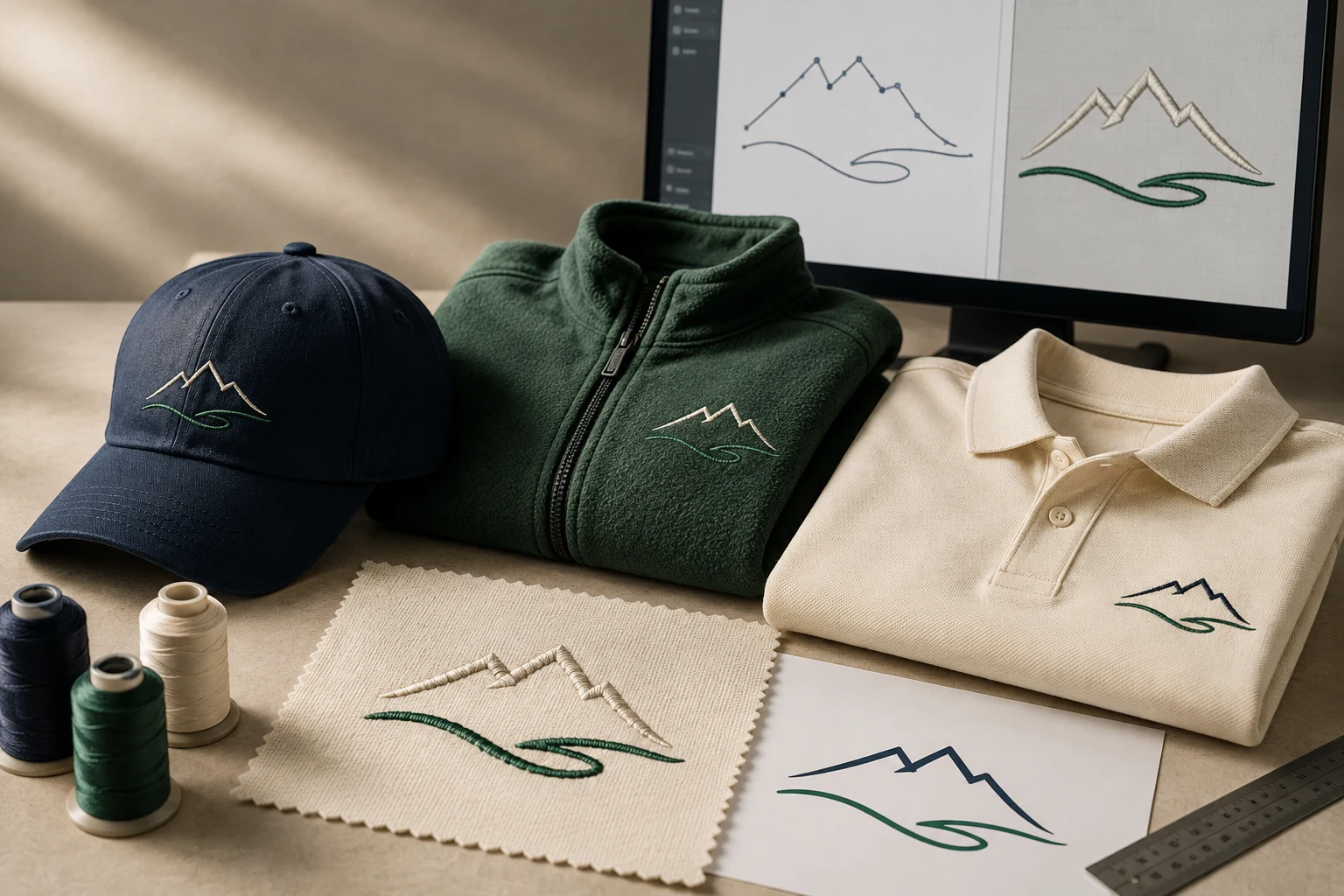
Cover image: AI-generated editorial concept; not a customer project or production proof.
For New Hampshire buyers, the best embroidery digitizing service is one that understands the intended garment, supplies compatible files, explains revisions clearly and supports a successful test sew-out. Compare providers using relevant stitched samples and a written project brief before committing to production.
Whether you need uniforms in Manchester, team apparel in Concord or merchandise for a Portsmouth event, start by deciding what you are buying: digital stitch files, scalable artwork or finished embroidered goods. Each requires a different scope of work.
Embroidery digitizing and vector art serve different purposes
Embroidery digitizing turns artwork into instructions for an embroidery machine. The deliverable is a stitch file prepared for the intended size and application. DigitEMB’s embroidery digitizing service describes options for projects such as logos, caps and jacket backs.
Vector art describes shapes using mathematical paths, so those shapes can be enlarged without the pixelation associated with enlarging raster artwork. This makes a vector master useful when the same design must appear on a small printed item and a larger sign. Adobe’s explanation of vector art covers this distinction.
A vector file still needs embroidery digitizing before it becomes a machine stitch file. Ask for both deliverables when your project includes embroidered clothing and printed materials.
Project need | Service to request |
|---|---|
A logo stitched onto apparel | Digitizing for the specified garment, placement and finished size |
A pixelated logo rebuilt for print | Vector conversion, with the printer’s file requirements supplied |
Matching embroidered and printed merchandise | Separate stitch and vector deliverables based on agreed artwork |
Finished uniforms, hats or bags | Garment decoration, with digitizing and sample approval included or separately arranged |
For artwork preparation, review DigitEMB’s vector art conversion services and confirm which output files your printer needs.
Choosing a local or online provider in New Hampshire
A nearby decorator may be useful when you want to inspect garment samples, discuss placement in person or collect finished goods. Confirm that these services are actually available before arranging a visit. A business accepting New Hampshire orders does not necessarily maintain a local office or production shop.
An online digitizer can be an option when you already have an embroiderer and need digital files. Establish who will test the design, send production feedback and approve the final version. If the decorator arranges digitizing, ask whether you will receive a reusable copy of the file.
For either arrangement, agree on communication hours and deadlines. New Hampshire buyers should specify Eastern Time when scheduling approvals with a remote supplier. Buyers coordinating production in Canada or the UK should also state the destination, preferred measurement units and quote currency. Keep digital file delivery separate from any garment production or shipping schedule.
How to compare quality and technical suitability
Ask for samples that match your application
Request close-up photographs of actual embroidery comparable to your project. A large jacket design is not sufficient evidence for a small uniform logo. Ask what fabric and finished dimensions were used, and whether the images show physical embroidery or a software preview.
Look for readable text, consistent outlines and clean boundaries between colors. Ask the provider to identify any details in your artwork that should be simplified before work begins.
Check how the design will suit the fabric
Stitch spacing, underlay and pull compensation need to suit the fabric and design. Pull compensation adjusts for the tendency of stitches to draw fabric inward; unsuitable settings can contribute to gaps or puckering. Hatch’s fabric guidance explains why these settings work together.
Give the digitizer the actual garment type and material. For a New Hampshire outdoor apparel project, for example, list the fleece jacket and cap as separate applications for review. Ask whether each needs its own file rather than assuming one version will suit every item.
Confirm file compatibility and future editing
Ask your embroiderer for the exact machine format and embroidery field limits before ordering. DST and PES are examples of stitch formats, while an editable working file can preserve information that exported machine files do not retain. Hatch distinguishes these file types in its file format documentation.
Specify the required finished dimensions and ask whether an editable source file is included. Confirm the terms for later size changes and use by another decorator.
Agree on a test sew-out
Arrange a sample on the intended garment or a representative material before approving a production run. Decide whether the digitizer or decorator will handle it and whether it carries a separate charge.
A physical test can reveal alignment problems that need adjustment. Hatch’s pull compensation guidance specifically recommends using a test stitch-out to identify areas for refinement.
Compare quotes, revisions and deadlines
Send the same brief to each provider so that you can compare equivalent work. Ask for a written total and a clear description of what it includes.
Quote item | What to clarify |
|---|---|
Artwork preparation | Whether cleanup or vector reconstruction is included |
Design versions | Which sizes, placements and garment applications are covered |
Deliverables | Machine files, editable source files, previews and color information |
Revisions | Included changes, revision limits and charges for a changed brief |
Sampling | Who performs the sew-out and how feedback reaches the digitizer |
Timing | First proof date, revision timing and final file delivery |
Finished goods | Separate garment, embroidery and shipping charges where applicable |
For an event order, work backward from the date the garments must be ready. Allow time for artwork approval, sampling, corrections and production. Ask the provider to confirm availability for your particular job rather than relying on a general turnaround statement.
Assess support during the quote process. Useful responses should address your garment, file requirements and deadline directly. Reviews can provide context, but relevant samples and a clear written scope make the proposal easier to evaluate.
Prepare a useful project brief
Include the following information with your artwork:
The clearest original artwork available, plus exact spelling and approved design details.
Finished width and height, with units stated; for example, 3 inches wide equals 76.2 mm.
Garment type, material, color and intended placement.
Machine model and required stitch format, supplied by the embroiderer.
Preferred thread colors or references, with the final selection confirmed by the decorator.
Any requested specialty treatment, such as 3D puff, appliqué or metallic thread.
Required deliverables, approval contact and project deadline with time zone.
For regional artwork, describe the intended imagery rather than expecting the provider to infer it. An original mountain outline, coastal motif or woodland illustration could suit a New Hampshire project. Supply the approved reference and identify which details must remain recognizable.
If you want specialty embroidery, ask for relevant samples and confirmation that the decorator can produce the requested effect. Keep this requirement in the initial brief so it is included in the proposed work.
Review vector artwork and material claims separately
For vector delivery, check the spelling, proportions, curves and agreed colors against the approved artwork. Ask your printer or cutter to confirm that the supplied file meets its production requirements. A scalable design still needs to be prepared for its intended use.
If environmental considerations affect your purchase, ask the garment decorator for specific information about the garments, thread, packaging and other physical materials. Request evidence for any certification being claimed. A digital artwork service alone does not establish the environmental qualities of the finished apparel.
Frequently asked questions
Does a digitizer need to be located in New Hampshire?
No. Choose a local arrangement when in-person review or collection matters. For remote work, confirm who handles sampling and how the digitizer and embroiderer will exchange feedback.
Can I send a JPG or PNG?
Ask the provider to assess it. Send the highest-quality original you have and state the final size. Confirm whether artwork reconstruction or simplification is needed and whether it changes the quote.
Do I need vector conversion before embroidery digitizing?
Ask whether it is necessary for your artwork. Order a vector master when you also need scalable artwork for print or other uses, and specify the embroidery stitch file as a separate deliverable.
Can the same file be used on a cap and a jacket?
Have both applications reviewed before reusing it. Provide the placement, dimensions and materials, and ask whether separate versions and samples are needed.
How can I choose the best service without a ranked list?
Compare relevant physical samples, technical answers, file compatibility, written scope and revision support. Select the provider whose proposal fits your specific New Hampshire project and whose sample you are prepared to approve.
Practical details for Choosing Embroidery Digitizing and Vector Art Services in New Hampshire
Use the article above as a starting point, then make the production brief specific to your own design. A stitch file is made for a finished size and material, so the artwork alone is only part of the instruction.
Work through these points in order and keep the answers with the artwork or production request. A short written brief makes it easier to compare a proof with the intended result, ask a useful follow-up question and avoid relying on assumptions made from a screen image alone.
The aim is not to add unnecessary steps. It is to identify the choices that change the final result before work begins. If a requirement is unknown, flag it for confirmation rather than guessing; that keeps the approval process focused on the design, material and use that apply to this particular project. Save the approved brief with the project files for future reorders or revisions.
Confirm the finished use
State the item, placement and finished width and height. A chest logo, cap front and jacket back do not use the same sewing area, even when they start from the same artwork.
Protect the smallest details
Review small lettering, narrow gaps, thin outlines and tiny colour changes at the final size. Simplifying a fragile detail before digitizing is often more reliable than trying to force it into a small sew-out.
Match the file to the machine
Tell the production team the embroidery machine or format required, along with the fabric or garment type. This lets them prepare the right export and make choices that suit the material rather than treating every job alike.
Quick questions to check before you proceed
What should I send with my artwork?
Send the clearest original available, the finished dimensions, placement, fabric or garment type and the required machine format if you know it.
Can the same file be used at every size?
Not always. Scaling changes the relationship between stitch length, detail and fabric, so a design may need review when the finished size or placement changes.
What should I check before production?
Confirm the spelling, colours, final size, placement and any details that must remain readable. A proof or sample is the best point to catch a change.