
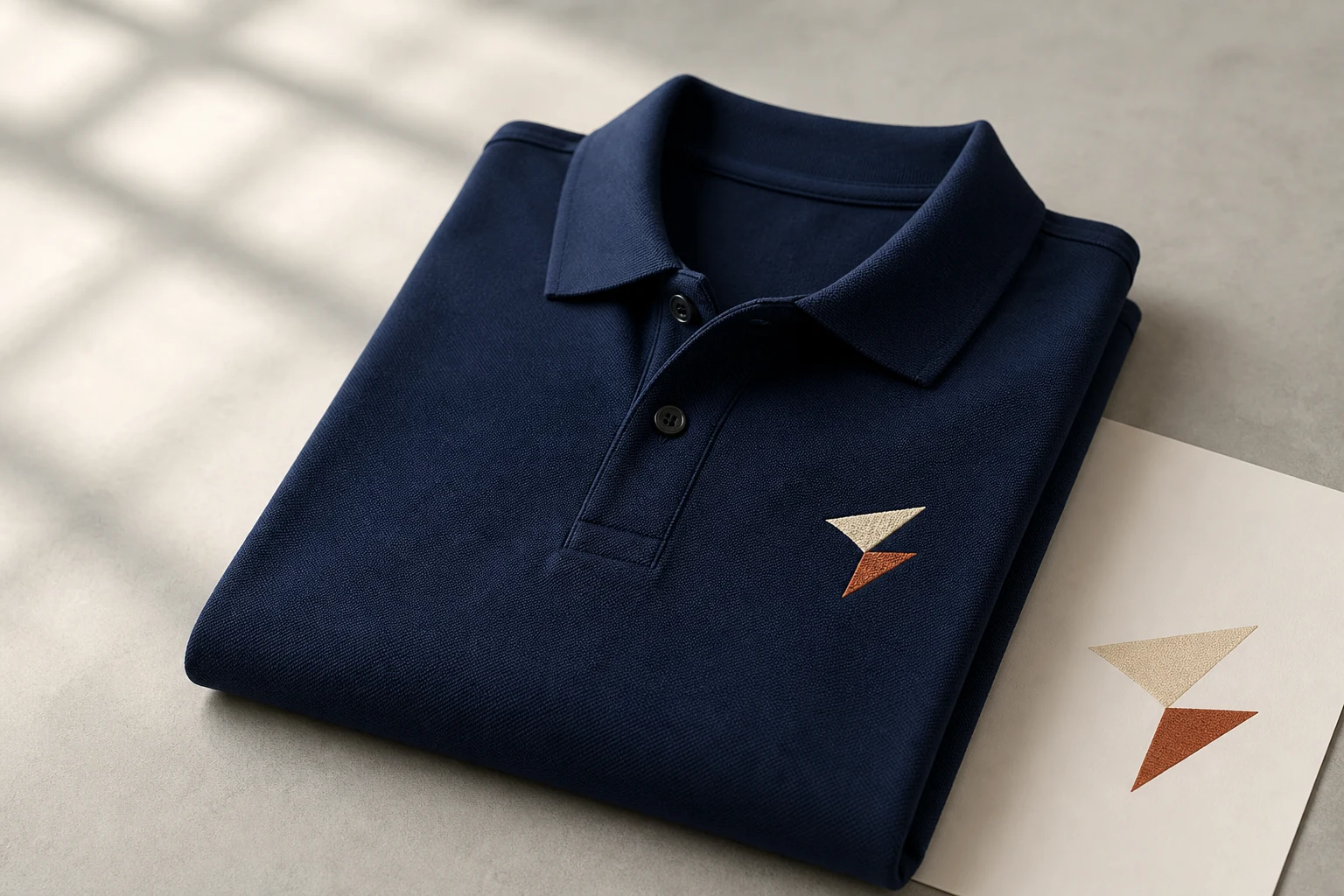
Cover image: AI-generated editorial concept; not a customer project or production proof.
For Illinois buyers, the best embroidery digitizing and vector art service is one that can prepare files for your actual application, show relevant work and explain how revisions and production checks will be handled. Compare providers using the same artwork, finished dimensions, fabric and deliverables. Confirm whether you are buying digital files, decorated products or both.
Whether you are arranging uniforms in Chicago, promotional merchandise in Springfield or personalized gifts elsewhere in Illinois, start with the finished item and work backward to the files it needs.
Understand which service your project needs
Embroidery digitizing prepares artwork as stitch instructions for an embroidery machine. The editable embroidery design and the exported machine file serve different purposes: Hatch explains that its EMB working file retains design information, while the machine format contains stitching data. Ask which files will be delivered and which your decorator requires. Hatch’s saving and exporting guidance.
Vector art describes shapes using mathematical lines and curves. Those shapes can be resized without the pixelation associated with enlarging a raster image. This makes vector artwork useful for logos across printed materials, signage and digital layouts. Adobe’s raster and vector explanation.
A vector logo still needs digitizing before it becomes machine embroidery. Vector conversion is also not a compulsory first purchase for every embroidery job: Hatch supports digitizing from both bitmap and vector artwork. Send your best original file and ask whether redrawing is necessary. Hatch’s artwork conversion overview.
Your project | What to request |
|---|---|
Embroidered uniforms, caps or bags | Digitizing for the stated size, placement, material and machine format. |
Printed banners, business cards or promotional graphics | Vector artwork prepared to the printer’s file requirements. |
A logo used on both apparel and printed materials | A vector master plus separately prepared embroidery files. |
Personalized towels or gifts | A review of the lettering, finished size and actual item before digitizing. |
Finished decorated products | A quote that explicitly includes products, decoration, sampling and delivery. |
Compare local and online options for Illinois orders
Decide which parts of the job benefit from physical access. If you need to inspect garments, compare thread samples or collect a finished order, ask a prospective Illinois decorator whether appointments and pickup are available at a confirmed address.
For digital files, evaluate the provider’s communication and ability to coordinate with your production shop. A location mentioned on a website does not establish that digitizing, sampling and garment production happen there. Ask who performs each stage and who handles a revision if the sample needs work.
For a Chicago event order, distinguish the date the files are needed from the date finished merchandise must arrive. For a project elsewhere in the state, make the same distinction between file delivery, sample approval, production and collection or shipping. Agree on dates and a named time zone for approval deadlines.
Buyers coordinating from Canada or the UK should also specify dimensions with units, quote currency and the destination of any physical goods. Keep digital-file delivery and merchandise delivery as separate items in the brief.
Judge providers by relevant evidence
Review work similar to your application
Ask for examples that match your product and design demands. A large jacket design provides limited evidence of how a provider handles a small uniform logo. Request close photographs of stitched work as well as digital previews, and ask what size and material the example uses.
For vector work, review the shape accuracy, spacing and lettering against the original artwork. Ask how unclear details will be resolved before the artist redraws them. Approve intentional changes instead of allowing missing information to become guessed artwork.
Ask how the design will be adapted
Give the provider the fabric and thread information available from your decorator. Embroidery settings may need adjustment when fabric or thread changes; Hatch specifically identifies these as reasons to change stitch density. Hatch’s stitch-spacing guidance.
Ask whether small text or fine details need simplifying at the requested size. If the same logo will appear on a polo, cap and towel, have each application reviewed. Avoid approving a promise that one file will suit every product without testing.
Confirm the deliverables and revision terms
Before ordering, ask for a written description of the machine file, preview and any editable source files included. Have your decorator confirm compatibility with its equipment and available embroidery area.
For vector artwork, obtain the printer’s preferred format and preparation requirements. Ask whether the delivered artwork contains editable paths and whether fonts or linked images need attention.
Clarify which corrections are included, how long revision support lasts and whether a new size, placement or product counts as additional work. Also confirm whether you may send the delivered files to another production shop.
Prepare one brief for comparable quotes
Use the same specifications when approaching each provider. Otherwise, an inexpensive file-only quote may be compared with an order that includes redraws, sampling or physical embroidery.
Brief detail | Information to provide |
|---|---|
Artwork | Best original file, exact wording and the version to use. |
Finished dimensions | Width and height in inches or millimeters for each application. |
Product and placement | Garment or item, material, color and intended decoration position. |
Production requirements | Decorator’s requested machine format or printer’s file specifications. |
Color references | Approved artwork colors and any thread selections already agreed with the decorator. |
Deliverables | Embroidery files, vector artwork, previews and editable files requested. |
Schedule | File deadline, sample review date and required arrival date for physical goods. |
Quote scope | Revisions, additional versions, sampling and any production or shipping charges. |
If a detail is undecided, identify it explicitly. For example, ask for a feasibility review of the logo size before requesting a final digitizing quote.
Compare total scope and support alongside price. Request confirmation of any rush availability for your particular job; do not build a production schedule around a general turnaround statement.
Coordinate artwork, sampling and production
A practical workflow begins with the buyer and decorator agreeing on the product, decoration area and file requirements. The artwork provider can then review the source and explain any adaptations before preparing the files.
Review the digital proof for spelling, proportions, omitted elements and stated dimensions. For embroidery, arrange a sew-out on the intended item or a representative material with the planned production setup. Inspect lettering, edges, alignment and the feel of the stitched area before authorizing the full run.
If a sample needs revision, send clear photographs and the relevant setup details with the feedback. Describe the visible issue precisely, such as a closed letter opening or an outline that does not meet its fill. Agree who will assess whether the file or production setup needs changing.
For printed items, have the printer review the vector file and provide the appropriate proof. Where appearance matters across both print and embroidery, review each output separately rather than treating one approval as approval of everything.
Keep the approved files, dimensions, product specifications and sample photographs together. For a reorder, check whether the garment, placement or size has changed before reusing the previous production files.
Match the files to the broader project
Corporate uniforms: identify every placement and garment style in the order. Give the digitizer and decorator the same artwork version and approval contact.
Personalized gifts and apparel: confirm names, initials and spelling individually. Request a review of the smallest lettering at the actual finished size.
Events and promotional products: list embroidered and printed items separately. A cap may need an embroidery file while a banner needs artwork prepared for print, even when both use the same logo.
Artists and small brands: keep an approved master of the original artwork and record any simplified embroidery variation. This makes it easier to reuse the design while understanding which version belongs to each application.
Explore DigitEMB’s embroidery digitizing services and raster-to-vector services. Send your artwork and production brief to confirm the appropriate service and deliverables for your Illinois project.
Frequently asked questions
Do I need an Illinois-based digitizer?
Choose according to the work you need. Confirm a local option when in-person sample review or pickup matters. For digital files, focus on clear specifications, relevant examples and coordination with the decorator who will run the design.
Does vector conversion include embroidery digitizing?
Confirm the quote. Vector artwork and embroidery machine files are separate deliverables. A project using both print and embroidery may require both services.
Can I submit a JPG or PNG?
Yes, bitmap artwork can be a starting point for digitizing. Send the best original available and have the provider assess unclear edges, lettering and detail before work begins. A vector redraw may help some projects, but it is not automatically required.
Can I reuse one embroidery file at different sizes?
Have the digitizer review the requested sizes before production. Keep the editable design where included, and request machine files prepared for the agreed dimensions. Approve a new sample when a change could affect the result.
How can I compare turnaround times fairly?
Ask when the first proof, revisions and final files will be ready. If ordering finished goods, obtain separate dates for sampling, production and delivery. Confirm when the schedule starts and what approval is needed from you.
Practical details for Choosing Embroidery Digitizing and Vector Art Services in Illinois
Use the article above as a starting point, then make the production brief specific to your own design. A stitch file is made for a finished size and material, so the artwork alone is only part of the instruction.
Work through these points in order and keep the answers with the artwork or production request. A short written brief makes it easier to compare a proof with the intended result, ask a useful follow-up question and avoid relying on assumptions made from a screen image alone.
The aim is not to add unnecessary steps. It is to identify the choices that change the final result before work begins. If a requirement is unknown, flag it for confirmation rather than guessing; that keeps the approval process focused on the design, material and use that apply to this particular project. Save the approved brief with the project files for future reorders or revisions.
Confirm the finished use
State the item, placement and finished width and height. A chest logo, cap front and jacket back do not use the same sewing area, even when they start from the same artwork.
Protect the smallest details
Review small lettering, narrow gaps, thin outlines and tiny colour changes at the final size. Simplifying a fragile detail before digitizing is often more reliable than trying to force it into a small sew-out.
Match the file to the machine
Tell the production team the embroidery machine or format required, along with the fabric or garment type. This lets them prepare the right export and make choices that suit the material rather than treating every job alike.
Quick questions to check before you proceed
What should I send with my artwork?
Send the clearest original available, the finished dimensions, placement, fabric or garment type and the required machine format if you know it.
Can the same file be used at every size?
Not always. Scaling changes the relationship between stitch length, detail and fabric, so a design may need review when the finished size or placement changes.
What should I check before production?
Confirm the spelling, colours, final size, placement and any details that must remain readable. A proof or sample is the best point to catch a change.