
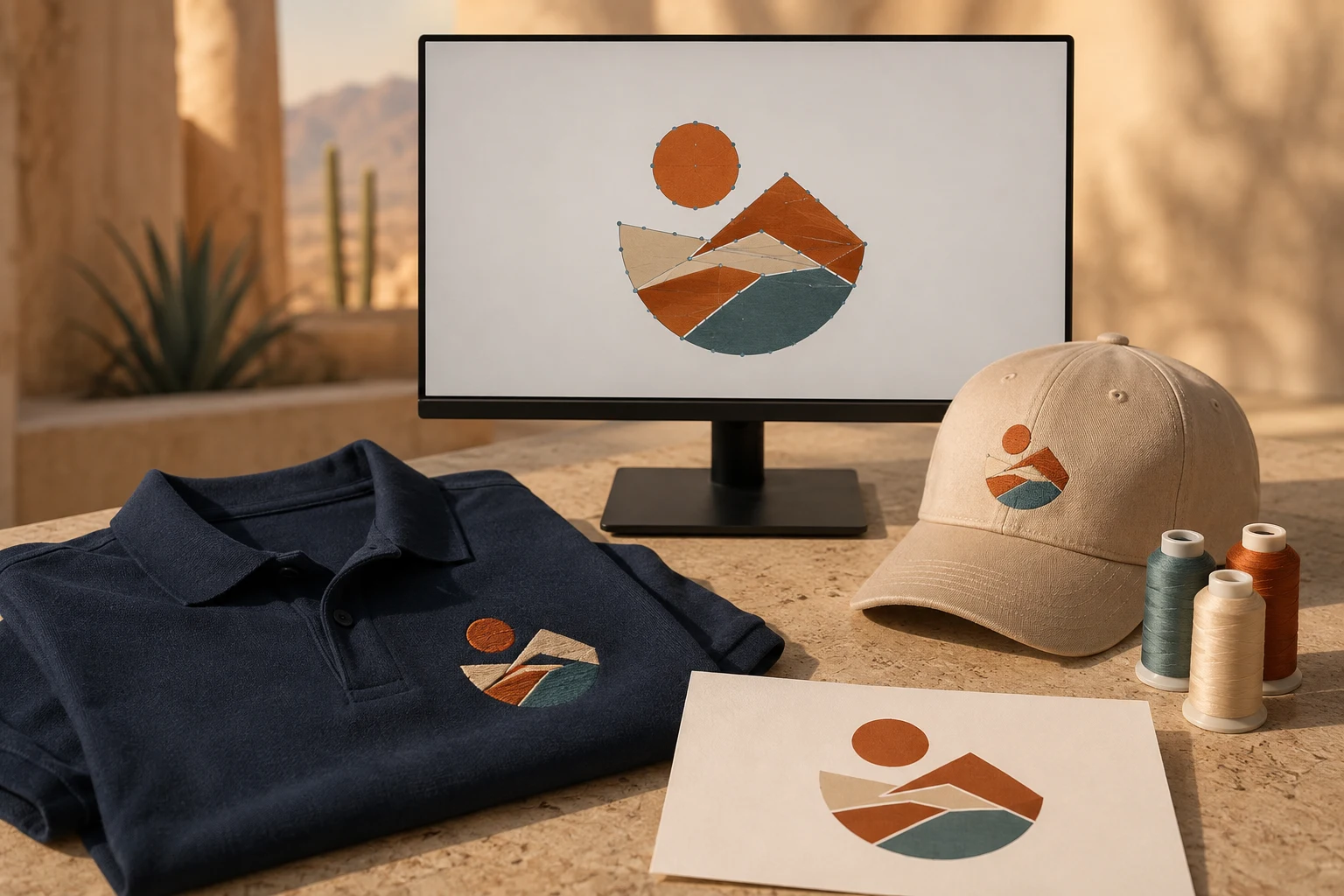
Cover image: AI-generated editorial concept; not a customer project or production proof.
For Arizona businesses, the best fit for embroidery digitizing and vector art is a provider that understands the intended product, supplies the correct files and offers a clear proof and revision process. Compare relevant work samples and written project terms before choosing. A statewide ranking cannot tell you whether a particular provider can handle your artwork, fabric and deadline.
Whether you are ordering uniforms in Phoenix, promotional caps in Tucson or branded jackets in Flagstaff, start by identifying who will produce the finished items. Their requirements should guide the artwork order.
Which service do you need?
Embroidery digitizing creates stitch instructions from artwork. Vector conversion creates editable shapes and paths for graphics. One logo may need both treatments when it appears on embroidered apparel and printed marketing materials.
Intended use | What to request |
|---|---|
Embroidered shirts, hats, jackets or bags | A digitized design for the agreed size, material and placement, exported in the format your embroiderer requests. |
Signs, business cards and promotional graphics | Vector artwork supplied to your printer’s specifications. |
A logo used across apparel and print | Separate embroidery and vector deliverables, with an agreed visual reference. |
Finished decorated products | A quote that explicitly includes garments or goods, decoration and delivery. |
Embroidery digitizing
Digitizing involves turning artwork into embroidery objects and stitches. Even software that automatically processes imported vector or bitmap artwork uses settings that influence the result; submitting an image does not settle the production decisions. Hatch’s auto-digitizing documentation describes this artwork-to-embroidery process.
Give the digitizer your intended fabric and finished dimensions. Underlay—the stitching beneath the visible design—may need adjustments for fabric, lettering appearance and size. Hatch’s underlay documentation explains these dependencies.
Vector art
Vector graphics describe shapes mathematically, allowing those shapes to scale without the pixelation associated with enlarging raster images. This makes them useful for logos appearing on materials of different sizes. Raster images remain useful for photographs and other pixel-based artwork. Adobe’s comparison of raster and vector graphics explains the distinction.
Tell the provider whether the artwork is intended for print, signage or cutting. Ask the receiving production shop to specify its preferred file format and preparation requirements before conversion begins.
Choosing a provider for an Arizona project
Confirm local handling and digital delivery separately
If you need to inspect garments, collect an order or review physical samples, ask whether the provider offers those services at a verifiable Arizona location. Confirm appointment arrangements before traveling.
For a digital file order, establish how the digitizer will exchange files and feedback with your embroiderer or printer. A Phoenix business using an online artwork service still needs someone responsible for approving the result on the actual product.
For an event in Scottsdale or a uniform rollout across several Arizona locations, work backward from the date the finished goods must arrive. Allow separate time for artwork preparation, revisions, sample approval, production and transport. Request a written schedule for your project.
Review comparable samples
Ask to see examples that resemble your proposed work in size, detail and application. For embroidery, request close photographs of stitched samples as well as digital previews. For vector work, request examples showing the original artwork and the completed redraw.
Useful questions include:
Can you show work with lettering and detail similar to this design?
What parts of the artwork would you simplify at the requested size?
Who will make and approve the physical embroidery sample?
What happens if the production shop identifies a file problem?
Treat software names as background information. Ask the provider to explain the decisions they would make for your project and how you will assess the result.
Compare complete quotes
Send each candidate the same artwork and specifications. Ask for an itemized scope covering artwork preparation, additional sizes, file formats, revisions and any physical sampling.
Confirm the quote currency when working across the US, Canada or UK. State dimensions with units and provide the event location and deadline time zone. These details make a quote easier to interpret when the buyer, artwork provider and production shop are in different places.
Customizing a logo across embroidery and print
Agree on changes to fine detail
Ask the provider to flag small lettering, narrow gaps or intricate elements that may need adjustment. Approve those changes before the full design is prepared. Keep a reference showing which features must remain recognizable and which may be simplified.
Review colors in the intended medium
Supply your brand color references and ask the printer and embroiderer how they will select ink and thread. Request physical samples where color approval matters. Record the approved choices so repeat orders have a clear reference.
Request each embroidery size explicitly
A scalable vector master does not make every embroidery size interchangeable. Hatch documents cases where resizing stitch files changes density or loses stitches and special effects. Ask for each intended embroidery size to be reviewed and tested rather than assuming one file covers every placement. Hatch’s guidance on resizing stitch files explains these limitations.
For example, if the same artwork will appear on a shirt and a jacket back, specify both dimensions in the order. Let the digitizer propose any necessary differences and obtain your approval.
What to send with your request
A complete brief helps providers identify missing information before quoting.
Brief item | What to include |
|---|---|
Artwork | The clearest available original, plus any existing editable files and an approved visual reference. |
Product and material | Garment or item type, fabric information and product photographs where useful. |
Size and placement | Finished width and height, units, placement and every required size variant. |
Production requirements | The embroiderer’s or printer’s requested formats and any supplied technical specifications. |
Colors and detail | Color references, exact wording and permission to propose simplifications. |
Delivery scope | Digital files, physical samples or finished products; identify which are required. |
Schedule and revisions | Required completion date, approval contact and questions about included changes. |
If you are considering DigitEMB, review its embroidery digitizing service and raster-to-vector service. Use the relevant service page to frame your request, then confirm the deliverables and project terms in your quote.
Approving the work before production
Review spelling, proportions, dimensions and requested colors against your original brief. Ask your production shop to confirm that the supplied files meet its requirements.
For embroidery, arrange a test sew-out on the intended material with the planned production setup. Examine lettering, outlines and the fabric around the design, then send clear photographs and measurements if revisions are needed. Confirm who is responsible for performing this test before placing the order.
For vector artwork, ask the receiving printer or sign maker to review the file and provide the appropriate production proof. Keep approved proofs and final files together so future suppliers know which version to use.
Frequently asked questions
Do I need a provider physically located in Arizona?
Choose local handling if you need in-person sample review, garment drop-off or collection. For digital artwork, focus on communication, compatible deliverables and coordination with the shop producing your goods. Verify any claimed local premises directly.
Can a vector logo be used directly for embroidery?
It can serve as source artwork, but it still needs digitizing into embroidery instructions. Ask your embroiderer which output format and dimensions they require.
Does digitizing include embroidered clothing?
Do not assume it does. Ask whether the quote covers digital files, a sample or a finished garment order, and have each included item listed.
How do I compare turnaround times?
Ask when the first proof will arrive, how revisions affect the schedule and when the final deliverables will be ready. For finished products, include sampling, production and shipping in the timeline.
Should I order vector conversion and digitizing together?
That can be useful when one logo will appear on both apparel and printed materials. Request separate deliverables and have each production supplier confirm its requirements before work starts.
Practical details for Choosing Embroidery Digitizing and Vector Art Services in Arizona
Use the article above as a starting point, then make the production brief specific to your own design. A stitch file is made for a finished size and material, so the artwork alone is only part of the instruction.
Work through these points in order and keep the answers with the artwork or production request. A short written brief makes it easier to compare a proof with the intended result, ask a useful follow-up question and avoid relying on assumptions made from a screen image alone.
The aim is not to add unnecessary steps. It is to identify the choices that change the final result before work begins. If a requirement is unknown, flag it for confirmation rather than guessing; that keeps the approval process focused on the design, material and use that apply to this particular project. Save the approved brief with the project files for future reorders or revisions.
Confirm the finished use
State the item, placement and finished width and height. A chest logo, cap front and jacket back do not use the same sewing area, even when they start from the same artwork.
Protect the smallest details
Review small lettering, narrow gaps, thin outlines and tiny colour changes at the final size. Simplifying a fragile detail before digitizing is often more reliable than trying to force it into a small sew-out.
Match the file to the machine
Tell the production team the embroidery machine or format required, along with the fabric or garment type. This lets them prepare the right export and make choices that suit the material rather than treating every job alike.
Quick questions to check before you proceed
What should I send with my artwork?
Send the clearest original available, the finished dimensions, placement, fabric or garment type and the required machine format if you know it.
Can the same file be used at every size?
Not always. Scaling changes the relationship between stitch length, detail and fabric, so a design may need review when the finished size or placement changes.
What should I check before production?
Confirm the spelling, colours, final size, placement and any details that must remain readable. A proof or sample is the best point to catch a change.