
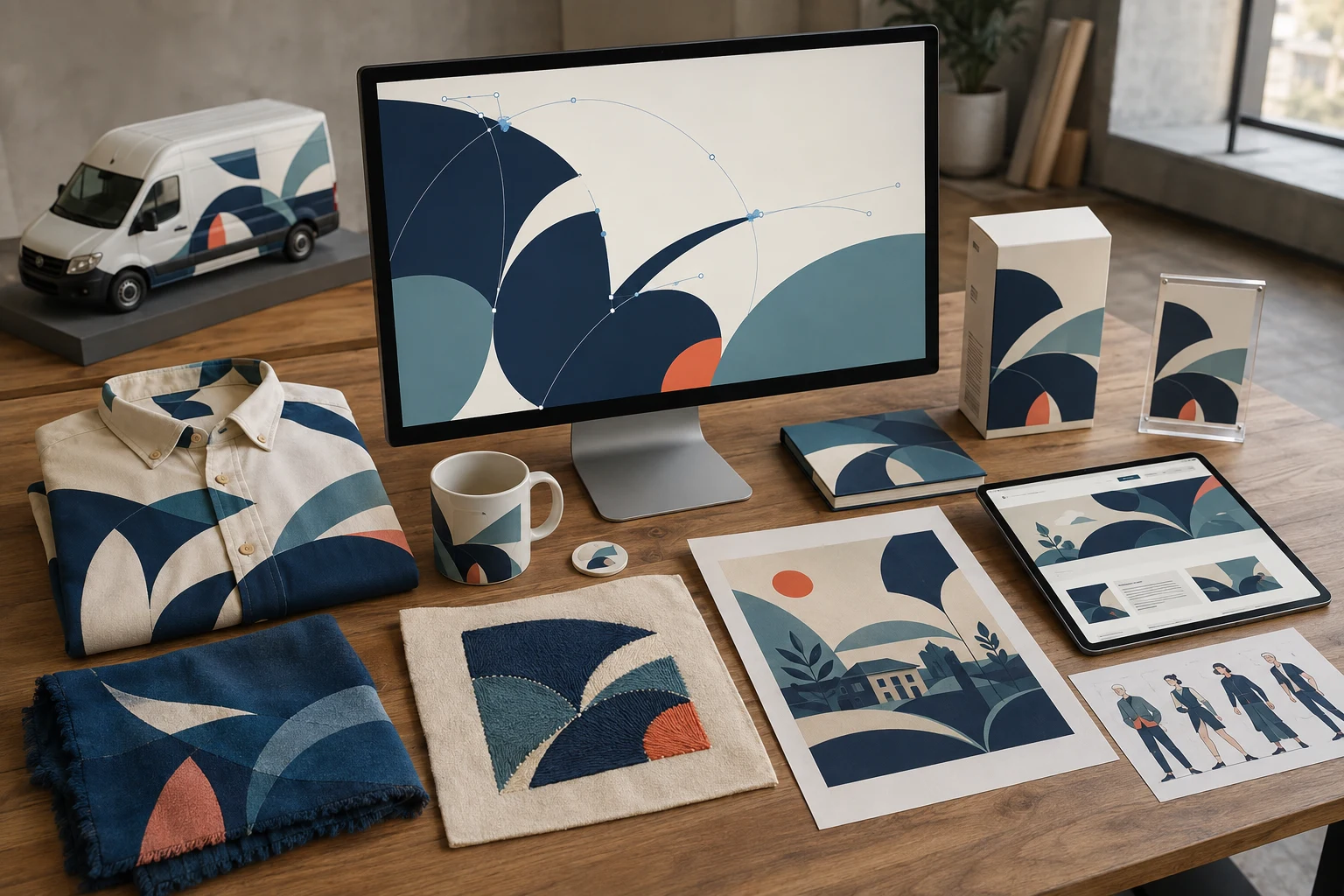
Cover image: AI-generated editorial concept; not a customer project or production proof.
Vector art services help businesses create or rebuild editable graphics for use across products, print and digital media. Ten niches that can benefit are print-on-demand, apparel and textiles, web design, commercial printing, promotional products, marketing, publishing, animation, vehicle wrapping, and packaging. The useful deliverable depends on how each business will reproduce the artwork.
For buyers in the US, Canada and UK, the starting point is the same: explain the intended use, supply the best available artwork, and obtain the receiving supplier’s file requirements before commissioning the work.
Why businesses use vector artwork
Vector graphics describe shapes using paths and curves. These elements can scale without the pixelation associated with enlarging a raster image. That makes vectors useful for logos, lettering and illustrations that need to appear at several sizes. Photographs usually remain raster images, and a design can combine both types. Adobe explains the differences between raster and vector graphics.
Editable artwork also makes it easier to request a new color variation, rearrange elements or prepare a simplified version. However, vector format alone does not guarantee accurate printing, smaller files or realistic imagery. The artwork still needs to suit its final size and production method.
1. Print-on-demand businesses
A POD seller might use the same illustration on a shirt, mug and poster. A vector master gives the designer a reusable starting point for adapting the composition to each product’s printable area.
The upload file may still need to be raster. For example, Printful advises using PNG or JPEG for most print products, depending on the product and method, and checking the individual product guidelines. Printful’s print-file guidance covers format, resolution, color profile and transparency.
What to request: an editable master plus separate exports prepared for the selected products. Include product templates and placement dimensions; a mug layout should not simply be stretched into a shirt design.
2. Apparel and textile businesses
Clothing brands can commission garment graphics, repeat-pattern artwork and label designs. Fashion designers can also request flat sketches with separate front and back views to communicate design details to manufacturers. Specify whether the assignment is decorative artwork, a technical drawing or both.
Embroidery businesses can use clean vector artwork as a reference, but it does not already contain machine stitching instructions. Digitizing adds stitch types, directions and other production settings. Wilcom notes that even automated conversion requires review of fabric-related settings and may need manual editing. Wilcom’s explanation of auto-digitizing describes this distinction.
What to request: editable garment graphics or clearly annotated sketches. For embroidery, specify the fabric, finished dimensions and required machine format as a separate digitizing brief. DigitEMB’s embroidery digitizing service is distinct from vector artwork preparation.
3. Web design businesses
Web designers can use vectors for interface icons, logos and explanatory illustrations. SVG supports scalable graphics and can be embedded in web content; it can also contain raster images. These capabilities are described in the W3C SVG specification.
A scalable asset still needs appropriate sizing and implementation. Supplying an SVG does not automatically make a page responsive or make a complex icon readable at a small size.
What to request: a consistent icon family, appropriate logo variations and SVG exports. Ask the web team to review the assets in their intended layouts and provide suitable accessible descriptions where needed.
4. Commercial printing businesses
Print shops can use vector logos and illustrations in business cards, brochures, posters and banners. Their artwork brief should reflect the actual printing process rather than assume that one export will suit every machine.
For screen printing, vector shapes can support color separation work, but a layered file is not automatically a completed set of separations. Spot colors, overprinting and other output settings require attention. Adobe’s color separation documentation explains these controls and the limits of an on-screen separation preview.
What to request: artwork prepared to the printer’s specifications, with the required colors and output format. Confirm whether the scope includes separations or only the underlying vector design.
5. Promotional product suppliers
Pens, mugs, keychains, caps and tote bags offer very different spaces for a graphic. Promotional product suppliers can commission alternate logo arrangements for these placements, including a simplified or single-color version where appropriate.
The valuable collaboration is deciding what remains legible on each item. Ask the decorator to assess small lettering and fine details before adapting the artwork across a product range.
What to request: clearly named variations for the intended products, each with its final dimensions and decoration method. Keep a visual proof alongside the production files so suppliers can identify the correct version.
6. Marketing and advertising agencies
Agencies can commission a coordinated set of logos, campaign illustrations, signage graphics and brand identity materials. Typical applications include business cards, letterheads, digital advertisements and outdoor displays.
A useful brief defines what stays consistent and what can change between placements. For example, a wide banner and a square social graphic may share a symbol and colors while needing different arrangements of text and imagery.
What to request: editable campaign assets, approved color references, alternate layouts and exports for the actual advertising channels. Identify who will maintain the master files when future revisions are needed.
7. Editorial and journalism businesses
Publishers can commission conceptual illustrations, diagrams, maps and charts for print and online articles. Vector artwork is especially useful when the same graphic needs versions for a magazine column, a full page and a web article.
The editorial team should supply and approve the underlying facts, labels and data. A polished illustration cannot establish that its information is accurate, and conceptual artwork should be clearly distinguished from documentary photography.
What to request: editable labels, the intended publication sizes and versions suited to each layout. Include the source data and any essential wording in the brief so the illustrator does not have to infer them.
8. Cartoon animation studios
Animation teams can commission characters, props and backgrounds as editable vector assets. Separating movable elements gives the animator more control over the artwork during production.
Software compatibility matters. Adobe Animate can import Illustrator files while preserving many editing features, but its documentation identifies differences in how layers, effects and other elements transfer. Adobe’s Illustrator-to-Animate guidance is a useful reference for this workflow.
What to request: the animator’s preferred file format, named layers and separate character components. Agree on expressions and poses in advance, and test an imported sample before commissioning a large asset set.
9. Vehicle wrapping businesses
Wrap designers can use vector logos, lettering and graphic patterns within a vehicle layout. This allows those elements to be revised as the installer reviews their placement.
Keep the artwork brief tied to the actual vehicle. Ask the installer to confirm the template, measurements and areas affected by doors, handles, windows or panel transitions. A vehicle mockup is a review aid, not a substitute for production approval.
What to request: editable graphics positioned on the installer’s accepted template, with the working scale clearly stated. Ask the wrap provider to approve any photographs, gradients and final print settings included in the design.
10. Packaging and label businesses
Packaging teams can commission logos, decorative illustrations and product-range variations for cartons, sleeves and labels. Keeping the artwork editable helps when product names, layouts or pack sizes change.
Start with the converter’s approved template. Ask the supplier to identify cut lines, folds and other production markings, and specify how those should be separated from printable artwork. Product wording and required label content should come from the buyer’s approved copy.
What to request: artwork placed on the correct template, clearly separated production markings and an approval proof for each product variation. Confirm responsibility for checking the final text before production.
What to include in a vector art brief
The most useful brief describes the finished application. For projects shared between US, Canadian and UK suppliers, explicitly state inches or millimeters rather than sending unlabeled measurements.
Brief detail | What to supply or confirm |
|---|---|
Intended use | The product, publication, website or display where the artwork will appear. |
Source artwork | The best available original and a clear description of what should change. |
Dimensions | Final width and height, units, and any template or working scale. |
Production method | Print, embroidery, cutting, animation or digital display requirements. |
Colors | Approved references and the receiving supplier’s requested color setup. |
Deliverables | Editable master, required exports, previews and any separate production work. |
Review scope | Who approves wording, appearance, file compatibility and physical samples. |
For an existing image that needs rebuilding, review DigitEMB’s raster-to-vector service and describe the intended output when requesting a quote. Confirm whether the assignment covers faithful conversion, design changes or additional production preparation.
Frequently asked questions
Does every business need vector artwork?
No. It is most useful for reusable logos, lettering, icons and shape-based illustrations. Photography usually remains raster. Choose the format around the content and its intended use.
Can one vector file work for every supplier?
Keep a master file, but confirm each supplier’s export and production requirements. A web asset, POD upload and embroidery design can require different deliverables even when they share the same source artwork.
Is a PDF always a vector file?
No. A PDF can contain raster imagery, vector elements or a mixture. Ask the designer to inspect its contents; the extension alone does not prove that the artwork is editable vector geometry. Adobe’s format comparison discusses this distinction.
Is vector conversion the same as logo design?
Vector conversion rebuilds supplied artwork as editable shapes. Logo design involves developing or changing the visual identity. State whether you want an accurate redraw or creative changes so the scope is clear.
Practical details for 10 Business Niches That Use Vector Art Services
Vector artwork is built from editable paths rather than a fixed grid of pixels. The clearest result starts with a specific intended use, because a file prepared for print, cutting and embroidery may need different checks.
Work through these points in order and keep the answers with the artwork or production request. A short written brief makes it easier to compare a proof with the intended result, ask a useful follow-up question and avoid relying on assumptions made from a screen image alone.
The aim is not to add unnecessary steps. It is to identify the choices that change the final result before work begins. If a requirement is unknown, flag it for confirmation rather than guessing; that keeps the approval process focused on the design, material and use that apply to this particular project. Save the approved brief with the project files for future reorders or revisions.
Start with the best source
Provide the largest, clearest original you have and include any brand colours, fonts or reference files. A small or blurry image can still be traced, but missing edges and lettering need careful confirmation.
Define the final use
Say whether the artwork is for print, cutting, screen printing, embroidery reference or a digital asset. This tells the artist which details, colour separations and file formats matter most.
Review paths, text and colour
Before using the finished file, check that lettering is correct, shapes are closed where required and colours match the approved artwork. Keep a master editable file as well as the delivery format used by production.
Quick questions to check before you proceed
Is a vector file the same as an embroidery file?
No. A vector is editable artwork; an embroidery file contains stitch instructions. Vector art can be useful source material for digitizing, but it still needs to be digitized for machine embroidery.
Can a blurry logo be converted?
Often, yes, but the result depends on what can be verified. Supply a clearer reference, font name or brand guide whenever possible.
Which details need approval?
Check spelling, line weight, enclosed spaces, colour choices and the shape of any logo elements before the file goes to print or production.