
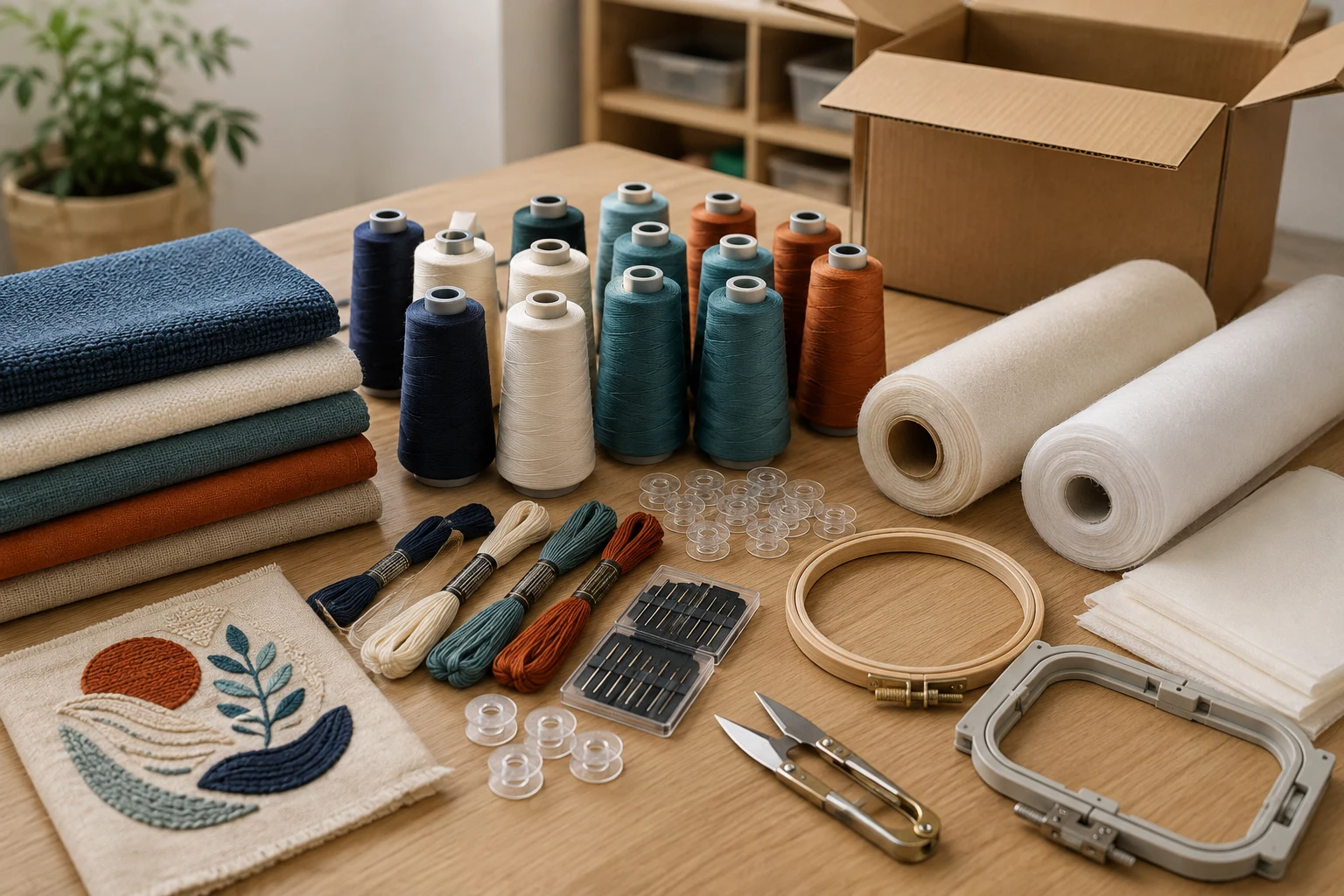
Cover image: AI-generated editorial concept; not a customer project or production proof.
Buy wholesale embroidery supplies by matching materials to your projects, testing a small order and comparing the total delivered cost of equivalent products. Start with the thread colors, needles and stabilizers you use regularly, then add specialty materials as projects require them. A larger order is worthwhile when you can use the stock and the savings outweigh shipping, storage and waste.
This guide covers buying materials for hand embroidery, machine embroidery, hobby groups and small businesses, with practical considerations for buyers in the US, Canada and UK.
What wholesale buying can offer
Embroidery materials may reach you through a manufacturer, distributor or specialist supplier. Before opening an account, ask whether the seller offers trade pricing, quantity discounts or retail multipacks. Confirm account eligibility, minimum order value and minimum quantities for each product or color.
Bulk purchasing can reduce repeat ordering and help you keep frequently used materials available. It does not automatically guarantee lower costs, consistent quality or access to every product in a manufacturer's range.
Concentrate your budget on materials with predictable demand. A large assortment can be useful for experimentation, but it may leave you with colors and accessories that rarely get used. Keep room in your budget for samples, replacements and unexpected project requirements.
Choose the right embroidery materials
Threads for hand and machine embroidery
Specify the product range, fiber, color code, thread size or weight, and length per skein or cone. Compare matching specifications before comparing prices.
For hand embroidery, stranded cotton is a useful option when a pattern calls for different numbers of strands. Cotton does not always have a matte finish: DMC's six-strand cotton floss is mercerized for sheen and separates so stitchers can vary the strand count. DMC six-strand embroidery floss.
For machine embroidery, choose thread according to the intended finish and the garment's care requirements:
Thread option | Buying consideration |
|---|---|
Polyester | Consider it for workwear and other items requiring demanding laundering; check the specific product's care instructions. |
Rayon or viscose | Consider it for a soft feel and silky sheen; confirm that the intended cleaning process is suitable. |
Metallic | Buy a sample first and check the manufacturer's needle and machine setup guidance. |
Specialty effects | Buy variegated, glow-effect or textured thread against a defined project requirement. |
Madeira explains the differences in polyester and viscose appearance, feel and laundering suitability in its thread selection guide. Treat care guidance as product-specific rather than assuming every thread of the same fiber performs identically.
Prioritize your most-used colors. Request a physical shade card or sample when color matching matters, and record the manufacturer and color code when reordering. Keep any lot information supplied with the material.
Needles and bobbins
Before buying a box of machine needles, confirm the needle system required by your machine, then select the size and point appropriate to the thread and fabric. Do not order by needle size alone. For hand embroidery, specify hand needles suitable for the pattern, fabric and number of strands.
Needle categories serve different purposes. SCHMETZ describes embroidery needles for rayon and polyester applications, jersey needles for knits and some stretch fabrics, and metallic needles with an enlarged polished eye for specialty threads. Its quilting needles have a taper intended for layered materials. These descriptions do not make every category interchangeable for embroidery. SCHMETZ needle guide.
A small assortment can help you test unfamiliar work. Once you have a successful setup, buy the exact needle specification you use regularly. Confirm bobbin compatibility and the recommended bobbin thread with your machine manual before ordering prewound bobbins in quantity.
Stabilizers and toppings
Buy stabilizer by its construction, weight, dimensions and intended use. Calculate how many usable hoop-sized pieces a roll will yield; a cheaper roll may create more offcuts.
Tear-away backing is commonly used with stable fabrics, with excess material torn away after stitching. Madeira tear-away backing guidance.
Cut-away backing remains behind the embroidery to provide support during and after stitching. Select it with the fabric, design and washing requirements in mind. Madeira cut-away backing guidance.
Water-soluble topping sits above the fabric to hold down surface loops or pile on materials such as terry. It has a different role from the backing underneath. Confirm that the textile can tolerate the specified removal process before buying a large quantity. Madeira water-soluble topping tutorial.
Hoops, tools and accessories
Include the tools needed to prepare and finish the work, but separate reusable equipment from supplies you consume:
Hoops and frames: Check machine attachment compatibility and usable embroidery area, or choose a suitable hand embroidery hoop for your project.
Scissors and snips: Allow for fabric cutting, close trimming and thread cleanup.
Marking tools: Test both the mark and its removal on a spare piece of the actual fabric.
Storage: Choose containers and compartments that keep product labels with the materials.
Fabric and blanks: Test a representative item before committing to a batch intended for the same design.
Reusable tools rarely need the same reorder schedule as thread, needles and backing.
Compare suppliers and equivalent quotes
Ask prospective suppliers for product specifications, sample availability and written order terms. Where a seller claims to be an authorized distributor, check that claim with the manufacturer. Use a small first order to assess product accuracy, packaging and communication.
A useful quote should answer these questions:
Quote detail | What to confirm |
|---|---|
Exact product | Manufacturer, product code, color and specification |
Pack contents | Number of items and length or dimensions per item |
Minimum order | Minimum value, pack quantity and color restrictions |
Stock status | Available quantity, backorders and substitution policy |
Delivery | Dispatch location, shipping charge and estimated timing |
Returns | Rules for opened packs, cut materials, damaged goods and incorrect items |
Support | Who handles compatibility questions and order problems |
Compare thread costs per equal length, needle costs per needle, and backing costs per usable piece or area. Keep fiber, weight and other relevant specifications consistent. Include cutting time and offcuts when comparing backing rolls with precut sheets.
Buying in the US, Canada and UK
Ask suppliers to quote delivery to your actual destination and identify the currency. For cross-border orders, request a clear explanation of which charges are included and which may be collected separately. Confirm who handles customs clearance and any return shipping before placing the order.
Convert dimensions into the same units when comparing US, Canadian and UK listings. Check whether backing weight is stated per unit area; it is different from the total weight of the roll. Treat estimated dispatch and transit times as planning inputs, and allow time to inspect and test the delivery before a production deadline.
Test samples before committing to a bulk order
Use the same fabric, design and finishing method you intend to use for the full project. For machine work, record the machine, needle, thread, bobbin, backing and settings so you can repeat the trial.
Check the sample for appearance, thread breaks, fabric damage, puckering, backing visibility and comfort. Where the finished item will be washed, test it using the intended care method within the material manufacturers' instructions. Inspect the result again afterward.
If the trial fails, identify the cause before buying more stock. Change one variable at a time so that the next sample tells you something useful.
When a project needs artwork prepared for machine embroidery, DigitEMB's embroidery digitizing service is a relevant next step. Provide the finished design size, fabric, placement and machine file requirements, then test the resulting file with your selected materials before production.
Plan quantities and place the order
Build an order list from confirmed projects and recent consumption. Include an allowance for sampling and normal waste based on your own results.
Count usable stock. Deduct materials already reserved for other jobs.
Estimate upcoming consumption. Use previous comparable projects or a measured sample.
Check replenishment timing. Ask about availability for repeat orders, especially for essential colors and backing.
Set a spending limit. Include delivery and any separately quoted charges.
Review the order line by line. Confirm codes, quantities, dimensions and whether substitutions are allowed.
Inspect the delivery. Compare the contents with the order and report discrepancies within the supplier's stated reporting window.
A practical reorder point is expected consumption during replenishment time plus a buffer suited to your workload. For example, if you use one pack a week and replenishment normally takes two weeks, two packs cover expected use during that period. Add a buffer based on demand variation and supplier reliability. This is a planning example, not a delivery guarantee.
Store supplies and keep stock records useful
Give each material a consistent storage location. Clear bins can make contents easy to see, while labeled drawers help keep small items organized. Retain packaging and follow any product-specific storage instructions.
Record the product code, quantity, supplier, receipt date and any lot details. Keep needles in their identified packs and distinguish backing types that look similar. Use older suitable stock first and mark partial cones or opened packs so they are counted accurately.
Set aside a dedicated area for preparing projects and reviewing stock. Reconcile your records after busy periods, and review slow-moving materials before placing another large order. Buying less of an unused color can save more than securing a larger discount on it.
Frequently asked questions
Are wholesale embroidery supplies always cheaper?
No. Compare equivalent products at their total delivered cost, then consider how much you will actually use. Unused stock, unsuitable materials and extra handling can erase a quantity discount.
Can a hobbyist buy embroidery supplies in bulk?
Ask the supplier. Confirm whether the offer is available to individuals, requires a trade account or has minimum quantities. For occasional projects, smaller packs may suit your needs better.
Which supplies should I buy in bulk first?
Start with tested materials you use repeatedly: staple thread colors, the correct needles, compatible bobbins and familiar backing. Purchase specialty colors and effects in smaller amounts until demand is clear.
Should I buy all my supplies from one supplier?
A combined order can simplify purchasing, but compare its total cost and product fit. Keep a record of a tested alternative for essential materials if continuity matters to your work.
Practical details for Wholesale Embroidery Supplies: A Practical Guide to Buying in Bulk
The best next step is to translate the topic in this article into a short, specific brief. That gives everyone involved the same reference before a file, proof or finished product is prepared.
Work through these points in order and keep the answers with the artwork or production request. A short written brief makes it easier to compare a proof with the intended result, ask a useful follow-up question and avoid relying on assumptions made from a screen image alone.
The aim is not to add unnecessary steps. It is to identify the choices that change the final result before work begins. If a requirement is unknown, flag it for confirmation rather than guessing; that keeps the approval process focused on the design, material and use that apply to this particular project. Save the approved brief with the project files for future reorders or revisions.
State the intended outcome
Describe where and how the finished item will be used, who it is for and the result that matters most. This helps separate a useful requirement from a visual preference.
Collect the source material
Provide the clearest artwork, references and text available. Mark anything that cannot change, such as a logo, spelling, colour or placement requirement.
Review the final details
Before approving work, check the real size, material, format and any production constraints. Confirm the details that affect how the design will look in use, not only on a screen.
Quick questions to check before you proceed
What should I prepare first?
Start with the artwork, its intended use, finished size and any requirements that cannot change.
Why is a proof important?
A proof is the shared reference for checking details before production. It is the best time to correct a size, spelling, colour or placement issue.
What makes a useful request?
A clear request explains the goal, provides the best available source material and identifies the details that need approval.