
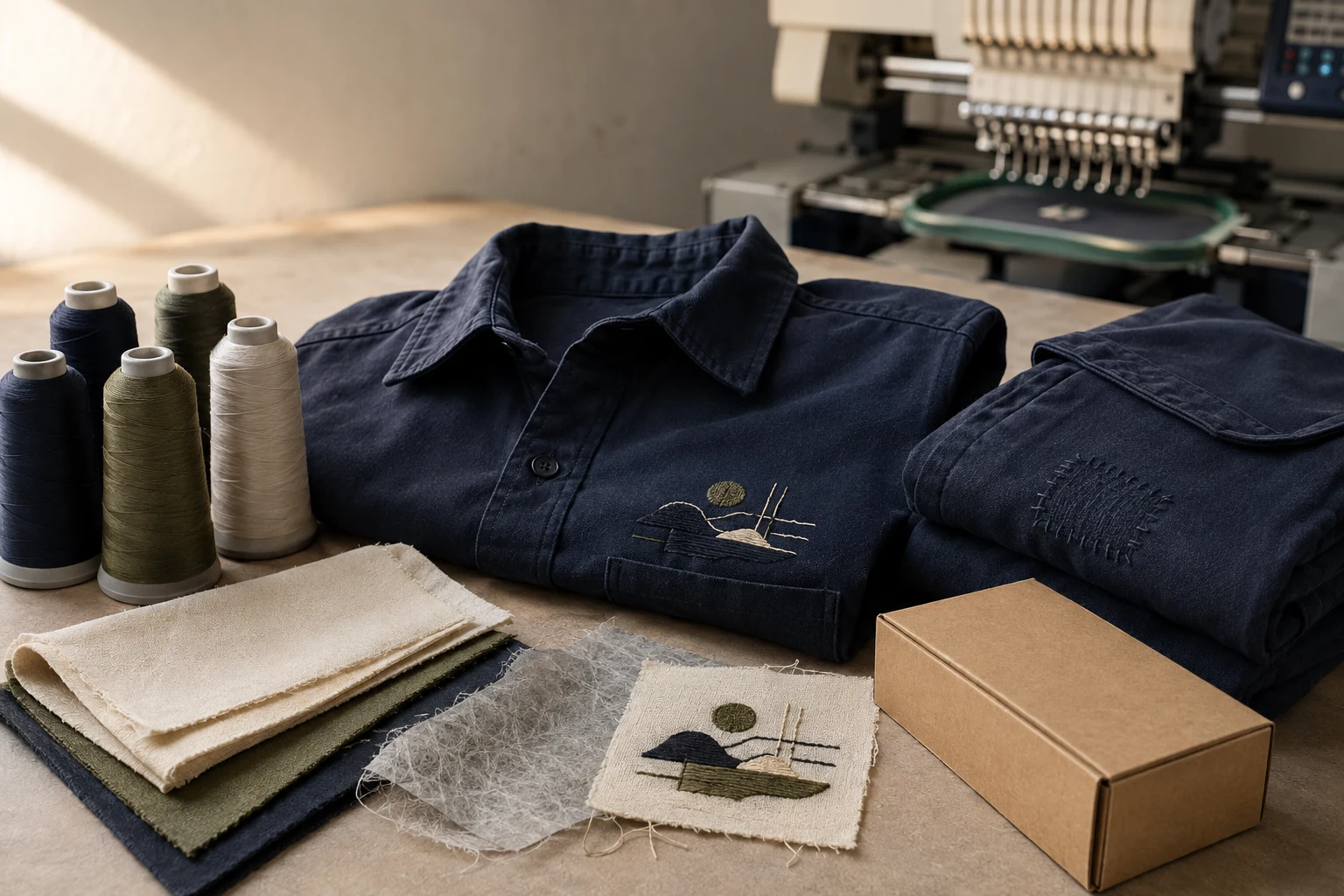
Cover image: AI-generated editorial concept; not a customer project or production proof.
Embroidery can support longer-lasting apparel, but it is not automatically sustainable. A practical approach is to choose garments people will keep wearing, verify material claims, test embroidery before production, avoid unnecessary stock and plan shipping carefully. Recycled thread is one useful option within that wider supply chain.
For buyers in the US, Canada and UK, the key question is: what evidence supports the environmental claims for this particular finished product?
Where the impact really sits
Start with the blank garment, then consider its decoration, delivery, use and eventual disposal. Avoid assuming that the blank always accounts for a fixed share of the footprint. UNEP identifies different textile hotspots for different impacts: dyeing and finishing, synthetic fibre production and laundering matter for climate, while cotton cultivation and consumer use matter for water scarcity. Its findings concern textiles broadly, rather than a measured footprint for an embroidered order. UNEP’s textile value-chain assessment.
Embroidery also adds thread, backing or stabilizer, machine operation and production waste. Although stitching does not require printing ink, the garment and thread still have upstream processing. Calling embroidery “chemical-free” would overlook that supply chain.
Supply-chain stage | What buyers should investigate |
|---|---|
Blank garment | Fibre composition, manufacturing information, fit, construction and intended care |
Thread | Exact product, recycled-content evidence and suitability for the garment’s use |
Backing and toppings | Material composition, required support, offcuts and removal method |
Production | Sample approval, rejected garments and repeat runs |
Fulfillment | Order quantity, packaging, shipment consolidation and transport route |
Use and end of life | Care instructions, repair options and local collection acceptance |
Choose the garment for its working life
Begin with the conditions the garment will face. A frequently washed hospitality uniform, a school sweatshirt and an occasional event shirt have different requirements. Confirm sizing, comfort and care expectations before selecting a blank: an unwanted garment offers little value even if one of its materials has strong environmental credentials.
Organic cotton deserves a closer look than a label alone. GOTS covers certified organic fibres alongside processing, environmental and social criteria. Its scope extends through the processing supply chain; buying a certified blank does not by itself establish that a subsequently decorated item qualifies as GOTS-certified. Ask whether the finished product and embroidery processing are covered. GOTS key features.
For repeat uniforms, consider whether the same garment specification will remain suitable for replenishment. Approve a physical sample and assess it after the intended washing and drying routine before committing to a larger order.
Recycled thread and backing: useful options with limits
Recycled-polyester embroidery thread is an available material option. For example, Madeira describes its Polyneon Green thread as manufactured from recycled PET bottles. That is evidence about a named thread product, not proof that an entire embroidered garment has a lower footprint. Confirm the exact thread, colour availability and care suitability with the supplier. Madeira’s Polyneon Green information.
Textile Exchange’s Recycled Claim Standard and Global Recycled Standard verify recycled materials and their chain of custody. GRS also includes processing requirements concerning social conditions, environmental practices and chemicals. Ask for documentation tied to the supplied product and check what any certification actually covers; a recycled-thread claim should not become a whole-garment claim. Textile Exchange’s RCS and GRS overview.
Backing choices require the same care. Madeira offers cut-away backing made from recycled polyester, alongside tear-away and wash-away products. These categories serve different embroidery needs; they are not a simple environmental ranking. Madeira’s embroidery backing guide.
Water-soluble backing dissolves during removal. That property alone does not establish biodegradability, harmlessness in wastewater or a lower overall impact. Likewise, recycled content does not establish that a used backing or its offcuts can be recycled locally. Request product-specific disposal guidance and confirm acceptance with the relevant waste collector.
Reduce rejected garments through testing
Material savings should preserve the support needed for a reliable result. BERNINA recommends choosing stabilizer around the fabric and design, and testing the combination. Its guidance explains that cut-away backing supports embroidery on knits and stretchy fabrics during production and throughout the garment’s life. BERNINA’s stabilizer guide.
Before production, provide the digitizer with the garment type, placement, finished dimensions and proposed thread. Request a sew-out using the intended fabric and stabilizer, then inspect legibility, puckering, coverage and comfort. BERNINA also advises testing with the same fabric and stabilizer as the project and adjusting embroidery settings as needed. BERNINA’s embroidery testing instructions.
The practical aim is to catch problems before they affect a batch. Do not treat the lowest stitch count as the goal: evaluate the finished result. Keep the approved file version, material specification and sample reference together for repeat orders.
When preparing a file brief for DigitEMB’s embroidery digitizing service, include those production details. Digitizing is one part of the process; the embroiderer still needs to validate the file on the intended materials.
Balance order size, shipping and useful wear
Producing only against confirmed demand can avoid speculative finished stock. It does not automatically establish a lower total footprint: individual orders may involve separate packaging, shipments and returns. Bulk orders also need scrutiny if their quantities exceed realistic demand.
For a team, school or workplace order, gather sizes and approve the sample before setting the quantity. Ask whether deliveries can be consolidated and whether the schedule allows alternatives to urgent shipping. For cross-border US, Canadian and UK orders, confirm where the blanks originate, where decoration happens and where finished goods dispatch from. A supplier’s address alone does not describe the journey.
Track a few practical measures across comparable orders: unwanted stock, rejected garments, replacement pieces and number of shipments. These records help identify improvements without inventing a carbon-saving percentage.
Plan for continued use as well. Give recipients care instructions suitable for both garment and decoration, consider repair before replacement, and ask local textile collectors whether they accept the finished item. Avoid promising recyclability without a receiving route.
Brief FAQs
Is embroidery more sustainable than printing?
There is no universal winner. Compare the actual garment, decoration materials, production process, reject rate, care needs and useful life. Durability can help, but stitching alone does not prove a lower environmental impact.
Does recycled thread make the whole garment recycled?
No. A thread claim describes that component. Request the blank’s fibre composition separately and ensure any finished-product wording reflects the documented scope.
Should every order use wash-away stabilizer?
No. Select stabilizer for the fabric, design and required support. Water solubility describes removal, and does not by itself establish an environmental advantage.
What should I ask a supplier first?
Ask for the garment specification, exact thread and backing products, evidence behind material claims, a sample approval process and the proposed production and shipping locations. Those details make the order easier to assess than a broad “eco-friendly” label.
Practical details for Sustainability in the Embroidery Supply Chain
The best next step is to translate the topic in this article into a short, specific brief. That gives everyone involved the same reference before a file, proof or finished product is prepared.
Work through these points in order and keep the answers with the artwork or production request. A short written brief makes it easier to compare a proof with the intended result, ask a useful follow-up question and avoid relying on assumptions made from a screen image alone.
The aim is not to add unnecessary steps. It is to identify the choices that change the final result before work begins. If a requirement is unknown, flag it for confirmation rather than guessing; that keeps the approval process focused on the design, material and use that apply to this particular project. Save the approved brief with the project files for future reorders or revisions.
State the intended outcome
Describe where and how the finished item will be used, who it is for and the result that matters most. This helps separate a useful requirement from a visual preference.
Collect the source material
Provide the clearest artwork, references and text available. Mark anything that cannot change, such as a logo, spelling, colour or placement requirement.
Review the final details
Before approving work, check the real size, material, format and any production constraints. Confirm the details that affect how the design will look in use, not only on a screen.
Quick questions to check before you proceed
What should I prepare first?
Start with the artwork, its intended use, finished size and any requirements that cannot change.
Why is a proof important?
A proof is the shared reference for checking details before production. It is the best time to correct a size, spelling, colour or placement issue.
What makes a useful request?
A clear request explains the goal, provides the best available source material and identifies the details that need approval.