
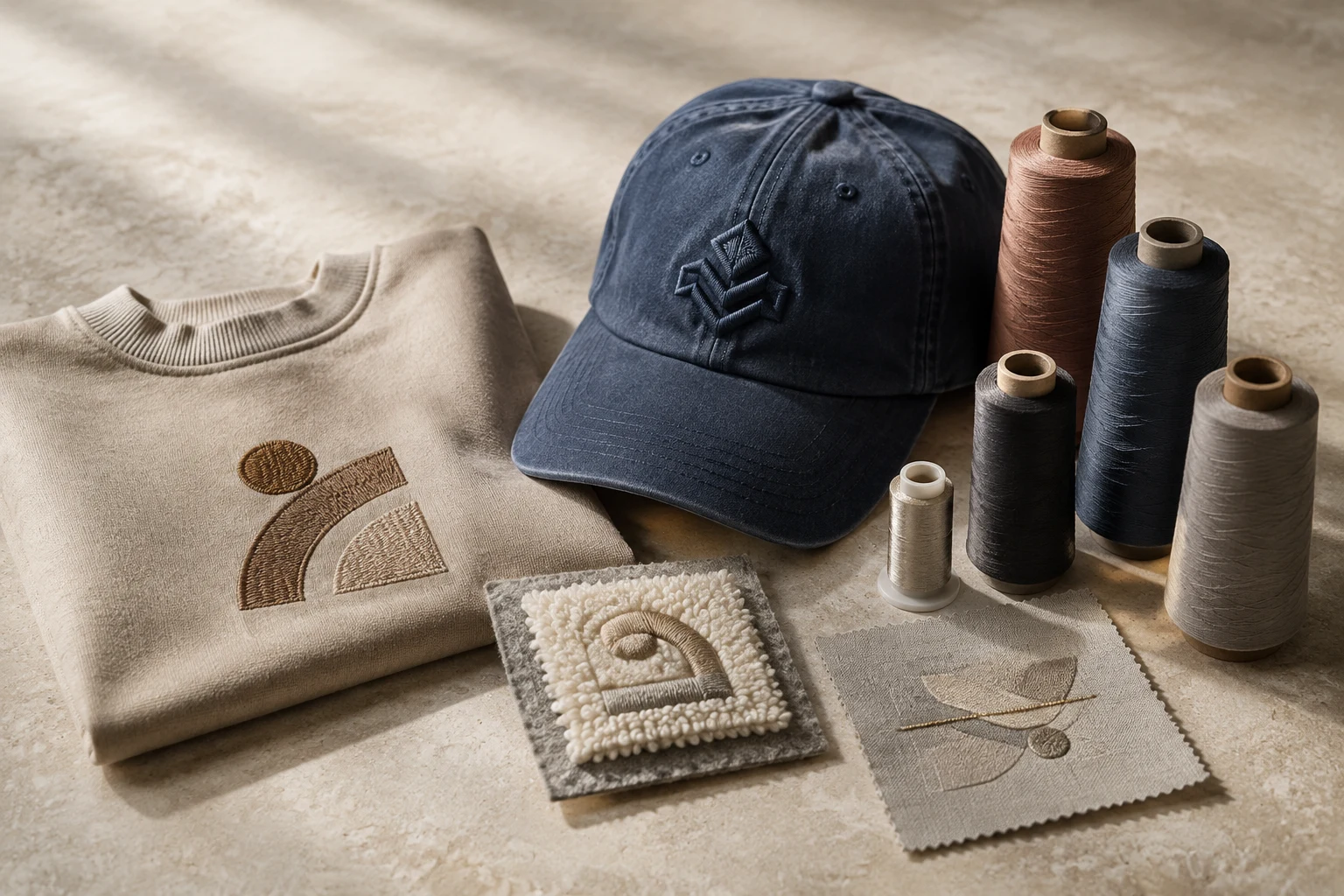
Cover image: AI-generated editorial concept; not a customer project or production proof.
For a seasonal embroidery refresh, consider three directions: muted heritage colors, texture through matte or raised finishes, and restrained metallic accents. Choose the look around the garment and the visibility your design needs, then approve a stitched sample before production. These are creative directions to explore, rather than a measured ranking of current market demand.
Muted heritage palettes and tonal embroidery
Dusty earth tones, faded navy and washed neutrals offer a starting point for an understated collection. Try clay on oatmeal, slate blue on navy, or warm gray on charcoal. These are suggested combinations; the final choice should come from physical thread samples against the actual garment.
Tonal embroidery uses thread close to the fabric color. It can suit a discreet chest emblem or cap motif, but a low-contrast treatment deserves extra scrutiny when a name or small lettering must remain readable. Compare the sample at its intended viewing distance, rather than judging only a close-up photograph.
For buyers coordinating production across the US, Canada and UK, record the thread manufacturer, product range and shade code. A description such as “heritage navy” leaves too much room for interpretation. Madeira also advises using a physical shade card because online colors can differ from the actual thread. Madeira color-matching guidance.
Texture as the statement
Texture can give a simple design character without adding more colors. Matte thread, foam-raised embroidery and chenille create different effects, so specify which finish you mean when briefing a decorator.
Matte thread for a quieter surface
A muted color and a matte finish are separate choices. A navy thread can still look glossy; a matte thread is designed to reduce that sheen. Madeira’s Frosted Matt range, for example, is a matte polyester embroidery thread. Ask to compare matte and lustrous samples on the same fabric before choosing the finish. Madeira matte thread information.
Raised puff lettering on caps
For a dimensional cap design, consider broad, simple lettering with selected areas raised over embroidery foam. The file needs to be prepared specifically for foam, with stitches that enclose it; adding foam beneath an ordinary flat embroidery file is not a reliable shortcut. Tell the digitizer the intended foam thickness before the file is prepared. Gunold’s foam embroidery guidance.
Chenille and felt appliqué for a varsity feel
Chenille offers a soft, raised surface, while felt appliqué introduces a distinct fabric layer. Either can be considered for a varsity-inspired letter or badge, but they are different production methods. Tajima describes machine chenille as using loop and chain stitches and offers dedicated chenille equipment. Confirm that your decorator can produce the requested construction before approving artwork. Tajima’s chenille explanation.
Keep the design brief visual: indicate where you want a plush surface, exposed felt or conventional flat stitching. That is more useful than asking for “extra texture” without identifying the effect.
Metallic accents with a clear purpose
A small metallic highlight can add contrast to an otherwise restrained design. Consider a narrow border, a star or one selected detail, and compare it with a version using ordinary thread. Keep the accent where it supports the design’s focal point.
Metallic thread needs product-specific planning. Madeira’s general guidance recommends appropriate needles, reduced stitch density and adjusted machine speed. However, its CR 40 product guidance allows different operating conditions, so there is no single speed or needle rule for every metallic thread. Have the decorator follow the selected thread’s instructions and test the actual design. Madeira metallic stitching guidance, CR 40 product guidance.
Tell the digitizer about metallic areas at the start. A color substitution alone may not address the thread’s construction or the stitch settings it needs.
Turn the look into a useful production brief
Choose one main effect first, then use other details sparingly. The following comparisons can help narrow the sample request.
Creative direction | What to confirm in the sample |
|---|---|
Muted or tonal colors | The design remains visible enough on the actual garment. |
Matte thread | The surface has the intended subdued finish under normal lighting. |
Raised puff lettering | The raised edges are clean and foam is enclosed. |
Chenille or felt appliqué | The texture, fabric layers and outline match the intended look. |
Metallic accents | The highlight is balanced and stitches run cleanly. |
Provide the artwork, garment fabric, placement, finished dimensions and intended thread or texture. State dimensions clearly in inches or millimeters, especially when working with suppliers in different countries. Include expected laundering conditions so the decorator can check the chosen materials’ care instructions.
For help preparing the stitch file, explore DigitEMB’s embroidery digitizing services. Specify the finish in the brief and arrange a physical sew-out with the decorator on the intended garment or equivalent material before approving production.
Frequently asked questions
Is tonal embroidery the same as matte embroidery?
No. Tonal describes the relationship between thread and garment colors. Matte describes the thread’s surface finish. You can use either separately or combine them.
Can an existing logo be adapted to these looks?
Often, but start with a sample proposal. A color change may be straightforward; switching to foam-raised lettering or a different construction requires the decorator and digitizer to assess the artwork.
Does every metallic thread require slower stitching?
The appropriate speed depends on the specific thread, design and machine setup. Follow the thread manufacturer’s product guidance instead of applying one setting to every metallic. Madeira’s CR 40 recommendations.
Practical details for Thread Trends We're Watching This Season
The best next step is to translate the topic in this article into a short, specific brief. That gives everyone involved the same reference before a file, proof or finished product is prepared.
Work through these points in order and keep the answers with the artwork or production request. A short written brief makes it easier to compare a proof with the intended result, ask a useful follow-up question and avoid relying on assumptions made from a screen image alone.
The aim is not to add unnecessary steps. It is to identify the choices that change the final result before work begins. If a requirement is unknown, flag it for confirmation rather than guessing; that keeps the approval process focused on the design, material and use that apply to this particular project. Save the approved brief with the project files for future reorders or revisions.
State the intended outcome
Describe where and how the finished item will be used, who it is for and the result that matters most. This helps separate a useful requirement from a visual preference.
Collect the source material
Provide the clearest artwork, references and text available. Mark anything that cannot change, such as a logo, spelling, colour or placement requirement.
Review the final details
Before approving work, check the real size, material, format and any production constraints. Confirm the details that affect how the design will look in use, not only on a screen.
Quick questions to check before you proceed
What should I prepare first?
Start with the artwork, its intended use, finished size and any requirements that cannot change.
Why is a proof important?
A proof is the shared reference for checking details before production. It is the best time to correct a size, spelling, colour or placement issue.
What makes a useful request?
A clear request explains the goal, provides the best available source material and identifies the details that need approval.