
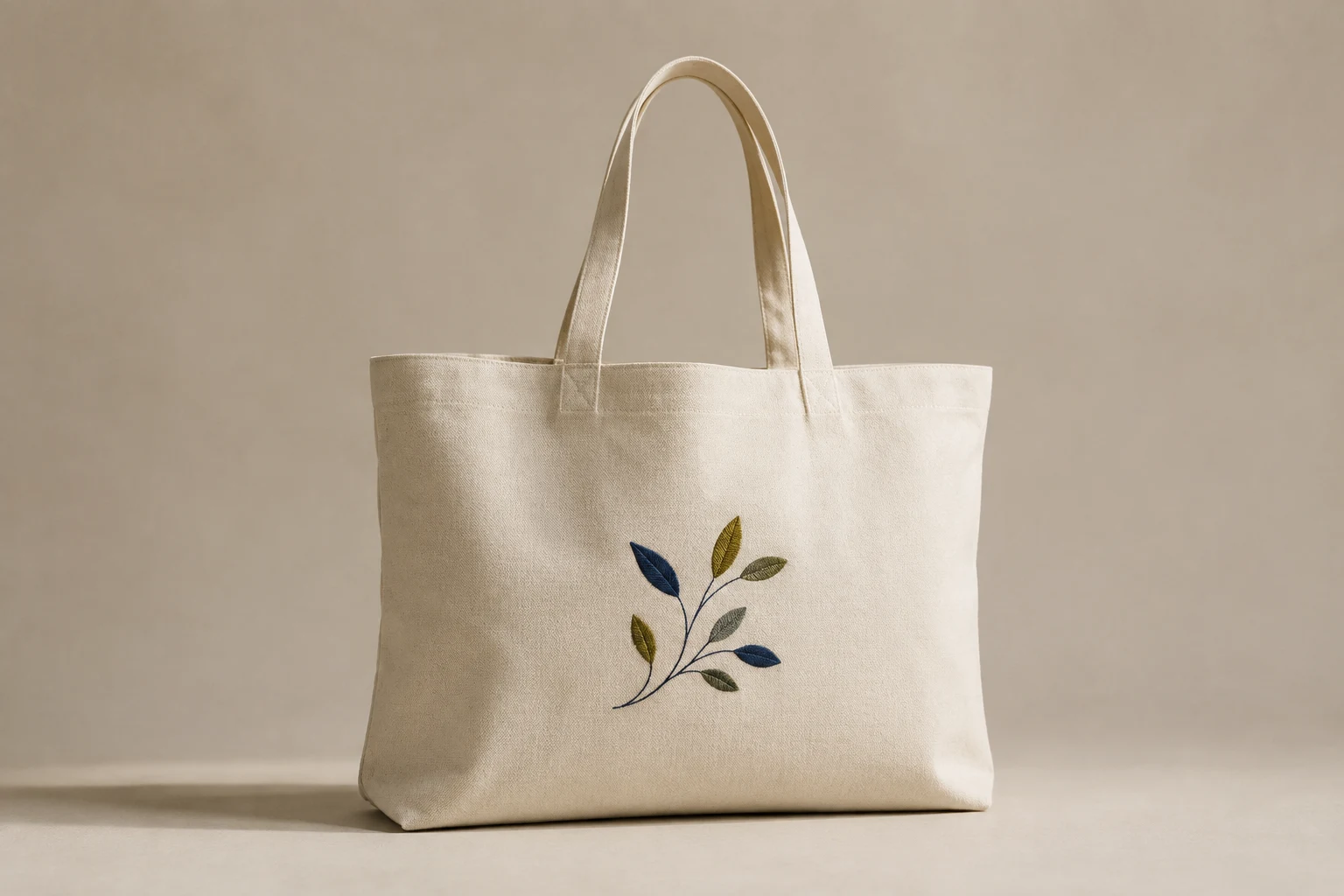
Cover image: AI-generated editorial concept; not a customer project or production proof.
Eco-friendly embroidery starts with choosing useful, durable items, checking material claims and planning production to avoid unnecessary waste. Assess the complete project: fabric, thread, backing, design, sampling, energy use, packaging and eventual reuse. An organic fabric or recycled thread alone does not establish the environmental performance of the finished item.
For buyers in the US, Canada and UK, the practical approach is to request specific material evidence, approve a representative stitched sample and agree on quantities and care requirements before production.
Choose materials for the finished item
Start with how the product will be used. A frequently washed uniform, reusable tote and decorative cushion have different requirements. Ask the supplier to identify the fabric composition and intended care conditions before selecting the embroidery materials.
Organic cotton and recycled materials
Organic cotton can be considered for fabrics and suitable threads, but request evidence for the actual product. Textile Exchange’s Organic Content Standard verifies organically grown material and its chain of custody. Treat this as evidence about organic content, rather than a guarantee covering every environmental attribute. Textile Exchange’s OCS overview.
For recycled polyester fabric, thread or backing, ask for the recycled percentage and which component it describes. Textile Exchange’s Recycled Claim Standard and Global Recycled Standard address recycled material verification and chain of custody; GRS also includes processing requirements concerning social, environmental and chemical practices. Textile Exchange’s RCS and GRS overview.
Compare candidates through samples and documentation. Avoid assuming that organic or recycled content automatically makes an item longer-lasting, suitable for every embroidery design or recyclable after use.
Thread, dyes and chemical claims
Ordinary machine embroidery forms the design with thread. If a project also includes printing, assess its inks separately. For the embroidered area, ask about the thread’s fiber composition, colorfastness, care instructions and any relevant test evidence.
A description such as “natural dye” should prompt questions about the actual process and finished material. It does not, by itself, establish that a thread is harmless or environmentally preferable.
OEKO-TEX STANDARD 100 concerns testing textiles for harmful substances. Check the certificate’s validity and which article it covers; do not treat the label as proof of organic content, recycled content or a measured carbon reduction. OEKO-TEX STANDARD 100.
Backing and other supporting materials
Include backing, topping and any adhesive in the material discussion. Madeira identifies cut-away backing for unstable fabrics such as knits and fleece, and tear-away backing for stable fabrics such as denim, twill and canvas. Fabric characteristics and the design still determine the appropriate choice. Madeira’s embroidery backing guide.
Ask the decorator to use an appropriately sized backing that provides the necessary support. Removing support simply to use less material can undermine the result. Request a sample when changing backing type or composition.
Use design and technology to prevent avoidable waste
Give the digitizer the finished dimensions, fabric, placement and intended thread before the file is prepared. Review whether tiny details, excessive coverage or unnecessary color changes can be simplified while preserving the artwork’s identity.
Connection planning is one useful software capability. Hatch explains that short connections between embroidery objects improve sewing efficiency and tend to reduce trims. Its closest-join settings need review after objects are moved, edited or resequenced. Hatch’s closest-join documentation.
Treat those capabilities as opportunities to improve a particular design. A lower stitch count alone is not an environmental score, and software does not establish a project’s energy or waste savings.
Use shared digital proofs to settle wording, dimensions and placement before sampling. Keep one approved artwork version so the buyer, digitizer and production shop work from the same information.
For artwork preparation, explore DigitEMB’s embroidery digitizing services. Confirm who supplies the garments, selects materials and performs the stitching. A digitizing order does not by itself establish that finished goods or certified materials are included.
Sample before committing to a production run
Ask for a sew-out using the planned fabric, thread and backing. Inspect the front and reverse for appearance, comfort, legibility and visible distortion. Where washing is part of normal use, agree on a sample care trial using the proposed instructions.
A useful approval sequence is:
Confirm the artwork, wording, placement and finished size.
Record the blank, thread and backing specifications.
Review a representative stitched sample.
Resolve changes and retain the approved version.
Authorize the required quantity and inspect the completed goods.
Keep technical changes traceable. If the production shop substitutes a material, ask whether a new sample or updated supporting documentation is needed.
Reduce waste across production and use
Order around a realistic need. Confirm garment sizes and quantities, and consider whether the design will remain useful beyond a single campaign or event. An evergreen motif may suit items intended for repeated use.
Discuss practical ways to handle leftovers: retaining suitable fabric for trials, using usable offcuts for smaller projects and separating waste according to the collector’s requirements. Confirm acceptance before describing scraps as recyclable.
For existing clothing, ask a decorator whether a repair or embroidered addition is appropriate for its condition. Reuse should preserve the item’s function and comfort.
Choose packaging that protects the goods without unnecessary layers. Give recipients care instructions for the complete embroidered item and realistic information about available reuse or collection options.
Measure energy and process improvements
Ask production teams to compare actual operating information. A newer machine or automated workflow is not sufficient evidence of lower energy use.
Useful records include electricity consumed over a defined production period, accepted units, rejected items, material offcuts and repeat sampling. Compare similar jobs and explain what the measurement includes. Electricity per accepted item is more informative than machine power ratings alone when output and rejection rates differ.
If renewable electricity is part of a supplier’s proposal, ask which facility and operations it covers and what documentation supports the statement. Keep any claim limited to that evidence.
Turn environmental preferences into a clear buying brief
Use the same requirements when comparing suppliers. This keeps the discussion focused on the job rather than a broad “green” description.
Project decision | What to request |
|---|---|
Product and use | Item specification, expected use and care requirements. |
Material preference | Component composition, organic or recycled content evidence, and permitted substitutions. |
Embroidery design | Artwork, placement, finished dimensions and thread references. |
Sample approval | Planned materials, review steps and responsibility for revisions. |
Production | Quantity, size breakdown and handling of rejected goods or surplus materials. |
Delivery and packaging | Destination, required date, packaging specification and shipping arrangements. |
For orders involving the US, Canada and UK, identify inches or millimeters explicitly. Confirm the quoted currency, delivery destination and responsibility for shipping and import charges. Separate digital file completion from delivery of physical goods.
Communicate specific, supported benefits
Describe what the evidence actually establishes: the recycled percentage of a named component, a verified organic content claim or a measured reduction in a defined production process. Keep supporting records with the product specification.
For US-facing marketing, the FTC’s Green Guides explain why broad environmental statements and claims such as compostable, degradable or recyclable need appropriate evidence and qualifications. A material description alone is insufficient to establish a disposal claim for the whole product. FTC environmental claims guidance.
For any destination market, ask suppliers for the exact claim wording and supporting scope. Do not extend a thread certificate to an entire garment, or a material benefit to every stage of production. Educational product information is most useful when it explains both the verified attribute and how to care for the item.
Frequently asked questions
Is recycled thread enough to make embroidery sustainable?
It establishes only one part of the specification, provided the recycled claim is supported. Also assess the blank, backing, production waste, intended lifespan and disposal options.
Can biodegradable thread make the whole item compostable?
Do not assume so. Fabric, backing, finishes and other components also matter, along with the disposal conditions. Request evidence for the complete item before making a compostability claim.
Should I remove backing or underlay to save material?
Ask the decorator to optimize the design and support together. Approve a tested setup that preserves appearance and usability; the smallest material quantity is not automatically the best result.
Does digital approval replace a stitched sample?
Digital approval is useful for artwork, wording and placement. A stitched sample lets you assess the proposed materials and construction together, so include it where those properties matter to the order.
What is the most useful first step?
Define an item people will use, specify the intended care and quantity, and request evidence for the material attributes that matter to your project. Then review the proposed embroidery on a representative sample.
Practical details for Eco-Friendly Embroidery Solutions: Materials, Production and Practical Choices
The best next step is to translate the topic in this article into a short, specific brief. That gives everyone involved the same reference before a file, proof or finished product is prepared.
Work through these points in order and keep the answers with the artwork or production request. A short written brief makes it easier to compare a proof with the intended result, ask a useful follow-up question and avoid relying on assumptions made from a screen image alone.
The aim is not to add unnecessary steps. It is to identify the choices that change the final result before work begins. If a requirement is unknown, flag it for confirmation rather than guessing; that keeps the approval process focused on the design, material and use that apply to this particular project. Save the approved brief with the project files for future reorders or revisions.
State the intended outcome
Describe where and how the finished item will be used, who it is for and the result that matters most. This helps separate a useful requirement from a visual preference.
Collect the source material
Provide the clearest artwork, references and text available. Mark anything that cannot change, such as a logo, spelling, colour or placement requirement.
Review the final details
Before approving work, check the real size, material, format and any production constraints. Confirm the details that affect how the design will look in use, not only on a screen.
Quick questions to check before you proceed
What should I prepare first?
Start with the artwork, its intended use, finished size and any requirements that cannot change.
Why is a proof important?
A proof is the shared reference for checking details before production. It is the best time to correct a size, spelling, colour or placement issue.
What makes a useful request?
A clear request explains the goal, provides the best available source material and identifies the details that need approval.