
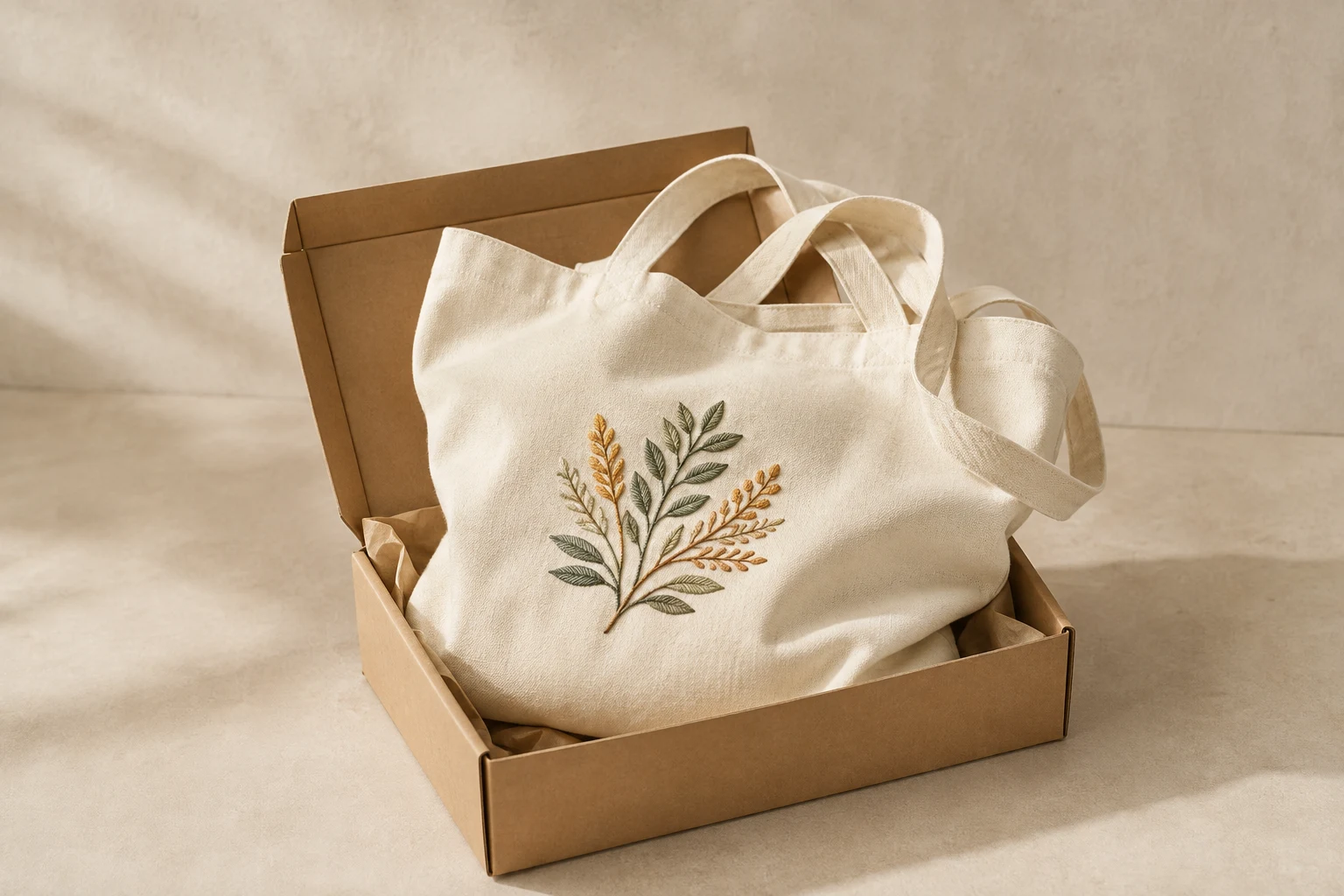
Cover image: AI-generated editorial concept; not a customer project or production proof.
An eco-friendly embroidery package should specify the product, thread, backing, production checks and packaging, with evidence for any environmental claims. Choose a package around its intended use and the complete finished item. An organic fabric or recycled thread alone does not establish the environmental performance of the whole order.
For buyers in the US, Canada and UK, this means asking the same practical questions whether ordering staff clothing, embroidered gifts, reusable bags or home textiles: what is included, what supports the material claims, and how will the finished embroidery perform?
What should an embroidery package include?
Use “package” to describe the agreed bundle of materials and services. Confirm whether the quotation covers finished embroidered goods, a craft kit or only design preparation. A digitized file and a delivered garment are different purchases.
Package component | What to confirm |
|---|---|
Base product | Item model, fabric composition, sizes, colors and quantity. |
Embroidery | Artwork, placement, finished dimensions and thread specification. |
Supporting materials | Bobbin thread, backing, topping and any adhesive or patch attachment. |
Design preparation | Digitizing, artwork adjustments and included revisions. |
Sample review | Who makes the stitched sample and what you approve before production. |
Packaging and delivery | Individual wrapping, outer packaging, destination and agreed shipping arrangements. |
Product information | Material evidence, care guidance and realistic reuse or disposal instructions. |
Ask suppliers to identify substitutions before accepting them. A change in garment, thread or backing should prompt a review of both the sample and the claims attached to the package.
Compare materials without assuming one is always best
The original material choices remain useful starting points. Evaluate them as options for a particular product rather than treating their names as sustainability ratings.
Organic cotton
For cotton blanks or threads sold as organic, request the organic content percentage and documentation identifying the relevant product. Textile Exchange’s Organic Content Standard verifies organically grown inputs and their chain of custody. That evidence answers a sourcing question; it does not establish every property of the finished embroidered item. See the Organic Content Standard explanation.
Keep appearance and performance in the decision. Review the actual color, fabric weight, feel and embroidered sample before selecting a cotton garment, tote or cushion cover.
Recycled polyester
Ask which component contains recycled polyester and in what proportion. A recycled embroidery thread does not make the garment itself recycled, and a recycled garment does not establish the composition of its decoration.
Textile Exchange’s RCS and GRS address recycled materials and chain of custody; GRS also includes processing requirements covering social, environmental and chemical issues. Request evidence applicable to the item being quoted. See the RCS and GRS overview.
Hemp and linen
Hemp and linen can remain on the shortlist for apparel, bags and home textiles. Ask for the full fiber blend, fabric construction, finish and care instructions. Compare physical samples for the texture and appearance you want.
Avoid accepting blanket statements that these materials require no pesticides, always use less water or necessarily outlast other fabrics. Ask for evidence tied to the specific sourcing or performance claim.
Lyocell
Distinguish generic lyocell from a named producer’s fiber. Lenzing describes a closed-loop process for its TENCEL™ Lyocell fibers. This is a producer-specific process claim, not proof that every lyocell fabric or finished embroidered package has the same production history. See Lenzing’s TENCEL™ Lyocell information.
Confirm the actual blend and have the proposed embroidery sampled on the selected fabric.
Fabrics marketed as bamboo
Check the fiber description carefully. The FTC explains that many textiles marketed as bamboo are rayon made from bamboo and that there is no evidence this rayon is naturally antibacterial. Do not transfer the plant’s properties to the processed textile. Read the FTC’s bamboo fabric guidance.
Check threads, dyes and backing separately
Ask for the thread manufacturer, product reference, fiber composition and care specification. If organic or recycled content matters to the order, identify exactly which thread carries that claim, including whether the bobbin thread differs.
For chemical testing, OEKO-TEX STANDARD 100 concerns textiles tested for harmful substances. Its purpose is different from verifying organic or recycled content. Check the certificate number and the product covered rather than treating a label as approval of every environmental claim. See the STANDARD 100 explanation and label-check guidance.
Ask what supports descriptions such as “natural dye” or “low-impact dye.” Do not infer that a natural origin means a chemical-free process or proves wash performance. If the package combines printing with embroidery, request the print and ink specifications separately.
Include backing, topping and adhesives in the material discussion. Ask what remains in the finished item, what is removed during production and how the supplier handles those remnants. Do not accept “washaway” as sufficient evidence of an environmental benefit.
Make sample quality part of waste prevention
A useful package should include a clear sample decision before the main order. BERNINA’s embroidery guidance recommends a test using the intended fabric and stabilizer. See its artista 630 manual.
Agree on a practical review routine:
Confirm the artwork, spelling, placement and finished dimensions, with inches or millimeters stated explicitly.
Review a stitched sample using the proposed product and embroidery materials.
Check legibility, alignment, puckering, the reverse side and comfort where the embroidery touches the wearer.
Assess the sample after care appropriate to the intended use, following the supplied instructions.
Record the approved design and materials before authorizing the full quantity.
Treat sampling as a way to identify problems before committing to a batch. It does not justify a promise of zero rejects or a quantified environmental saving.
Customization can still be expressive: choose colors, motifs and placements that suit the product. If working with a local artisan, agree on materials, sample responsibilities and repeat-order expectations. Location alone does not establish environmental or labor performance.
Include packaging, care and reuse in the package
Ask whether individual wrapping is necessary for distribution or protection. Consider a shared outer pack where suitable, while ensuring the goods arrive usable. Specify packaging materials and quantities rather than simply requesting “green packaging.”
For recyclable or compostable packaging, ask for the conditions and destination-specific disposal route supporting the claim. Buyers distributing products across the US, Canada and UK should check local collection guidance instead of assuming recipients have the same facilities.
Include concise care information with the finished goods, either on an appropriate label or an accessible product-information page. Ask how to handle repairs, replacement pieces and later reorders. Before describing a product as recyclable, confirm that an actual collection or processing route accepts its complete construction.
Compare the full quote and the evidence
Give each supplier the same product, artwork, quantity, sample requirements and delivery destination. Request the quote currency explicitly—USD, CAD or GBP—and identify design preparation, samples, decoration, packaging and shipping separately. Confirm any applicable taxes or import charges with the quotation rather than assuming they are included.
A lower unit price is only useful when the package meets the same requirements. Avoid ordering surplus items solely to reach a discount threshold; base quantities on intended recipients and realistic demand.
When explaining the purchase to customers or staff, use specific supported descriptions. For example, identify the documented recycled content of a named component rather than calling the entire package “planet-friendly.” Keep those qualifications alongside product photos, social posts and care information. Request separate evidence for labor claims instead of inferring them from a material choice.
For the artwork-preparation part of a machine embroidery order, explore DigitEMB’s embroidery digitizing service. Supply the selected fabric, placement, finished dimensions and the production shop’s required file format. Confirm physical goods, sourcing evidence and packaging with the supplier responsible for those parts of the order.
Frequently asked questions
Does organic cotton make the whole package organic?
No. Identify which components the claim covers. The fabric, embroidery thread, backing and other additions need separate consideration, and any finished-product claim needs appropriate supporting evidence.
Is recycled thread enough to choose one package over another?
It is one consideration. Compare the blank, supporting materials, sample quality, quantity and packaging as well. Ask for the recycled content and documentation for the exact thread offered.
Are these packages always more durable?
Do not assume that from an environmental description. Review the finished sample and care performance for the intended application, whether it is frequently washed workwear or a decorative home textile.
Can existing garments be included?
Ask the embroiderer to assess their condition, fabric, placement access and suitability for the proposed design. Agree on a sample and responsibility for supplied items before committing the full batch.
What should I send when requesting a package quote?
Send the item type, quantity and size breakdown, artwork, embroidery dimensions, placement, material preferences, evidence requirements, packaging needs, delivery destination and required date. Ask the supplier to confirm the complete scope in writing.
Practical details for Eco-Friendly Embroidery Packages: Materials, Quality and Buying Guide
The best next step is to translate the topic in this article into a short, specific brief. That gives everyone involved the same reference before a file, proof or finished product is prepared.
Work through these points in order and keep the answers with the artwork or production request. A short written brief makes it easier to compare a proof with the intended result, ask a useful follow-up question and avoid relying on assumptions made from a screen image alone.
The aim is not to add unnecessary steps. It is to identify the choices that change the final result before work begins. If a requirement is unknown, flag it for confirmation rather than guessing; that keeps the approval process focused on the design, material and use that apply to this particular project. Save the approved brief with the project files for future reorders or revisions.
State the intended outcome
Describe where and how the finished item will be used, who it is for and the result that matters most. This helps separate a useful requirement from a visual preference.
Collect the source material
Provide the clearest artwork, references and text available. Mark anything that cannot change, such as a logo, spelling, colour or placement requirement.
Review the final details
Before approving work, check the real size, material, format and any production constraints. Confirm the details that affect how the design will look in use, not only on a screen.
Quick questions to check before you proceed
What should I prepare first?
Start with the artwork, its intended use, finished size and any requirements that cannot change.
Why is a proof important?
A proof is the shared reference for checking details before production. It is the best time to correct a size, spelling, colour or placement issue.
What makes a useful request?
A clear request explains the goal, provides the best available source material and identifies the details that need approval.